







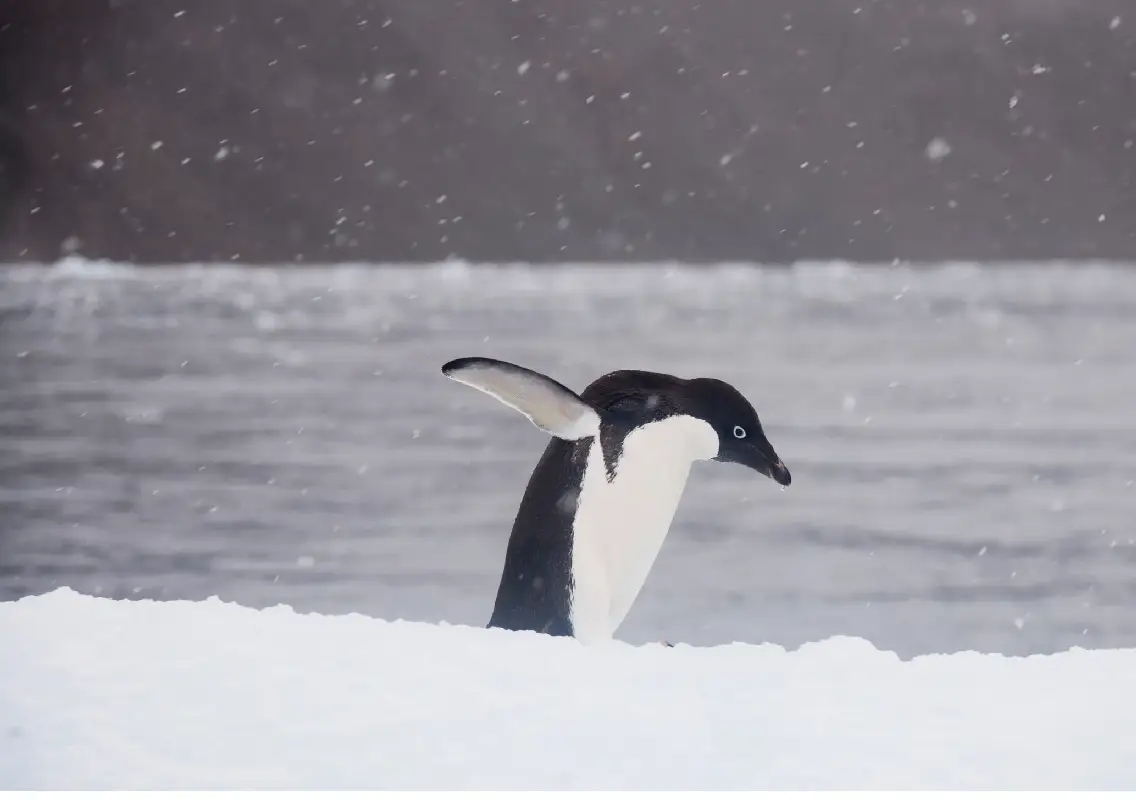


A short clip from Encounters at the End of the World, directed by Werner Herzog, has resurfaced online, drawing renewed attention to one of the documentary’s most talked-about moments — the so-called “nihilist penguin”.
The scene that captured the internet’s imagination
In the footage, Herzog narrates the sight of a lone penguin breaking away from its colony in Antarctica. Instead of heading towards the sea and feeding grounds, the penguin walks inland, toward the mountains and the vast Antarctic interior — a direction Herzog notes is roughly 70 kilometres away and almost certainly fatal.
What makes the moment striking is Herzog’s observation that even if the penguin were physically returned to the colony, it would likely resume its solitary march. The narration is delivered in Herzog’s signature reflective tone, avoiding scientific certainty and instead lingering on the unsettling strangeness of the behaviour.
A question of interpretation, not diagnosis
Over the years, the clip has frequently been framed online as an example of “nihilism” in animals, but Herzog himself never claims to explain the penguin’s motivation. Instead, the scene serves as a reminder of the limits of human understanding when observing the natural world.
The filmmaker has often warned against projecting human psychology, intention or narrative meaning onto animals. In this context, the penguin becomes less a symbol of despair and more a challenge to human instincts to explain everything through familiar emotional frameworks.
Herzog’s recurring themes
The resurfaced clip has also renewed discussion about Herzog’s broader filmmaking style. His documentaries often focus on isolation, extremity and the uneasy boundary between observation and interpretation. Rather than offering neat conclusions, Herzog frequently leaves viewers with unresolved questions.
In Encounters at the End of the World, the Antarctic landscape functions not just as a setting, but as a space where human logic struggles to apply — and the penguin’s solitary walk becomes one of the film’s most enduring images.
Why the moment still resonates
The continued fascination with the “nihilist penguin” reflects a broader cultural tendency to search for meaning in nature, even where none may exist. The clip’s renewed circulation suggests that audiences remain drawn to moments that resist easy explanation, especially when framed through Herzog’s distinctive voice and philosophy.
More than a viral curiosity, the scene endures because it quietly unsettles a comforting assumption — that the natural world must always make sense on human terms.