







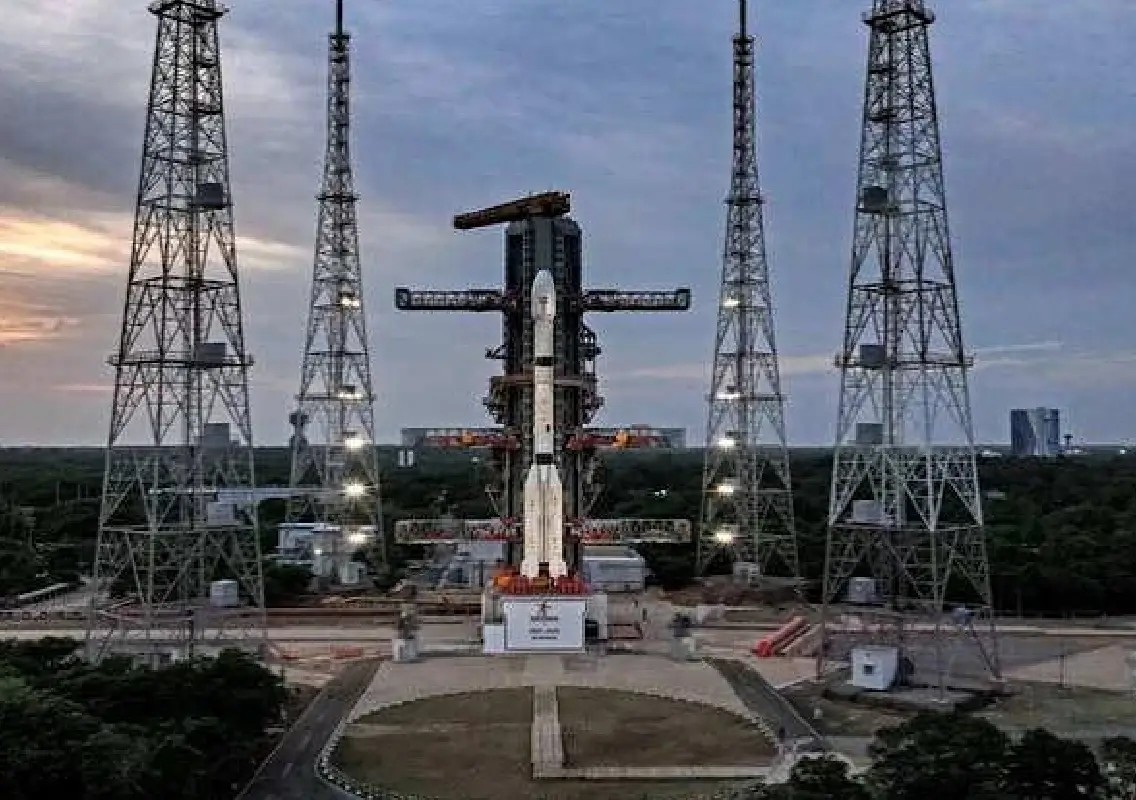


Sriharikota : The Indian Space Research Organisation (ISRO) has successfully launched EOS-05, India’s first dedicated imaging satellite designed to operate from a geosynchronous orbit, marking a significant achievement for the country’s Earth observation capabilities.
The satellite was launched aboard the GSLV-F17 rocket from the Satish Dhawan Space Centre in Sriharikota early on Friday. Around 18 minutes after lift-off, EOS-05 was successfully separated and injected into its intended sub-geosynchronous transfer orbit. The spacecraft will now undergo a series of orbit-raising manoeuvres before reaching its operational orbit.
The mission is particularly significant as EOS-05 is designed to provide frequent and continuous observations of a specific region of the Earth. Once positioned in its final geosynchronous orbit, approximately 36,000 km above Earth, the satellite is expected to strengthen India’s ability to monitor weather systems, natural disasters, agriculture and other important activities.
A new eye over India
EOS-05 represents an important addition to India’s Earth observation capabilities. Unlike satellites operating in lower Earth orbits, which pass over different regions and capture images periodically, a geosynchronous imaging satellite can maintain a much more persistent view of a particular area.
This capability can be particularly valuable during rapidly developing events such as cyclones, floods, landslides and other natural disasters. Frequent imagery can help agencies track changing conditions and support quicker assessment and response.
The satellite is also expected to have applications in agriculture and environmental monitoring. Regular observations can assist in understanding changes on the ground, monitoring vegetation and assessing large-scale environmental developments.
The mission has therefore been described as an ‘eye in the sky’ — a satellite capable of keeping a sustained watch over the country and surrounding areas from space.
A successful GSLV-F17 mission
EOS-05 was carried by the GSLV-F17, a three-stage launch vehicle using solid, liquid and cryogenic propulsion technologies.
The successful performance of the rocket’s cryogenic stage was especially important to the mission. After lift-off, the vehicle followed its planned trajectory and completed the critical sequence required to place the satellite into its transfer orbit.
ISRO Chairman V. Narayanan said the 2,367-kg EOS-05 was in ‘perfect health’ after its injection into the intended sub-geosynchronous transfer orbit. He described the mission as a major achievement for the Indian space programme.
The satellite, weighing about 2,367 kg, is also reported to be the heaviest satellite launched by a GSLV to date. Its advanced imaging capabilities are expected to provide India with a new level of space-based observation once it reaches its operational orbit.
Important comeback after January setback
The EOS-05 success comes after a difficult start to ISRO’s 2026 launch calendar.
The PSLV-C62 mission, which lifted off in January carrying the EOS-N1 Earth observation satellite and other payloads, encountered an anomaly near the end of its third stage. ISRO reported that the vehicle experienced increased disturbance in its roll rates, followed by a deviation from the planned flight path. The space agency subsequently began a detailed analysis of the incident.
The January setback had placed added significance on ISRO’s subsequent missions. The successful GSLV-F17 flight now provides a strong boost to confidence in the organisation’s launch capabilities and its ability to learn from previous challenges.
It also marks ISRO’s first successful launch of 2026, after the January PSLV-C62 mission failed to complete its intended mission.
Lessons from an earlier unfinished mission
EOS-05 also carries a larger significance because it follows India’s earlier attempt to establish a dedicated imaging capability from geosynchronous orbit.
In 2021, the GSLV-F10 mission carrying EOS-03 failed after an anomaly involving the cryogenic stage. The spacecraft could not reach its intended orbit.
Five years later, EOS-05 represents a renewed effort to achieve the same broader objective. The successful GSLV-F17 flight demonstrates the progress made in launch vehicle and satellite technology since the earlier setback.
The latest mission is therefore more than another satellite launch. It reflects ISRO’s continuing efforts to develop increasingly sophisticated Earth observation systems capable of delivering timely information for national development and disaster preparedness.
Benefits for agriculture and disaster management
One of the most important expected benefits of EOS-05 is its potential contribution to disaster management.
India regularly faces cyclones, floods, landslides, droughts and other natural hazards. Rapid access to updated imagery can help authorities assess the extent of damage, identify affected areas and support planning for relief and recovery operations.
Agriculture is another major area where the satellite could prove useful. Earth observation data can support the monitoring of crops, vegetation and changing environmental conditions across large geographical areas.
Its ability to observe a region more continuously could also complement data from India’s existing fleet of Earth observation satellites, providing decision-makers with additional information when quick updates are essential.
A significant step for India’s space programme
The EOS-05 mission comes at a time when India is steadily expanding its capabilities in space-based Earth observation, launch vehicles and advanced satellite technology.
The successful launch demonstrates the reliability of the GSLV system while highlighting ISRO’s growing ability to place heavier and more sophisticated payloads into demanding orbits.
Although the launch itself was successfully completed, the mission is not yet entirely over. EOS-05 remains in its transfer orbit and must perform further manoeuvres to reach its intended operational position. Once that process is completed, the satellite is expected to begin its role as a persistent imaging platform.
For ISRO, the achievement represents both a technological milestone and an important recovery after the disappointment of January. For India, EOS-05 promises a stronger space-based eye capable of supporting agriculture, environmental monitoring and disaster response.
The successful launch has once again demonstrated the expertise of Indian space scientists and engineers and added a significant new capability to the country’s growing space infrastructure.