







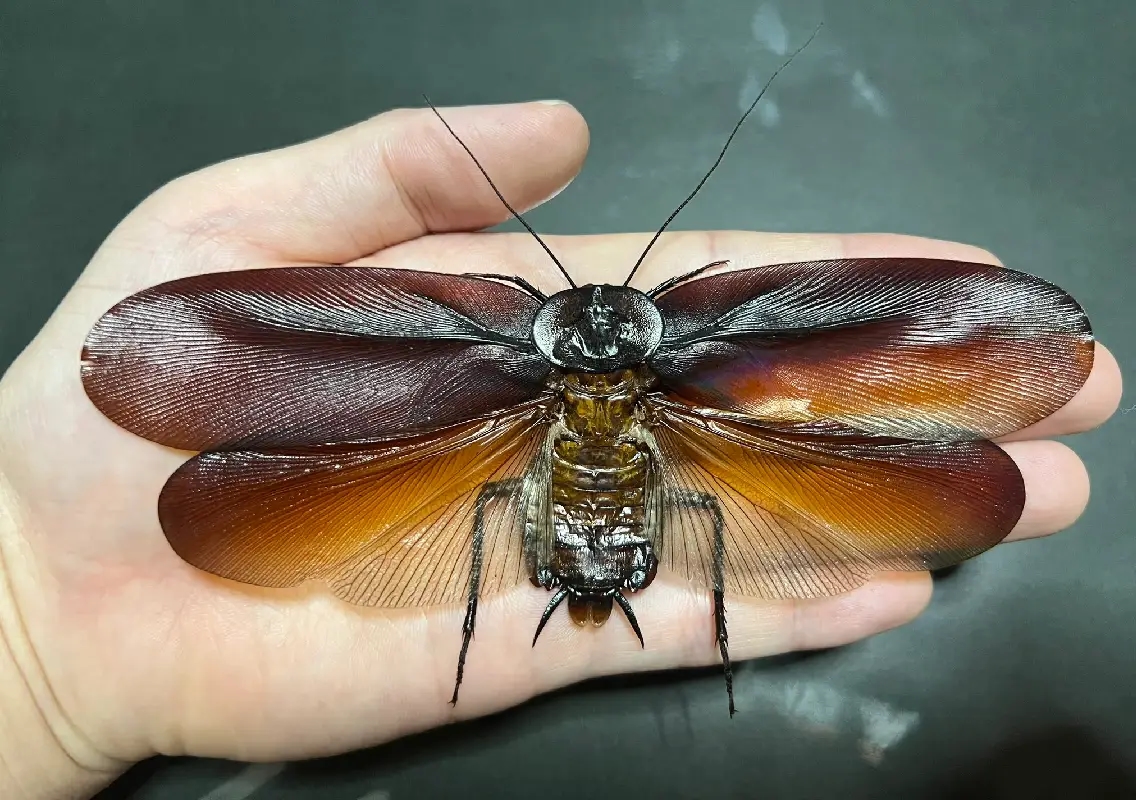


Megaloblatta, the world’s largest cockroach genus, is known for its enormous size, rainforest habitat and unique defensive traits studied for over a century.
The Megaloblatta genus, home to the largest winged cockroaches on the planet, has long intrigued entomologists for its exceptional size, unusual behaviours and ecological role within Central and South American rainforests. Ongoing research continues to reveal new insights into how these insects evolved to thrive in dense, humid forests — and why they remain one of the most striking examples of insect diversity.
A record-breaking rainforest giant
According to Guinness World Records, the world’s largest winged cockroach is Megaloblatta longipennis, a species native to the tropical forests of Peru, Ecuador and Panama. One preserved female specimen from the collection of Akira Yokokura in Yamagata, Japan, measures an extraordinary 97 mm long and 45 mm wide, with wingspans reaching up to 20 cm.
In comparison, most common cockroaches measure between 0.6 and 7.6 cm, making Megaloblatta one of the most extreme examples of size variation within the order Blattodea.
How Megaloblatta fits into the insect world
Megaloblatta belongs to:
- Kingdom: Animalia
- Phylum: Arthropoda
- Class: Insecta
- Order: Blattodea
- Superfamily: Blaberoidea
- Family: Ectobiidae (formerly Blattellidae)
- Subfamily: Nyctiborinae
Members of Ectobiidae typically have flexible egg cases and, in some groups, wood-feeding habits. Megaloblatta species, usually nocturnal, inhabit forest floors, tree bark crevices and moist leaf litter.
Discovery and early scientific confusion
The genus was first described in 1887 by German entomologist Heinrich Dohrn, who studied specimens from Peru, Panama and possibly western Colombia. Dohrn named the genus using Greek roots meaning “large cockroach” — a reference to its striking size.
Early research occasionally confused Megaloblatta with the genus Blabera, largely due to misidentified specimens. Scientific clarity improved as more samples were collected during the early 20th century. A key contribution came from American entomologist Morgan Hebard in 1920, whose work on Panama’s cockroach fauna helped refine species descriptions and distributions.
Further fieldwork throughout the Amazon and Central America expanded scientific collections, laying the groundwork for more detailed studies on behaviour and ecology.
Behavioural discoveries: the defensive “alarm sound”
In 1982, researchers documented a remarkable behavioural trait in Megaloblatta blaberoides nymphs: the ability to produce a loud defensive sound by rubbing specialised abdominal structures. The noise is used to deter predators and offers scientists additional characteristics to differentiate species within the genus.
Physical traits that aid survival
Megaloblatta species possess an elongated, flattened body that enables them to slip into narrow crevices under bark or soil. Their features include:
- Large pronotum that shields the head when threatened
- Strong, spined legs built for speed across forest floors and tree trunks
- Two pairs of wings — rigid forewings for protection and delicate hindwings for short glides
- Long antennae and large compound eyes adapted for low-light environments
Some species also exhibit abdominal structures linked to sound production, adding to their unique defensive repertoire.
Size and differences between males and females
The genus contains the largest cockroach species known, with adults typically ranging from 4 cm to over 9 cm in length. The largest known specimen, a female M. longipennis, reached 9.7 cm in length.
Sexual dimorphism is pronounced:
- Males often have longer wings and may glide more frequently, spending greater time in forest canopies.
- Females are broader, with larger abdomens suited for carrying egg cases.
Size can vary by habitat quality. Species in the moist, resource-rich Amazon tend to grow larger than those in comparatively drier regions. Smaller species, such as Megaloblatta insignis, remain around 4 cm, while others are true rainforest giants.
A genus still offering scientific surprises
More than a century after its discovery, Megaloblatta continues to captivate scientists studying insect evolution, rainforest adaptation and defensive behaviours. As researchers document new specimens and conduct genetic analyses, the genus may reveal further insights into how climate, habitat fragmentation and ecological pressures shape biodiversity in tropical forests.