







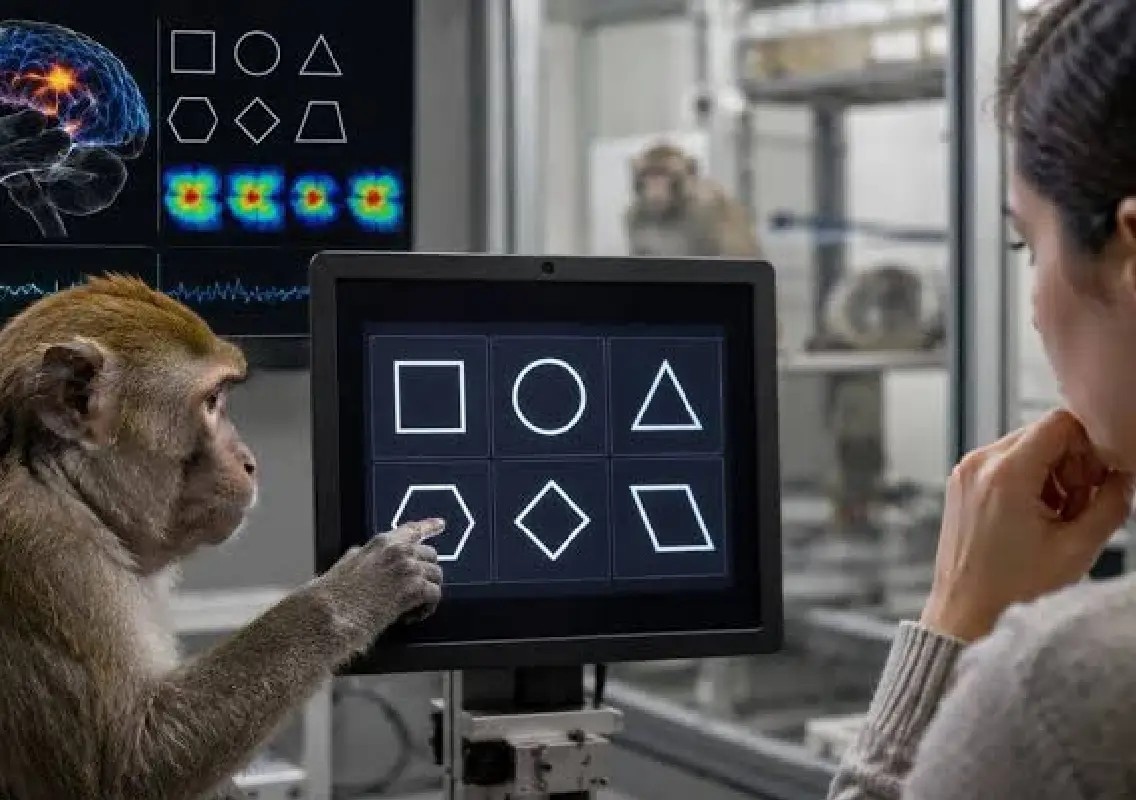


Pittsburgh: Monkeys may share some of the same basic instincts humans use to understand shapes and geometry, according to a new study comparing monkeys, young children and adults with little formal education in geometry. Researchers found that the groups made similar kinds of mistakes while completing shape-matching tasks, suggesting that their minds may approach geometric information in surprisingly similar ways.
The study, published online in the Proceedings of the National Academy of Sciences on July 20, examined how different groups recognised and matched shapes and angles. Researchers compared preschool children in the United States, adults from the Tsimane’ community in Bolivia and the Himba community in Namibia, and two groups of monkeys — rhesus monkeys in a laboratory and olive baboons at a zoo.
The findings challenge the idea that the human ability to understand basic geometric relationships is entirely unique to our species.
Researchers test geometric instincts
The researchers wanted to investigate whether people and other primates process shapes in fundamentally different ways.
Geometry is often associated with formal education, with concepts such as right angles, parallel lines and equal lengths taught in classrooms. However, humans encounter shapes and spatial relationships long before they learn formal geometry.
This raised an important question for scientists: could some of the mental abilities needed to recognise geometric relationships have developed much earlier in primate evolution?
Cognitive neuroscientists Jessica Cantlon and Jialin Li of Carnegie Mellon University led the research, working with colleagues including Caroline DeLong of the Rochester Institute of Technology.
The researchers designed computer-based tests that required participants to match shapes and angles.
The human participants included groups with very different educational backgrounds. The Tsimane’ and Himba adults involved in the study generally do not receive the kind of formal geometry instruction common in US schools, allowing researchers to examine geometric reasoning without relying solely on classroom learning.
Monkeys played games for treats
The monkey participants completed similar tasks on screens.
Rhesus monkeys were tested in a laboratory, while olive baboons at Seneca Park Zoo in Rochester, New York, used a special system known as the Primate Portal.
The portal is located in a cabin inside the baboon enclosure. A screen outside the cabin displays the games, while a researcher operates the system and provides rewards.
The monkeys were motivated by treats when they selected the correct answer. Some became enthusiastic participants, with one male baboon named Kalamata reportedly willing to play for hours each day.
One of the games used a “match-to-sample” format. A shape such as a square appeared first. Two possible choices then appeared, such as a square and a triangle. The monkey had to select the shape matching the original.
Correct answers were rewarded with food.
The researchers could then compare not only how accurately the different groups performed but also the types of mistakes they made.
Similar mistakes offer an important clue
The researchers found that the two monkey species and the human groups made similar types of errors during the shape-matching tasks.
Those similarities were important because the study was not simply measuring whether participants got answers right or wrong. Researchers also examined patterns in their mistakes and compared those patterns with two computer models representing different possible ways of processing geometric information.
The results suggested that monkeys and humans may rely on similar mental processes when dealing with shapes.
Jialin Li said the findings indicate that humans are not unique in this ability, although humans appear to be better at it.
The result adds to growing evidence that some cognitive abilities once thought to be uniquely human may have deeper evolutionary roots.
Formal geometry may not be the whole story
The study does not suggest that monkeys understand geometry in exactly the same sophisticated way as humans.
Humans have developed formal mathematical systems involving definitions, proofs, symbols and complex calculations. Monkeys have not been shown to possess this type of mathematical knowledge.
Instead, the researchers were examining more basic geometric intuition — the ability to recognise relationships between shapes and angles.
These abilities can be useful in everyday life without requiring formal mathematical education. Recognising whether two objects have similar shapes or whether lines and angles relate to one another can support navigation and interaction with the physical environment.
The researchers’ findings suggest that some of these intuitive abilities may be shared among primates.
Scientists urge caution over the findings
Other researchers welcomed the study while pointing out that the results do not provide a complete explanation of how monkeys and humans think.
Moira Dillon of New York University, who was not involved in the research, noted that computer models can provide possible explanations for behaviour but cannot directly reveal what is happening inside an animal’s mind.
Another researcher, Véronique Izard of the University of Paris Cité and France’s National Centre for Scientific Research, pointed out that the study relied on only two computer models.
A different model could potentially identify differences between human and monkey thinking that were not detected by the models used in this research.
The researchers therefore regard the findings as evidence of similar patterns in behaviour rather than proof that monkeys and humans consciously think about geometry in exactly the same manner.
Children are helping design monkey games
The research has also created an unusual connection between animal cognition and children’s education.
Elementary school students have been developing computer games for the baboons through programmes associated with the Primate Portal.
Students have designed their own versions of shape-matching games, considering both the coding and the visual elements that monkeys need to distinguish.
One 11-year-old student, Michael Sufra, created a game featuring rocket shapes and a cartoon cat. Another student, Cora Dimino, designed a game involving animal images in different colours.
Several hundred children have participated in the programme and have had the opportunity to watch monkeys play games they helped create.
The experience also appears to have an educational benefit. Earlier research by Caroline DeLong and colleagues found that coding games for monkeys can help children develop problem-solving skills.
Research opens a window into primate minds
The findings contribute to a broader scientific effort to understand how human cognitive abilities evolved.
Scientists have long studied whether abilities such as language, tool use, numerical reasoning and spatial understanding are uniquely human or whether they have older evolutionary origins.
Evidence from different animal species has increasingly suggested that several abilities exist in simpler forms outside humans.
The new study adds geometric intuition to that discussion.
By comparing children, adults and monkeys using similar tasks, researchers can investigate cognitive abilities without relying entirely on formal education or language.
Humans remain better at complex mathematics
The study does not diminish the extraordinary mathematical abilities developed by humans.
People can learn advanced geometry, algebra, calculus and other mathematical disciplines through education and cultural transmission. Human societies have also developed sophisticated mathematical notation and systems that allow knowledge to accumulate across generations.
What the research suggests is that the foundation for recognising certain geometric relationships may not have appeared suddenly with human mathematical culture.
Instead, some of the underlying cognitive machinery may have existed much earlier in primate evolution.
That distinction is important. Humans may have transformed basic spatial intuition into formal mathematics, while monkeys appear to retain only simpler versions of some of the same abilities.
A new perspective on animal intelligence
The study provides another example of how experiments can challenge assumptions about animal intelligence.
Monkeys completing computer games designed to test geometric reasoning may seem far removed from traditional mathematics classrooms. Yet the patterns in their responses offer scientists clues about how different minds process the physical world.
The involvement of schoolchildren also adds an engaging dimension to the research, allowing young programmers to contribute to experiments examining animal cognition.
Ultimately, the findings suggest that humans may not have a monopoly on the mental foundations of geometry. While people remain far more capable of formal mathematics, some basic instincts for recognising shapes and spatial relationships may be part of a cognitive heritage shared with other primates.