







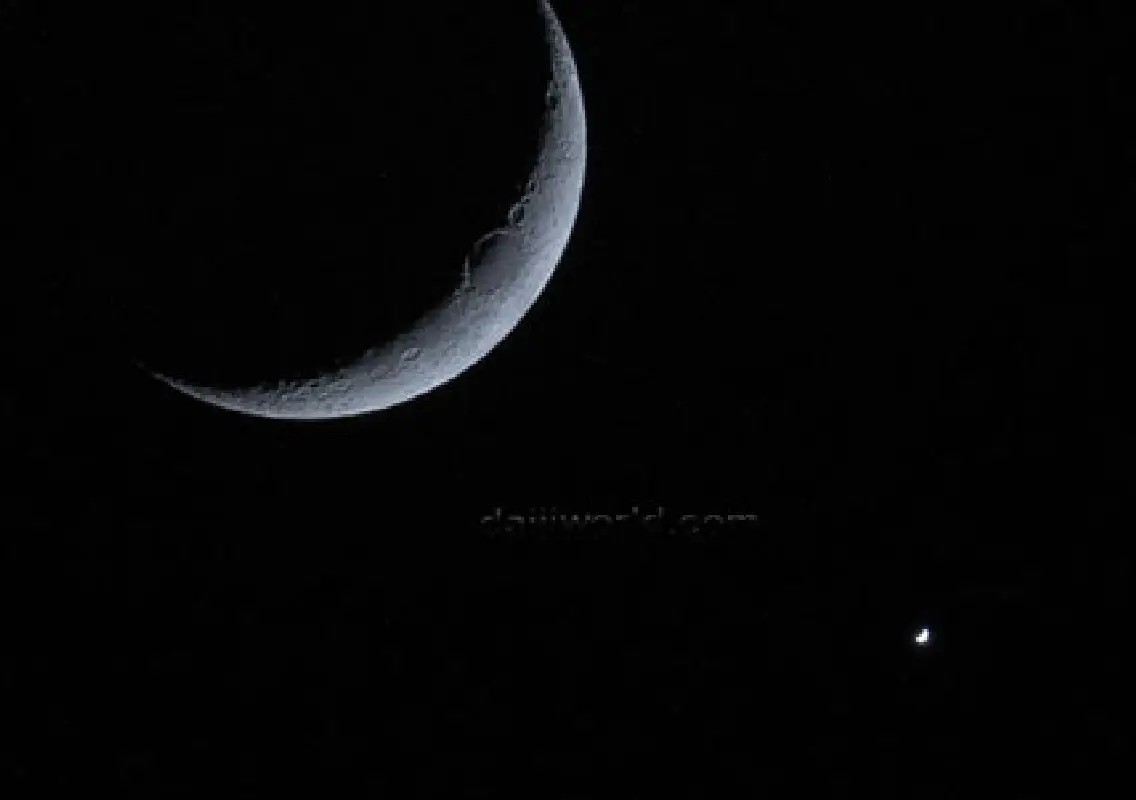


Mangaluru : Skywatchers and residents in Mangaluru were treated to a spectacular celestial display on Monday evening as a bright crescent Moon and Venus appeared close together in the western sky, coinciding with Ganesh Chaturthi celebrations.
The waxing crescent Moon and exceptionally bright Venus were clearly visible shortly after sunset, creating a striking sight for people who stepped outdoors during the festival. Several residents captured photographs of the celestial pairing as it appeared above the coastal city.
Rare celestial alignment attracts attention
The close pairing of the Moon and Venus was particularly notable because observers in parts of central and southern India experienced a lunar occultation of Venus, in which the Moon passed in front of the planet and temporarily obscured it.
Mangaluru was outside the direct path of the occultation. As a result, residents in the coastal region witnessed what appeared as a spectacular near-miss, with the Moon and Venus remaining visibly close to each other rather than Venus disappearing behind the Moon.
The contrasting appearance of the two objects added to the beauty of the event. Venus appeared as an intensely bright point of light alongside the slender curve of the crescent Moon.
What is a lunar occultation?
The Indian Institute of Astrophysics (IIA) explains that an occultation occurs when one celestial body passes in front of another from the observer’s viewpoint, temporarily blocking it from sight.
A lunar occultation occurs when the Moon passes in front of a more distant celestial object, such as a planet or star.
Because the Moon is relatively close to Earth, its position against the background sky changes significantly depending on the observer’s location. Consequently, a lunar occultation can be visible from one part of the world while observers elsewhere see only a close conjunction.
For people directly within the occultation path, the Moon completely covered Venus for a period. In Mangaluru, observers instead enjoyed the visually striking conjunction.
Festival evening adds to the experience
The celestial event coincided with Ganesh Chaturthi, giving the evening an additional visual attraction for residents and festival-goers.
After sunset, people stepping outside for celebrations could see Venus shining brightly beside the crescent Moon in the western sky. The combination of the festival atmosphere and the rare astronomical alignment made the evening especially memorable for many observers.
Celestial events such as conjunctions and occultations also provide opportunities for people to observe astronomical phenomena without specialised equipment.
Why Venus appeared so bright
Venus is often one of the brightest objects visible in Earth’s night sky after the Sun and Moon. Its brightness makes it relatively easy to identify during the evening or morning depending on its position in its orbit.
When Venus appears close to a thin crescent Moon, the contrast between the brilliant planet and the delicate lunar arc can create an especially striking scene.
The alignment was therefore visible to ordinary skywatchers across areas where weather and visibility permitted, although the exact appearance differed according to location.
Mangaluru witnesses a near-miss
The event once again highlighted how an astronomical phenomenon can look different from different parts of the country.
While some observers were able to witness the Moon pass directly in front of Venus, people in Mangaluru saw the two objects approach one another in the sky without the planet being completely hidden.
For coastal Karnataka’s skywatchers, the result was a beautiful close conjunction that complemented the festive evening.
The Moon and Venus eventually moved farther apart in the western sky as the evening progressed, bringing the brief visual spectacle to an end. For those who managed to look up after sunset, however, the celestial pairing provided a memorable reminder that some of nature’s most striking displays require nothing more than a clear sky and a moment of attention.