







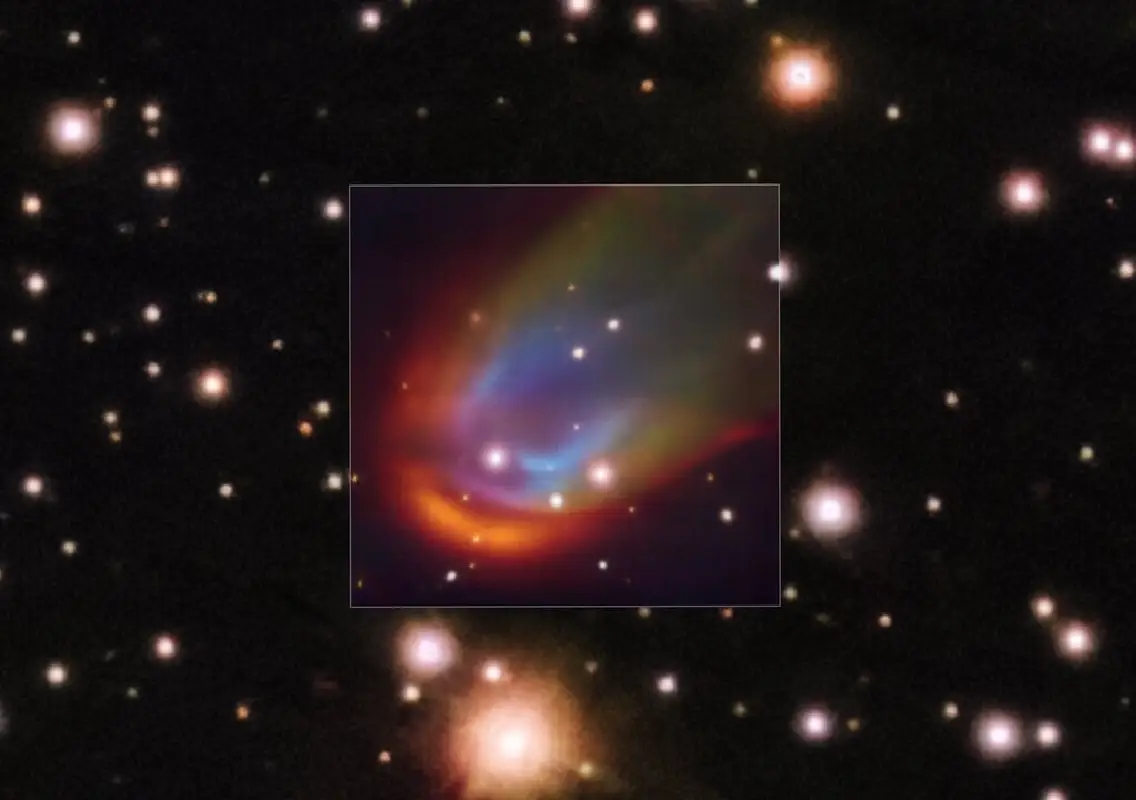


Astronomers using the European Southern Observatory’s Very Large Telescope (VLT) have discovered a striking and unexpected shock wave surrounding a dead star, challenging long-held ideas about how such stars interact with their environment.
The object, known as RXJ0528+2838, is a white dwarf located about 730 light-years from Earth. White dwarfs are the dense remnants left behind when low-mass stars die and are usually considered relatively calm. However, new observations reveal a large bow-shaped shock wave — a structure that, according to current theories, should not exist around this star.
Discovery defies existing theories
“We found something never seen before and, more importantly, entirely unexpected,” said Simone Scaringi of Durham University, co-lead author of the study published in Nature Astronomy. His colleague, Krystian Iłkiewicz from the Nicolaus Copernicus Astronomical Center in Poland, added that the star is producing a powerful outflow of material that “shouldn’t be there” based on known mechanisms.
As RXJ0528+2838 moves through interstellar gas, it creates a bow shock — similar to the wave formed ahead of a moving ship. Such shocks are normally driven by material flowing out from a star, but this white dwarf shows no evidence of the usual disc that powers such outflows.
Magnetic field may hold the key
RXJ0528+2838 is part of a binary system, orbiting with a Sun-like companion. In most such systems, matter forms a disc around the white dwarf before being ejected. In this case, no disc is present. Instead, researchers believe a strong magnetic field may be channelling material directly onto the star, generating the mysterious outflow.
Observations using the MUSE instrument on ESO’s VLT confirmed that the nebula originates from the system itself and has likely been forming for over 1,000 years. However, the magnetic field alone cannot fully explain its longevity.
Looking ahead
Scientists say the finding forces a rethink of how matter behaves around dead stars. Future observations with ESO’s upcoming Extremely Large Telescope are expected to uncover more such systems and help solve what researchers describe as a “mystery engine” powering these unexpected outflows.