







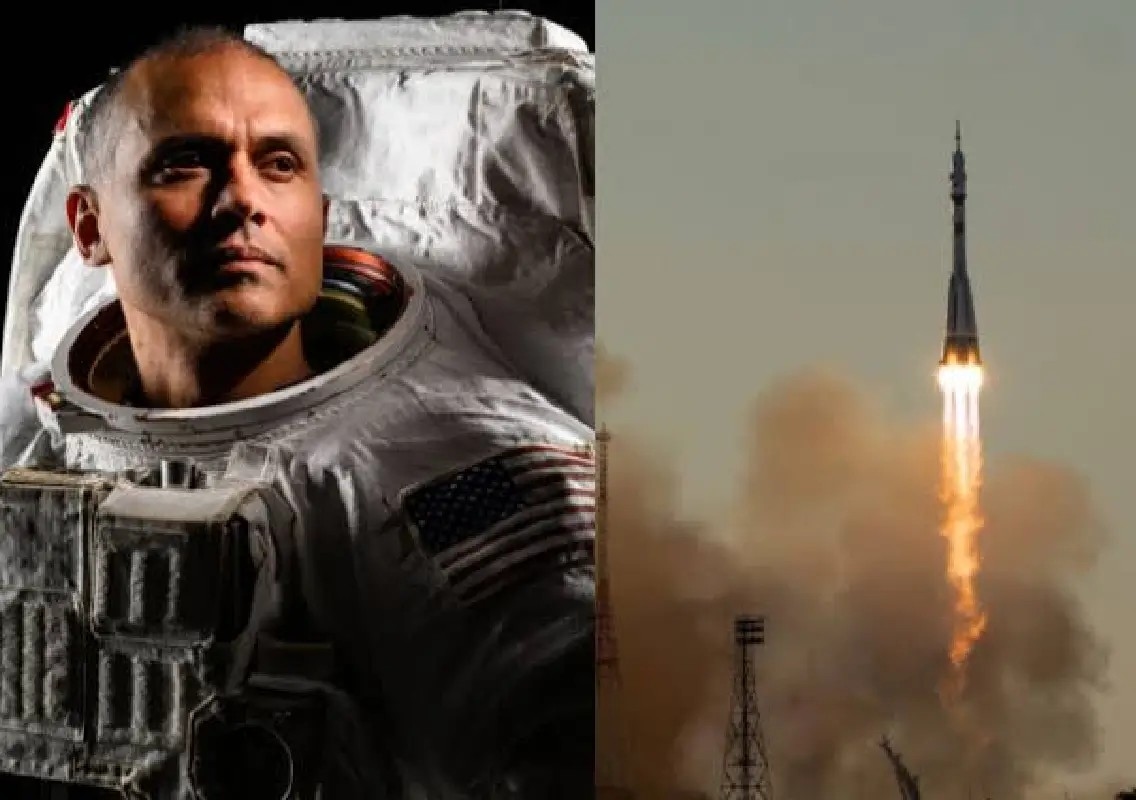


NASA astronaut Anil Menon and two Russian cosmonauts successfully arrived at the International Space Station (ISS) in the early hours of Wednesday after completing a little over three-hour journey aboard the Soyuz MS-29 spacecraft.
The spacecraft docked with the orbiting laboratory following a flawless launch from the Baikonur Cosmodrome in Kazakhstan on Tuesday evening, marking the beginning of a new long-duration scientific mission.
Successful launch and docking
The Roscosmos Soyuz MS-29 spacecraft lifted off at 8.17 pm IST on Tuesday, carrying Menon along with Russian cosmonauts Pyotr Dubrov and Anna Kikina.
The launch coincided with the International Space Station passing directly over the Baikonur Cosmodrome, allowing the spacecraft to reach the orbital laboratory in just over three hours.
After docking, the crew entered the ISS, where they were welcomed by the station’s existing astronauts and cosmonauts with hugs and handshakes.
Anil Menon’s first space mission
This mission marks Anil Menon’s first journey into space since being selected as a NASA astronaut. A physician, engineer and former SpaceX flight surgeon, Menon has played a significant role in supporting human spaceflight programmes before beginning his own mission.
During his stay aboard the ISS, he is expected to participate in a wide range of scientific experiments, technology demonstrations and maintenance activities that support future deep-space exploration.
International cooperation in space
The mission highlights the continued cooperation between NASA and Russia’s Roscosmos under the long-running International Space Station programme, despite broader geopolitical tensions.
The ISS continues to serve as a unique platform where astronauts from different countries live and work together while conducting research in microgravity that benefits science, medicine and future space exploration.
The Soyuz MS-29 crew is expected to spend several months aboard the station before returning to Earth after completing its scheduled scientific mission.