







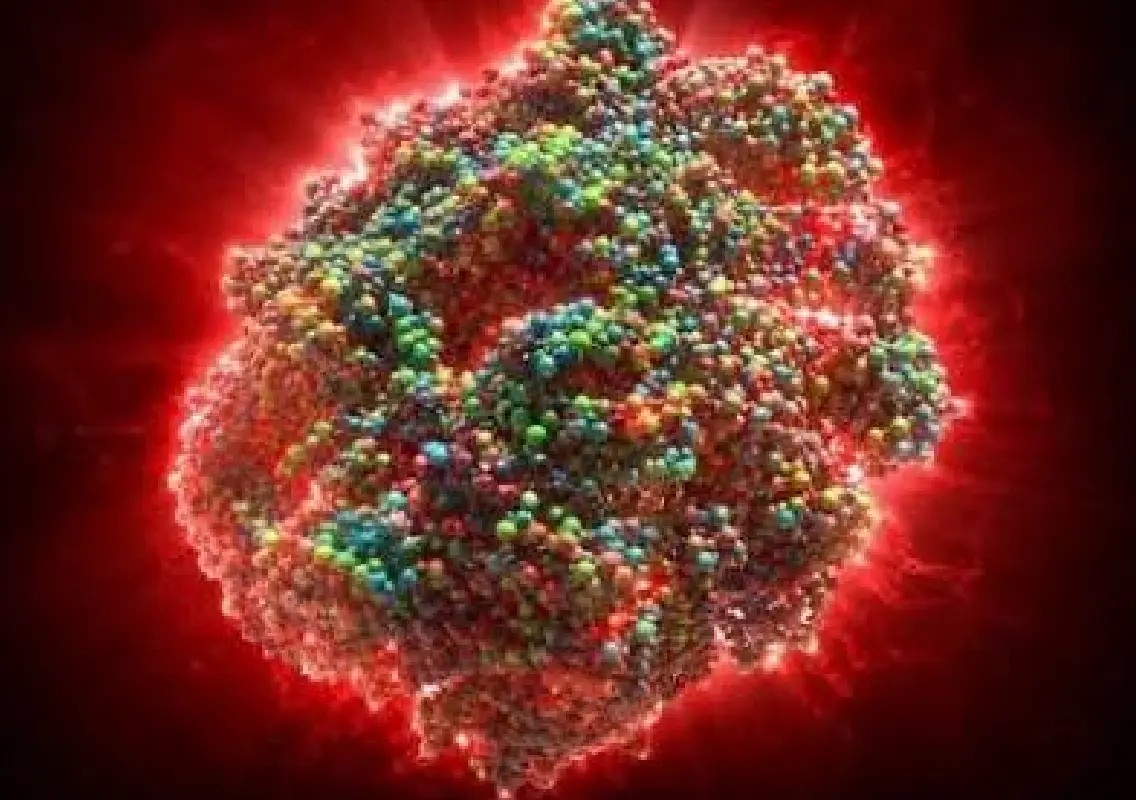


Tokyo: Researchers from Sophia University in Japan have quantified how much matter produced in high-energy oxygen–oxygen collisions reaches thermal equilibrium, providing fresh insight into how quark–gluon plasma develops in relatively small collision systems.
The study, published in Physical Review C on August 12, examines oxygen–oxygen collisions at the Large Hadron Collider (LHC) at CERN at an energy of 5.36 TeV.
Oxygen collisions offer an important middle ground
High-energy nuclear collisions recreate conditions similar to those that existed shortly after the birth of the universe. Under such extreme conditions, protons and neutrons can break down into their fundamental constituents, creating quark–gluon plasma (QGP).
Large collisions involving heavy nuclei can produce matter that behaves like a fluid. However, researchers have also observed collective behaviour in much smaller collision systems, raising questions about whether these systems genuinely reach thermal equilibrium.
Oxygen nuclei provide an intermediate system between proton–proton and heavy-ion collisions, making them particularly useful for studying this transition.
Researchers separate equilibrated and non-equilibrated matter
The team, led by Professor Tetsufumi Hirano of Sophia University, used the dynamical core–corona initialization (DCCI2) model to distinguish between two components.
The core represents matter that reaches local thermal equilibrium and can be described using relativistic hydrodynamics. The corona consists of particles that remain largely non-equilibrated.
The approach allowed researchers to estimate the proportion of matter displaying collective, fluid-like behaviour without assuming that the entire collision system reaches equilibrium.
Non-equilibrated component remains significant
The analysis found that when the number of charged particles produced near the centre of the collision exceeded about 20, the equilibrated core became the larger component.
However, the corona did not disappear even in the most central oxygen–oxygen collisions. It continued to account for approximately 30 per cent of the total hadron yield.
The findings indicate that oxygen collisions occupy an intermediate regime between systems dominated by non-equilibrated particles and those where collective fluid-like behaviour is more prominent.
Particle momentum measurements provided further evidence of this transition. The core generally dominated at lower momenta, while the corona became increasingly important at higher momenta. The change occurred at higher momentum for heavier particles, reflecting the stronger effect of collective expansion.
Findings could help study nuclear structure
The researchers also examined strange-baryon production. Ratios of strange baryons to charged pions increased as collision activity increased but remained below levels expected under complete chemical equilibrium.
According to the researchers, this supports the conclusion that a non-equilibrated component persists even when the equilibrated component becomes dominant.
The findings could also help scientists investigate the possible alpha-cluster structure of oxygen nuclei. Understanding the degree of equilibration is important when interpreting particle distributions as signals of nuclear structure.
The team plans to extend the framework to other intermediate collision systems, including neon–neon collisions, to better understand how nuclear structure and system size influence the formation and equilibration of quark–gluon matter.