







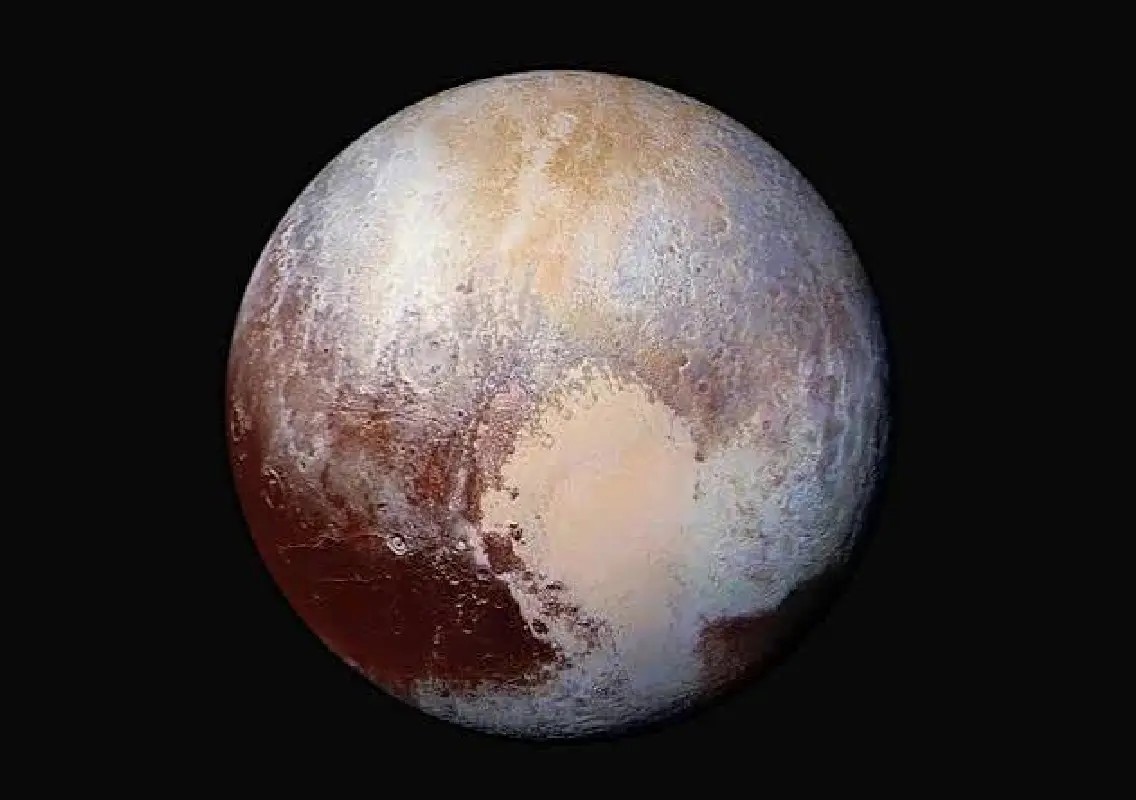


Scientists studying images captured by NASA’s New Horizons spacecraft have found evidence suggesting that liquid nitrogen may be rising through cracks in the frozen surface of Sputnik Planitia, Pluto’s famous heart-shaped basin.
The finding offers fresh clues about how Pluto’s icy landscape continues to change despite surface temperatures reaching around -229°C.
Liquid nitrogen may be rising from below
Sputnik Planitia appears smooth from a distance, but detailed images reveal irregular polygons, troughs and dark narrow features across its nitrogen-ice surface. Researchers believe some of these darker areas may have been formed when liquid nitrogen reached the surface through cracks.
Because Pluto’s atmosphere does not produce nitrogen rainfall, scientists say the material is likely coming from beneath the ice. The source could involve melting at the base of the kilometres-deep nitrogen glaciers, potentially caused by pressure-induced heating. Heat from Pluto’s interior may also contribute.
Pluto shows an unusual icy process
Researchers compared the Pluto images with satellite images of glacial regions in Greenland and Antarctica, where liquid water can emerge from beneath ice and create ponds and channels.
The process on Pluto could resemble volcanism, but instead of molten rock, nitrogen ice is involved. Scientists describe this possible activity as a form of cryovolcanism.
The surface of Sputnik Planitia is believed to be less than one million years old, meaning the features identified in the study may have formed relatively recently.
Findings could help explain other frozen worlds
The research could also provide insights into other icy bodies, including Neptune’s moon Triton, which has shown evidence of nitrogen-related surface activity.
Scientists say further mapping and laboratory research are needed to understand how nitrogen behaves under the extreme temperatures, pressure and stress found on Pluto.
The study highlights how the dwarf planet continues to reveal unexpected geological processes, years after New Horizons provided humanity with its first close-up view of its surface.