







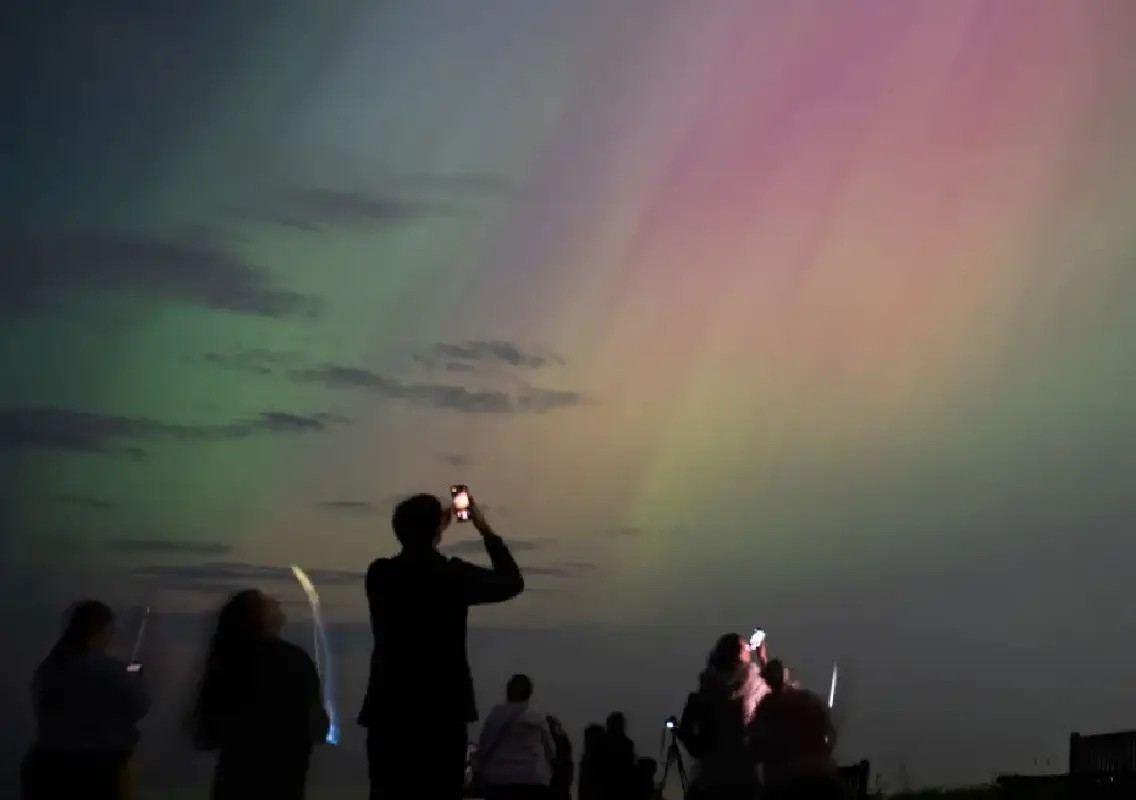


A powerful solar eruption is heading towards Earth, prompting space weather agencies to issue alerts for a strong geomagnetic storm that could illuminate skies with vibrant auroras and potentially affect communication systems.
The event began on June 6 when a region on the Sun known as Active Region 4461 released an M1.8-class solar flare, accompanied by a dense and fast-moving filament eruption travelling at nearly 1,400 kilometres per second.
What triggered the solar storm?
According to space weather experts, the eruption involved a solar filament — a massive ribbon of relatively cool, dense plasma suspended above the Sun’s surface by magnetic fields.
When these magnetic structures become unstable, they can erupt violently, launching huge clouds of magnetised plasma into space. Scientists believe this particular eruption is directed towards Earth.
The United States Space Weather Prediction Center has issued a G3 (strong) geomagnetic storm watch, with a possibility of brief G4 (severe) conditions if solar wind interactions intensify.
Aurora displays expected
One of the most visible effects of a geomagnetic storm is the appearance of auroras, commonly known as the Northern and Southern Lights.
When charged particles from the Sun interact with Earth’s magnetic field and atmosphere, they produce colourful displays of green, red and purple light across the night sky.
A G3-level storm could push auroras to much lower latitudes than usual, making them visible in regions that rarely experience such displays.
Possible impact on Earth
While Earth’s magnetic field shields the planet from most harmful solar radiation, strong geomagnetic storms can occasionally affect satellite operations, radio communications, navigation systems and power infrastructure.
Experts are closely monitoring the storm’s magnetic orientation, which will determine how strongly it interacts with Earth’s magnetosphere.
Scientists monitor developments
Researchers say the final intensity of the storm will only become clear shortly before it reaches Earth. Space weather forecasters continue to monitor incoming solar wind data for signs of stronger-than-expected activity.
For skywatchers, however, the event offers the possibility of witnessing one of nature’s most spectacular phenomena.