







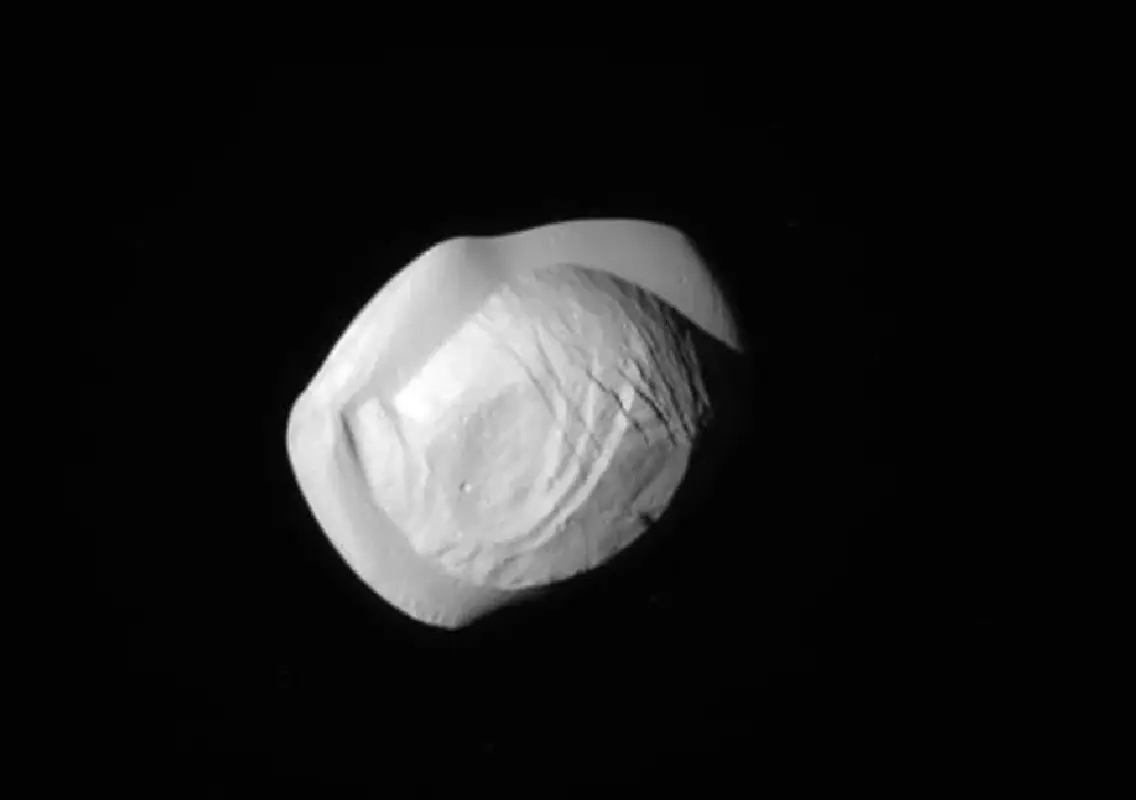


Hidden within the magnificent rings of Saturn lies one of the Solar System’s most unusual celestial bodies — the tiny moon Pan.
Discovered in 1990, Pan measures only about 28 kilometres across, yet its striking appearance has intrigued scientists for decades. The moon is known for its distinctive ravioli-like shape, created by a ridge that wraps around its equator.
A moon shaped by Saturn’s rings
Researchers believe Pan’s unique structure formed over millions of years as particles from Saturn’s rings gradually accumulated around the moon’s equator.
This process created a thick equatorial ridge that gives the moon its unusual flattened shape. The ridge is composed of icy ring material that slowly gathered due to Pan’s weak gravity.
Orbit inside the Encke Gap
Pan orbits Saturn within a narrow region of the rings known as the Encke Gap.
The moon’s gravity helps keep this gap clear by sweeping away or scattering ring particles that drift into its orbit. As it moves along its path, Pan also creates small waves and disturbances in the surrounding rings.
Cassini mission reveals stunning images
Much of what scientists know about Pan comes from detailed observations made by the Cassini–Huygens spacecraft.
Images captured during the mission revealed the moon’s dramatic equatorial ridge and showed how even a relatively small moon can influence the structure of Saturn’s massive ring system.
A reminder of cosmic complexity
Although Pan is tiny compared to many other moons in the Solar System, its interaction with Saturn’s rings demonstrates the complex gravitational dynamics that shape planetary systems.
Scientists say objects like Pan provide valuable insights into how moons, rings, and planetary bodies evolve over time, making it one of the most fascinating small worlds orbiting Saturn.