







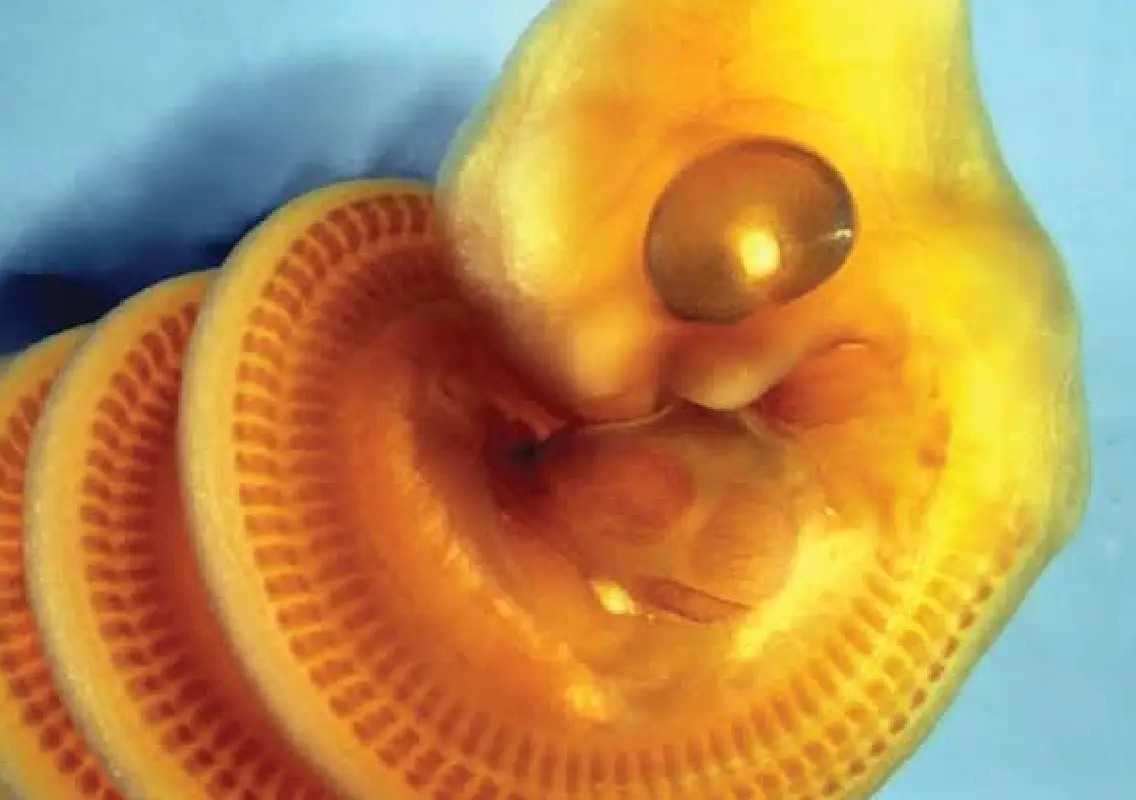


Snake embryos may begin life with a striking right-handed curl for a surprisingly simple reason: their bodies grow faster than their internal organs.
Scientists studying more than 900 snake embryos have found evidence that the unusual spiral shape is created by the physical forces acting inside the developing egg.
It starts with a growing body
As a snake embryo develops, its body lengthens rapidly. However, its gut does not grow at the same pace.
This difference in growth creates a kind of natural tether inside the embryo. As the body continues to lengthen while remaining connected to the slower-growing gut, the developing snake has limited room to extend.
The result is a buckle that gradually turns into the familiar spiral shape.
CT scans revealed what was hidden
To understand how the shape develops, researchers examined more than 900 embryos and used CT scans to look inside the eggs.
The scans allowed them to observe the relationship between the growing body and internal organs without relying only on what could be seen from outside.
Their findings suggest that the distinctive right-handed coil is not simply a random position adopted by the embryo. Instead, it emerges from the physical constraints created during development.
A tiny twist with a bigger lesson
The discovery offers a new perspective on how animal bodies take shape before birth or hatching.
Rather than being controlled entirely by genetic instructions, some features may emerge from the interaction between growth, anatomy and physical forces.
For snakes, a simple difference in how quickly the body and gut grow appears to help create one of the earliest and most recognisable features of their development — a tiny embryo curled into a right-handed spiral.