







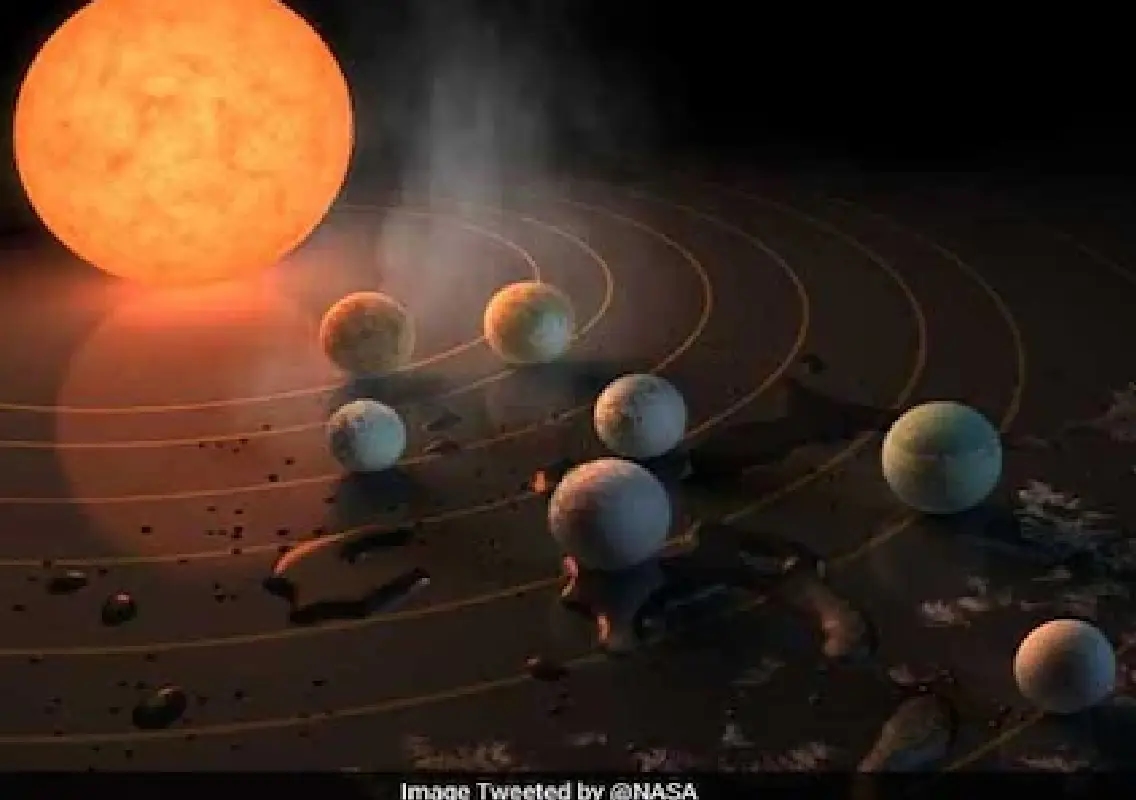


In a major breakthrough for astronomy, scientists have confirmed the presence of a second young planet forming around a star similar to our Sun, offering a rare glimpse into how planetary systems like ours take shape.
A rare look into early solar system formation
The star, WISPIT 2, located about 437 light-years away, is extremely young at just 5 million years old. It has not yet begun full nuclear fusion, making it an ideal system to study early planet formation.
Astronomers had earlier identified one massive planet, WISPIT 2b. Now, a second planet, WISPIT 2c, has been confirmed within the same system.
Discovery of a second giant planet
WISPIT 2c is estimated to be between 8 to 12 times the mass of Jupiter and orbits closer to the star than its sibling. The discovery was confirmed using advanced spectroscopic techniques with powerful instruments like the Very Large Telescope (VLT).
This method allowed scientists to verify the planet’s presence and even detect atmospheric elements such as carbon dioxide, strengthening evidence that it is indeed a forming gas giant.
Why this discovery matters
The WISPIT 2 system is only the second known case — after the PDS 70 system — where multiple planets have been directly observed forming around a star.
This makes it a valuable “cosmic laboratory” for scientists to study how planets emerge from protoplanetary disks of gas and dust.
A window into our own origins
Researchers believe WISPIT 2 closely resembles what our own Solar System may have looked like in its early stages.
The system contains rings and gaps in its surrounding disk, believed to be carved out by forming planets. Scientists suspect there may even be a third planet yet to be discovered.
Future discoveries ahead
With upcoming advanced telescopes like the Extremely Large Telescope (ELT), astronomers expect to uncover even more details about such young systems.
Experts say these discoveries are helping bridge the gap between theoretical models and real observations of how planetary systems form and evolve.