







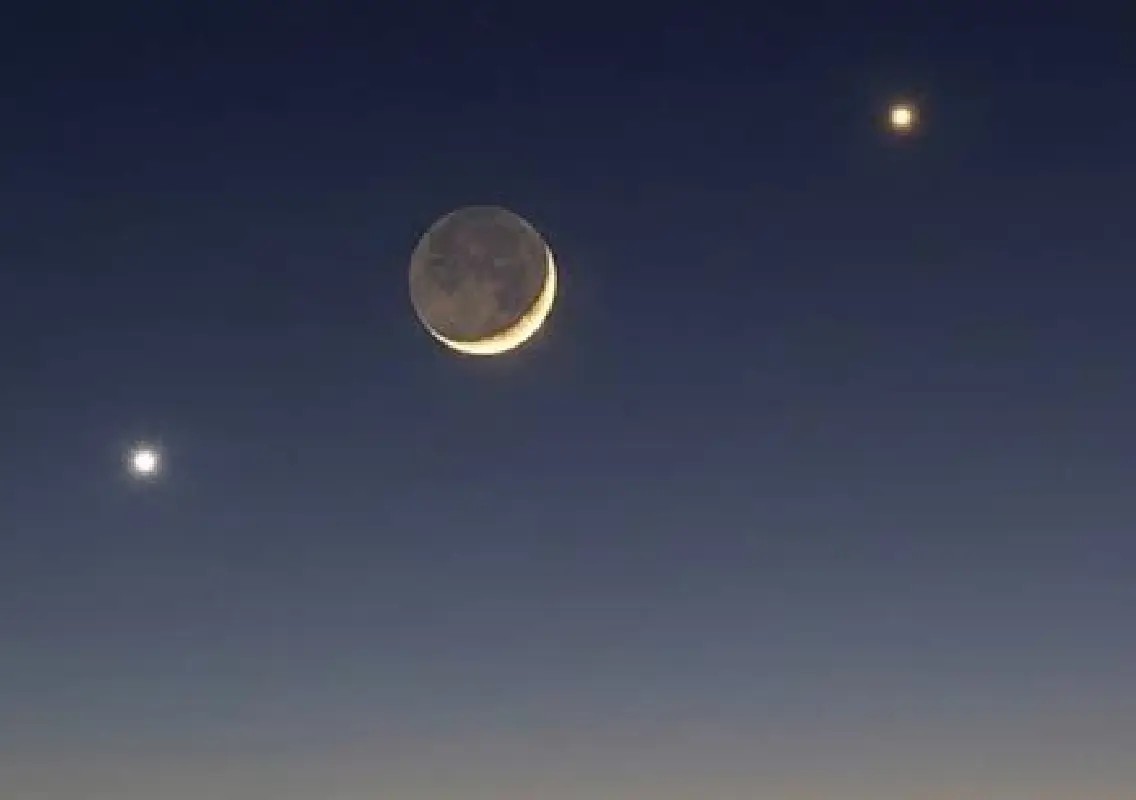


New Delhi : Sky watchers have plenty to look forward to this month as the Moon embarks on a series of close encounters with planets, bright stars and star clusters, creating several striking celestial events across the September sky.
Following August’s eclipse season, September’s night sky is set to remain busy, with the Moon making close approaches to — and in some parts of the world passing directly in front of — Jupiter, Venus and other prominent celestial objects.
A lunar occultation occurs when the Moon passes between an observer on Earth and another celestial object, temporarily blocking that object from view. The phenomenon can be particularly fascinating when the object is a bright planet such as Jupiter or Venus.
According to astronomy guides for September, the Moon will occult Jupiter on September 8 and Venus on September 14, although visibility of the actual occultations will depend heavily on the observer’s location.
Jupiter disappears behind the Moon
One of September’s most notable events will occur on September 8, when the Moon passes directly in front of Jupiter.
The event will be visible from parts of Canada, Greenland, the United States, eastern Russia and the North Pacific. In other regions, observers may instead see the Moon and Jupiter appearing extremely close together in the sky.
The occultation is particularly noteworthy because it is the first lunar occultation of Jupiter since May 2023, according to astronomy sources.
For observers outside the occultation path, the close conjunction can still offer a beautiful sight. The thin crescent Moon and bright Jupiter will appear close together, creating an attractive pairing in the early sky.
However, in some locations the event occurs during daylight, making the actual disappearance of Jupiter considerably more difficult to observe.
Venus follows six days later
Just six days after Jupiter’s encounter with the Moon, another bright planet will take centre stage.
On September 14, the Moon will pass in front of Venus, producing another lunar occultation. The event will be visible from parts of Europe, Africa, the Middle East, South and Southeast Asia and western Russia.
Venus is among the brightest objects in Earth’s sky, which makes the event particularly interesting for skywatchers. Under suitable conditions, the planet can be visible even during daylight, although careful observation and favourable skies are required.
For observers outside the occultation zone, the Moon and Venus will still appear close together.
The pairing should be especially attractive after sunset, when Venus shines brightly near the western horizon.
September offers more lunar encounters
The Moon’s journey through the September sky does not end with Jupiter and Venus.
The lunar disc will also pass near several prominent stars and deep-sky objects during the month. The Moon’s movement against the background stars creates opportunities for observers to see different celestial pairings from night to night.
Astronomy guides list encounters involving Mars, the Pleiades and other bright objects, while a second encounter with the Pleiades is expected towards the end of the month.
These events are caused by the Moon’s relatively rapid movement across the sky compared with the distant background stars and planets.
Because the Moon travels along a path close to the ecliptic, it regularly passes near planets and zodiacal constellations.
Venus will shine exceptionally brightly
Even for people unable to observe either occultation, Venus will be one of September’s most rewarding targets.
NASA’s September skywatching guide says Venus will reach peak brilliance on September 18 during its current evening appearance. The planet will appear low in the western sky shortly after sunset and should stand out prominently against the darker sky.
A clear western horizon will provide the best opportunity to see it before it sets.
Venus’s brightness makes it an excellent target for casual skywatchers because it can generally be identified without specialist equipment.
Harvest Moon closes the month
September’s celestial highlights will continue towards the end of the month with the arrival of the Harvest Moon.
The full Moon will occur on September 26. Around the same period, the Moon will appear close to Saturn, while Neptune will also be in the region of the sky for observers equipped with suitable optical equipment.
The Harvest Moon is traditionally associated with the full Moon closest to the September equinox.
This year’s September equinox occurs on September 22, marking the beginning of astronomical autumn in the Northern Hemisphere and spring in the Southern Hemisphere.
The changing position of the Moon around the equinox provides another opportunity for observers to explore the night sky.
What makes an occultation special?
A conjunction occurs when two celestial objects appear close together from Earth’s perspective. An occultation goes a step further: the nearer object actually passes across the line of sight and temporarily hides the more distant object.
The Moon is ideally placed to produce these events because it is relatively close to Earth and moves noticeably against the background sky each night.
When the Moon approaches a planet, the two can appear dramatically close. If an observer happens to be within the narrow geographic path of the occultation, the planet can then disappear behind the Moon before re-emerging from the opposite side.
The exact timing and visibility vary considerably by location.
This means that an event described as a lunar occultation may not be visible as an occultation from every country. Some observers may see only a close conjunction, while others may see the planet disappear completely.
How to watch the September events
Many of the month’s celestial encounters can be enjoyed with the naked eye, particularly the close approaches involving the Moon, Venus and other bright objects.
Binoculars or a small telescope can provide additional detail, particularly when attempting to observe an occultation or faint objects near the Moon.
However, observers should exercise extreme caution when attempting to view daylight events. Optical equipment must never be pointed towards the Sun, as direct sunlight through binoculars or a telescope can cause severe and permanent eye damage.
For the best viewing experience, skywatchers should choose a location with a clear horizon and minimal light pollution where possible.
Checking the precise visibility and timing for the observer’s location is also important because occultation paths can cover only certain parts of the world.
A month packed with reasons to look up
September 2026 offers an unusually busy programme for anyone interested in observing the Moon and planets.
The Jupiter occultation on September 8, Venus occultation on September 14, Venus’s peak brilliance, the September equinox and the Harvest Moon all provide different reasons to look towards the sky.
For experienced astronomers, the month provides opportunities to observe rare occultations and track the changing positions of celestial bodies. For casual observers, several of the events can be appreciated simply by stepping outside and looking towards the appropriate part of the sky.
The events also offer a reminder that the night sky is constantly changing. The Moon’s movement can transform its relationship with planets and stars from one night to the next, creating fleeting alignments that may not be visible again for years.
With Jupiter set to disappear behind the Moon early in the month, Venus following soon after and the Harvest Moon arriving later, September promises to be a rewarding month for skywatchers around the world.