







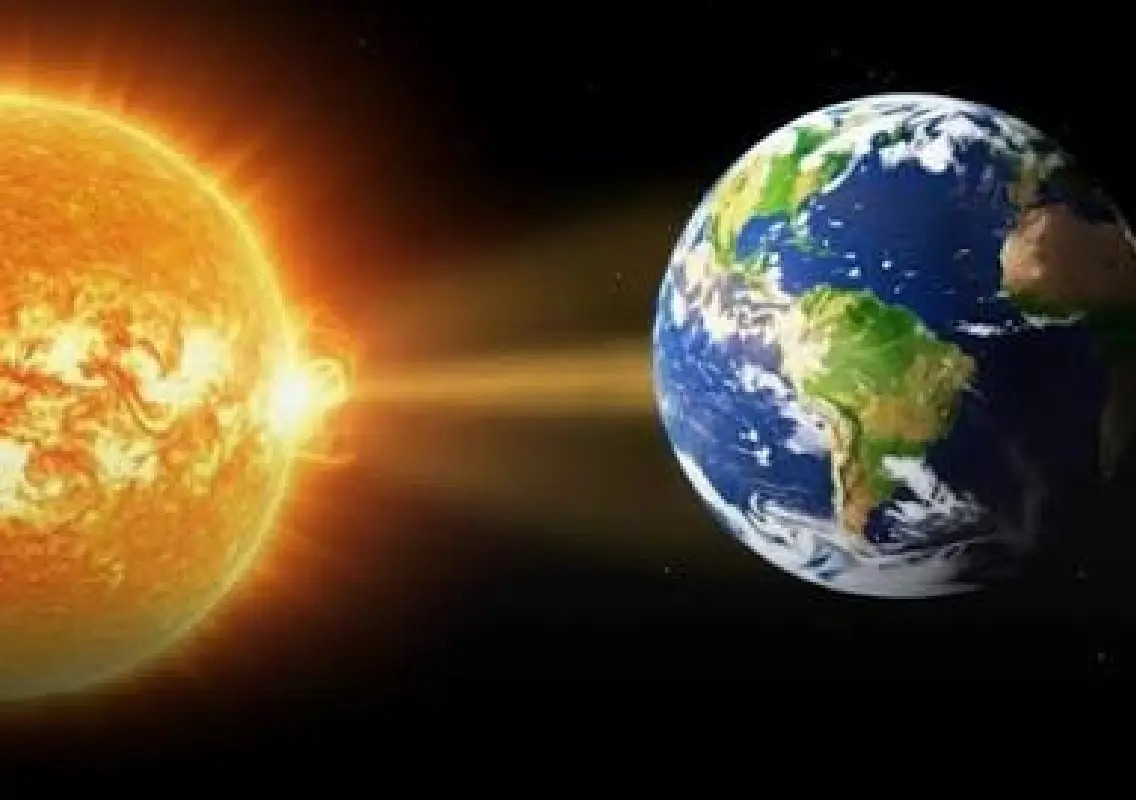


Washington: Earth’s ancient climate may have been influenced not only by changes occurring on the planet itself but also by the Sun’s journey through the Milky Way, according to new NASA-funded research.
Scientists have found that the Solar System may have passed through extremely dense and cold interstellar clouds at least three times during the past 14 million years. Computer simulations suggest that these encounters could have compressed the heliosphere — the enormous bubble of charged particles generated by the solar wind — to a fraction of its usual size.
The research offers a new perspective on the factors that may have influenced Earth’s climate history. Scientists have traditionally examined processes such as volcanic activity, changes in greenhouse gases, ocean circulation and variations in Earth’s orbit when investigating ancient climate shifts. The new work suggests that conditions in interstellar space may also have played a role.
The study was carried out by researchers associated with NASA’s SHIELD centre, or Solar Wind with Hydrogen Ion charge Exchange and Large-Scale Dynamics, which studies the interaction between the solar wind and the surrounding interstellar environment.
The Sun travels through a changing galactic environment
The Solar System is not stationary in space. The Sun and all the planets orbit the centre of the Milky Way, carrying the entire Solar System through an environment filled with gas, dust, radiation and magnetic fields.
Much of this material is extremely thinly distributed. However, the Sun can occasionally encounter regions where interstellar material is considerably denser.
The heliosphere normally acts as a protective boundary around the Solar System. It is created by the continuous stream of charged particles flowing outward from the Sun, known as the solar wind.
This bubble extends far beyond the orbit of the planets and helps shield the Solar System from some high-energy particles originating outside it.
However, the size and shape of the heliosphere are not fixed.
When the Solar System enters a region containing denser interstellar material, the pressure exerted on the heliosphere can increase substantially. According to the new simulations, some of the clouds encountered by the Sun were sufficiently dense and cold to compress the heliosphere dramatically.
Three encounters may have occurred
The computer modelling indicates that the Sun passed through extremely dense, frigid interstellar clouds at least three times over the last 14 million years.
During these periods, the pressure from surrounding interstellar material could have pushed the heliosphere inward.
Instead of maintaining its usual protective extent, the heliosphere may have shrunk to a fraction of its normal size.
That change could have had consequences for Earth because the planet would have been exposed to a substantially different space environment.
The research does not suggest that the Sun itself suddenly became weaker or stronger during these encounters. Rather, the surrounding galactic environment changed the extent of the protective region created by the solar wind.
This distinction is important because the proposed climate influence comes from changes in the Solar System’s surroundings rather than from a major alteration in the Sun’s energy output.
Earth may have faced greater cosmic exposure
If the heliosphere became significantly smaller, Earth could have spent periods outside or close to the edge of this protective bubble.
That would have allowed more material and radiation from interstellar space to interact with the Earth’s surrounding environment.
According to the research, cold interstellar material containing hydrogen could have interacted with Earth’s upper atmosphere. Cosmic rays may also have had greater access to the atmosphere during periods when the heliosphere was compressed.
The resulting atmospheric changes could have influenced the planet’s climate system.
The research suggests that increased moisture in the upper atmosphere and changes in atmospheric chemistry could have affected global weather patterns.
Scientists are particularly interested in whether these changes may have contributed to periods of cooling and potentially some ancient ice-age conditions.
Interstellar dust provides clues
One of the intriguing aspects of the research is that the proposed encounters are supported by physical evidence found on Earth and beyond.
Scientists have identified traces of interstellar dust in several ancient materials, including deep-sea ocean sediments, samples associated with the Moon and ancient Antarctic ice.
These deposits provide evidence that material from outside the Solar System has reached the Earth’s environment.
Such discoveries are important because they offer a way of comparing computer models with physical evidence preserved over geological timescales.
The presence of interstellar material does not, by itself, prove that a particular cloud caused an ice age. However, the evidence strengthens interest in investigating connections between the Solar System’s passage through the galaxy and changes recorded in Earth’s climate history.
The heliosphere acts as a cosmic shield
The heliosphere is one of the most important structures in understanding how the Solar System interacts with interstellar space.
It is essentially a vast region dominated by particles flowing outward from the Sun. Its outer boundary marks the point where the influence of the solar wind meets the surrounding interstellar medium.
The heliosphere is not a rigid shell. Its size changes depending on conditions both inside and outside the Solar System.
When external pressure increases, the bubble can contract. When external pressure decreases, it can expand.
The latest research focuses on what may happen when the Solar System encounters unusually dense interstellar clouds.
A major compression could significantly change the amount of cosmic material and radiation reaching the inner Solar System.
For Earth, which is located relatively close to the Sun compared with the enormous scale of the heliosphere, such changes could potentially alter the atmospheric environment.
Climate history has many influences
Earth’s climate has never been controlled by a single factor.
Over millions of years, the planet has experienced major changes caused by variations in atmospheric greenhouse gases, volcanic activity, continental positions, ocean circulation and orbital cycles.
Changes in solar activity can also affect Earth’s environment.
The new research adds another potential influence: the changing interstellar environment through which the Solar System travels.
This does not mean that every major climate change or ice age was caused by the Sun entering a dense cloud.
Instead, scientists are proposing that galactic conditions may have been an additional factor capable of influencing Earth’s climate under particular circumstances.
The interaction between these different processes could make the history of Earth’s climate considerably more complex than previously understood.
Cold clouds could affect atmospheric conditions
The interstellar clouds examined in the research were described as extremely dense and cold compared with the surrounding space environment.
When the Solar System moved through such regions, the increased external pressure could have compressed the heliosphere.
At the same time, interstellar hydrogen and cosmic rays could have interacted more strongly with Earth’s upper atmosphere.
According to the study’s interpretation, increased atmospheric moisture at high altitudes could influence cloud formation and radiation balance.
Even relatively small changes in atmospheric composition can have consequences for Earth’s climate when sustained over long periods.
The researchers are therefore examining whether these cosmic events correspond with known episodes of climate change preserved in geological records.
Evidence from the ocean, Moon and Antarctica
The discovery of interstellar dust in ancient materials is particularly valuable because Earth’s surface is constantly changing.
Rocks can be eroded, recycled and buried, while sediments accumulate in layers that preserve traces of past environments.
Deep-sea sediments can therefore act as historical records of material that reached Earth from space.
Similarly, lunar material provides another archive because the Moon lacks Earth’s active atmosphere and weather systems.
Ancient Antarctic ice also preserves particles and chemical signatures from earlier periods.
By comparing evidence from these different sources, scientists can investigate whether traces of interstellar material coincide with periods when the Solar System may have entered dense clouds.
A new way to examine ancient ice ages
The possibility that the Solar System’s galactic surroundings influenced Earth’s climate could change how researchers interpret some periods of Earth’s deep past.
Ice ages are generally studied through evidence of temperature, atmospheric composition, ocean circulation and geological changes.
The new research suggests that scientists may also need to consider whether Earth was exposed to unusual interstellar conditions at the same time.
If future studies establish a stronger chronological connection between dense-cloud encounters and climate changes, interstellar space could become an important component of models explaining some ancient environmental shifts.
However, researchers will need additional evidence before determining how large the effect may have been.
More research is needed
The findings are based significantly on computer simulations and interpretations of geological and extraterrestrial evidence.
That means the research does not establish that a particular interstellar cloud directly triggered a specific ice age.
Establishing such a connection would require detailed comparisons between the predicted timing of Solar System encounters and independent records of ancient climate changes.
Scientists would also need to determine precisely how changes in the heliosphere affected cosmic-ray levels and Earth’s atmosphere and how those atmospheric changes translated into global climate effects.
The research nevertheless provides a compelling framework for investigating these questions.
Earth’s climate may have a cosmic connection
The study highlights the fact that Earth is part of a much larger cosmic system.
The planet’s climate is influenced by processes taking place on Earth, but the Earth itself is travelling through space along with the Sun and the rest of the Solar System.
During the past 14 million years, the Sun may have encountered dense, cold interstellar clouds several times. When that happened, the pressure of surrounding material could have compressed the heliosphere and altered the Solar System’s exposure to the interstellar environment.
Traces of interstellar dust preserved in deep-sea sediments, lunar material and Antarctic ice provide intriguing physical clues that such encounters occurred.
The findings do not overturn existing explanations of climate change, but they add an unusual and potentially important piece to the puzzle. They suggest that some of Earth’s ancient climatic changes may have been influenced by events far beyond the planet itself.
As scientists continue to reconstruct the Sun’s journey through the Milky Way, Earth’s climate history may increasingly be viewed not simply as a story of geological and atmospheric changes, but as one shaped partly by the changing cosmic neighbourhood through which our Solar System has travelled.