







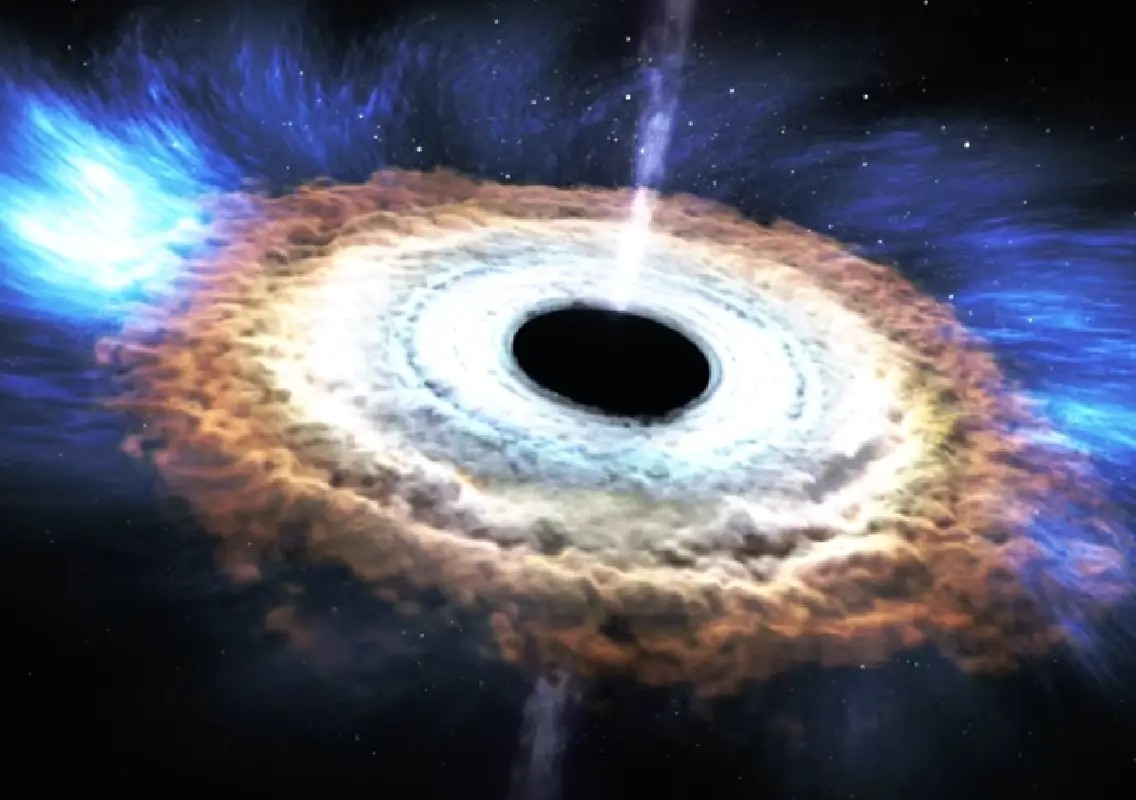


Washington: Astronomers using the James Webb Space Telescope (JWST) have discovered three actively feeding supermassive black holes in a single distant galaxy, offering an extraordinary glimpse into the early universe.
The galaxy, identified as J0148-4214, is more than 12.5 billion light-years from Earth. Its light has travelled for about 12.5 billion years, meaning scientists are observing the galaxy as it appeared when the universe was only around 1.2 billion years old.
Three black holes in one galaxy
Researchers led by the Max Planck Institute for Extraterrestrial Physics identified three black holes that are actively consuming surrounding matter.
Two are located close together near the galaxy’s centre, while a third lies farther away. The two central objects are separated by about 620 light-years, with observations suggesting they could eventually merge. The third black hole is located roughly 5,500 light-years from the centre.
Their estimated masses are also striking. The largest is around 80 million times the mass of the Sun, while the other two are estimated at about 600,000 and two million solar masses.
A window into the young universe
The discovery is significant because it provides the first evidence of three active supermassive black holes existing together in a single galaxy at such an early stage of cosmic history.
Scientists believe interactions and galaxy mergers may have helped these enormous objects grow rapidly. The findings could therefore improve understanding of how supermassive black holes formed and evolved soon after the Big Bang.
The discovery once again demonstrates JWST’s ability to look deep into cosmic history and reveal structures that existed billions of years before Earth took its present form.