







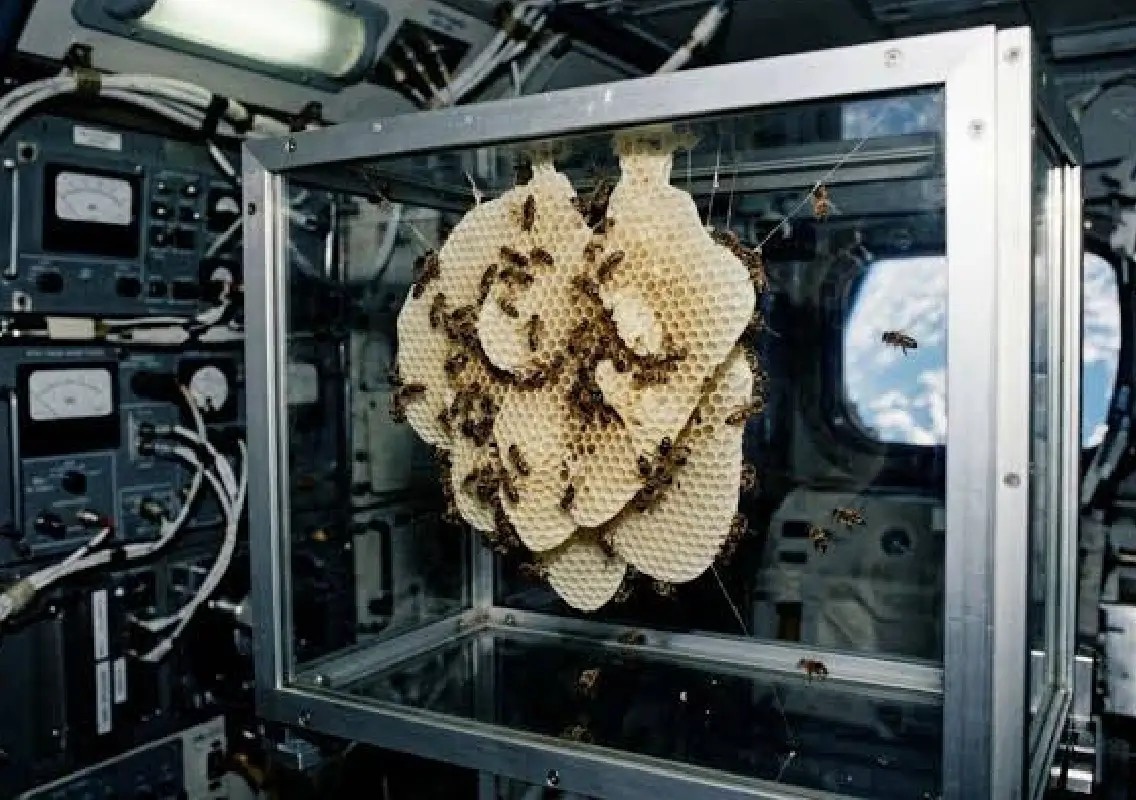


Washington: Thousands of honeybees once became unusual passengers aboard NASA’s space shuttle Discovery as scientists sought to understand how the insects would behave in microgravity.
The 1984 experiment was not about producing honey in space. Instead, researchers wanted to study one of the most important tasks inside a hive — building honeycomb.
Thousands of bees sent into orbit
Around 3,300 to 3,400 honeybees were placed in a specially designed enclosure aboard Discovery.
Scientists were interested in how the insects would construct their familiar six-sided wax cells when gravity could no longer provide the normal cues that help them orient themselves.
An earlier 1982 mission had also carried 14 honeybees and other insects. Those bees struggled to fly in microgravity and tended to cling to surfaces.
The larger 1984 experiment gave researchers an opportunity to observe how a colony adapted over a longer period.
Bees learn to build without gravity
On Earth, honeybees normally construct comb inside a hive, where gravity and contact with other bees help guide their movements.
In space, those familiar signals disappeared. The bees initially built sections of comb at different angles rather than producing the neatly aligned structures commonly seen in terrestrial hives.
As the mission continued, however, the bees adapted to moving in microgravity and began constructing honeycomb both on the provided foundation and elsewhere inside their enclosure.
The colony ultimately produced around 31 square inches of honeycomb.
Queen laid 35 eggs in space
The experiment produced another intriguing observation. The queen bee laid 35 eggs during the mission.
However, the eggs did not hatch after the bees returned to Earth, and the reason was not established.
The experiment therefore demonstrated that bees could maintain several important colony behaviours in microgravity, but it did not establish that a complete bee colony could successfully reproduce in space.
A glimpse of future space farming
The research was also relevant to the possibility of growing food away from Earth.
Honeybees play an important role in pollinating many plants used in agriculture. If humans eventually establish long-term agricultural systems in space, pollinating insects could potentially form part of those systems.
The bees’ ability to build comb, move around and maintain familiar colony routines despite the absence of normal gravity offered scientists an unusual glimpse into how insects might adapt to life beyond Earth.