







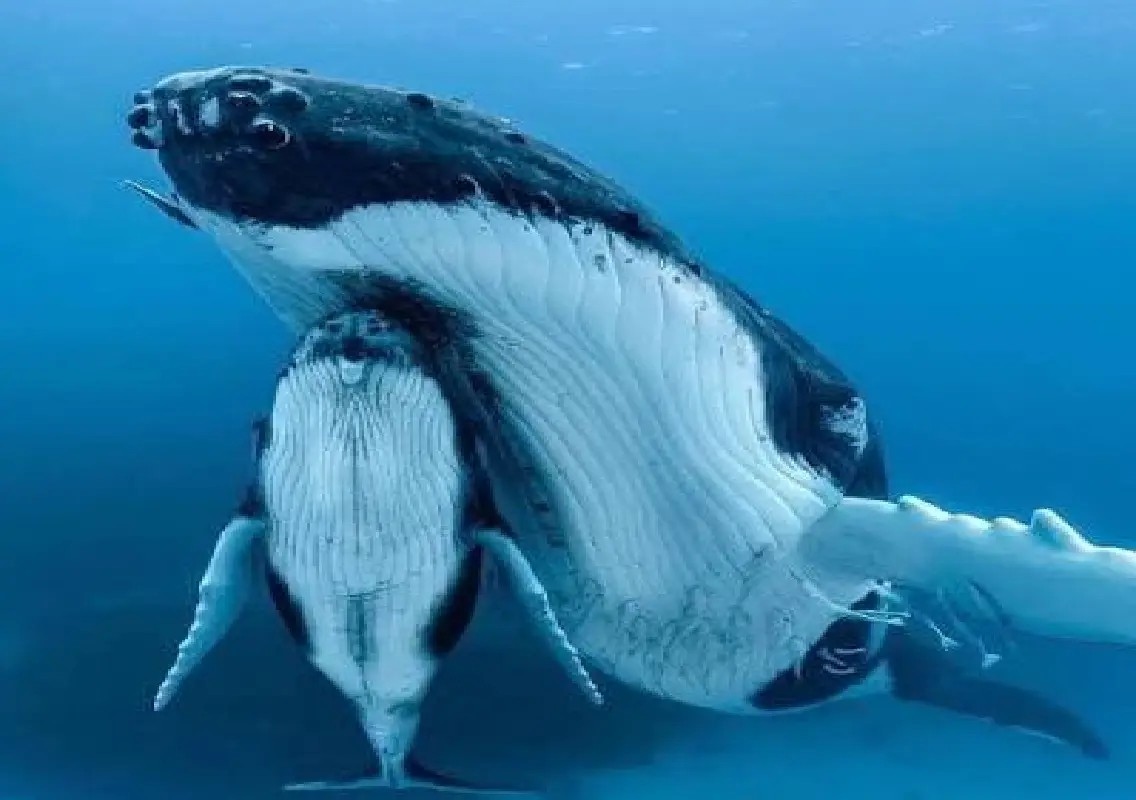


It was a heartbreaking sight off the Australian coast last July. A newborn humpback whale calf lay motionless on the seafloor, while its mother remained nearby, repeatedly returning to her dead young.
The behaviour has drawn scientific attention because researchers are still learning about how whales respond to the death of their offspring and what such encounters may reveal about their social and emotional lives.
A mother that would not leave
The calf was found about a kilometre from the Australian coast. Although it was clear that the newborn had died, its mother stayed in the area and was observed interacting with the body.
Researchers have documented similar behaviour in several whale and dolphin species. Mothers have sometimes been seen carrying, pushing or remaining close to dead calves for extended periods.
Such observations can be deeply moving to people, but scientists caution against automatically interpreting them as evidence of human-like grief.
What happens inside a whale’s mind?
One possibility is that mothers may initially struggle to recognise that their calf is dead. A young calf normally remains closely associated with its mother, and continued physical contact could be part of a response to an unusual situation that the animal does not immediately understand.
Another possibility is that the behaviour reflects a form of attachment or distress. Scientists cannot directly measure an animal’s subjective emotional experience, making it difficult to determine precisely what the mother was feeling.
Researchers therefore study such encounters alongside whale behaviour, biology and social relationships.
A reminder of the mysteries of the ocean
The incident provides another glimpse into the complex lives of humpback whales, whose long migrations and social behaviour continue to fascinate researchers.
While science cannot yet say exactly what the mother experienced, her prolonged presence beside her dead calf highlights the strong bonds that can exist between whale mothers and their young.
The sight also serves as a poignant reminder that much of the emotional and social world of marine mammals remains beyond human understanding.