







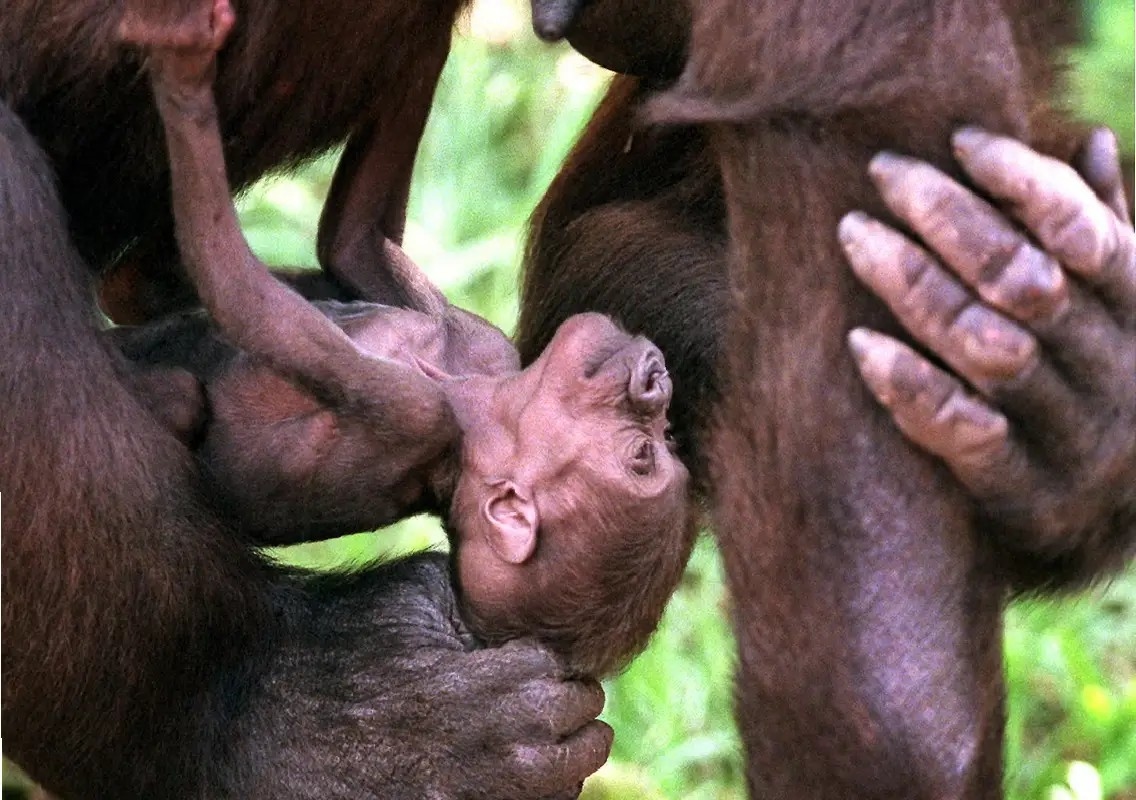


The sight of a chimpanzee mother carrying her dead infant for weeks or even months has long puzzled scientists. A new University of Oxford study suggests that the behaviour may be closely linked to the strength of the mother-infant bond, while the circumstances surrounding the infant’s death may also influence how long the mother continues carrying the body.
A bond that continues after death
Researchers analysed 83 documented cases across 15 sites, finding that carrying lasted from around 30 minutes to as long as 126 days, with an average of about 11 days. Older infants tended to be carried for longer, suggesting that stronger maternal bonds may influence the behaviour.
The study, published in Biology Letters, examined nine possible explanations for differences in carrying duration. Four factors emerged as credible predictors: the cause of death, the age of the infant, maternal investment and temperature.
Why the cause of death matters
The most consistent factor was how the infant died. Infants that died from disease were carried longer than those that died through infanticide.
Researchers suggest that disease-related deaths may be less immediately obvious to the mother than deaths caused by traumatic events. However, this does not establish that chimpanzees understand death in the same way humans do.
Scientists remain cautious
The findings do not prove that chimpanzee mothers understand that death is permanent. Researchers say the behaviour could be explained by the persistence of maternal care combined with social, biological and environmental factors.
The discovery is nevertheless important for understanding the evolution of responses to death. Chimpanzees and bonobos are our closest living relatives, sharing a common ancestor with humans roughly 6–8 million years ago.
The study suggests that sometimes, a powerful maternal bond may continue even after life itself has ended.