







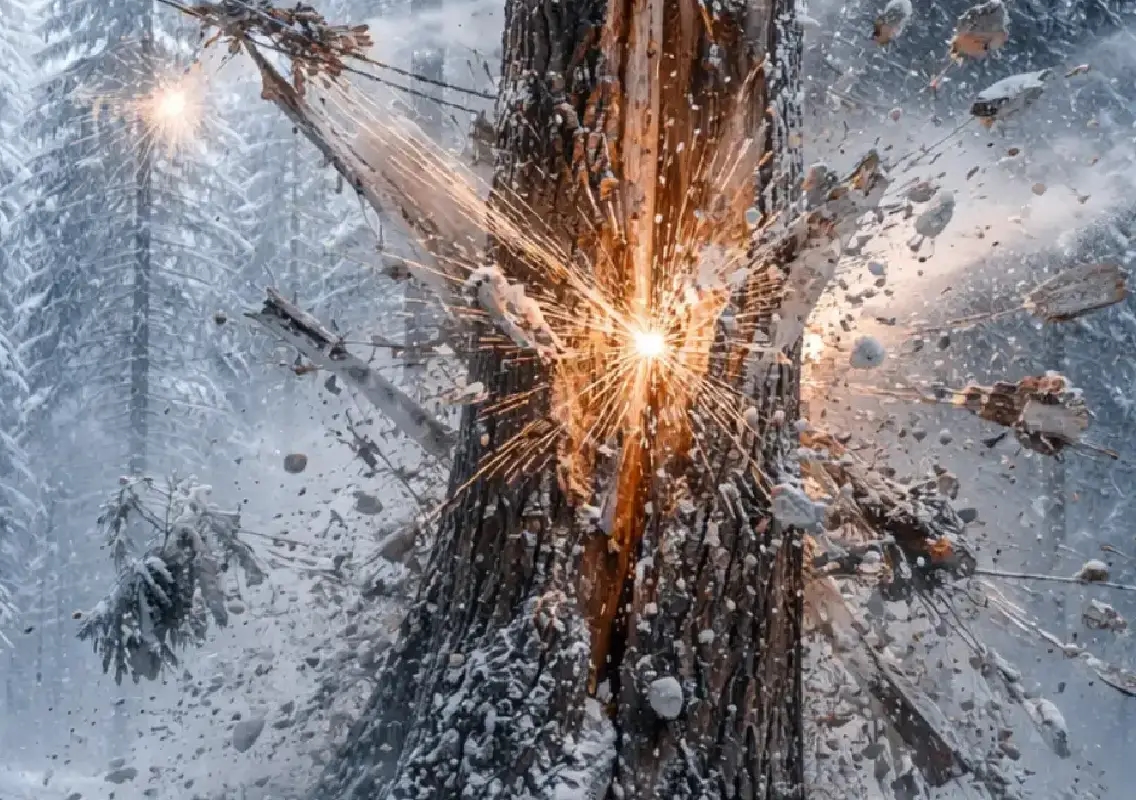


As harsh winter conditions grip parts of the world, videos of trees making loud cracking or banging sounds have gone viral online, with many users claiming that trees are “exploding” in freezing temperatures. Forestry experts, however, say the reality is far less alarming — and far more scientific.
What causes the loud cracking sounds
Experts explain that the phenomenon is known as frost cracking. According to Virginia Tech professor John Seiler, trees are not exploding in the literal sense. Instead, rapid drops in temperature cause water and sap inside the tree to freeze and expand, creating internal pressure.
When the outer bark cools and contracts faster than the inner wood, the uneven stress can cause the wood to split suddenly, producing sharp, gunshot-like sounds. The Wisconsin Department of Natural Resources describes this as “unequal contraction” between layers of the tree.
Loud but usually harmless
While the noise can be startling, experts stress that frost cracks are usually not dangerous. Bill McNee, a forest health specialist with the Wisconsin DNR, notes that dramatic tree damage seen in some viral clips is extremely rare. In most cases, only minor splits or falling branches occur.
Arborist Simon Peacock, speaking to Canadian media, said such cracks often close naturally when temperatures rise. “The break doesn’t harm the tree and will heal when the weather warms,” he explained, though the same crack may reopen in future winters.
Which trees are most vulnerable
Thin-barked trees such as maples, birches and lindens are more prone to frost cracking. According to Eric Otto of the Minnesota Department of Natural Resources, trees that are non-native to colder regions are also at higher risk, as they may not be adapted to extreme temperature swings.
Why most trees survive winter
Trees prepare for winter by shedding much of their internal water and entering a dormant state. They also have thousands of internal vessels, so even if one ruptures, the tree continues to function. Only in rare cases do frost cracks lead to serious long-term damage.
Experts emphasise that while the sounds may be dramatic, they are simply part of how living trees respond to extreme cold — unsettling, brief, and usually nothing to fear.