







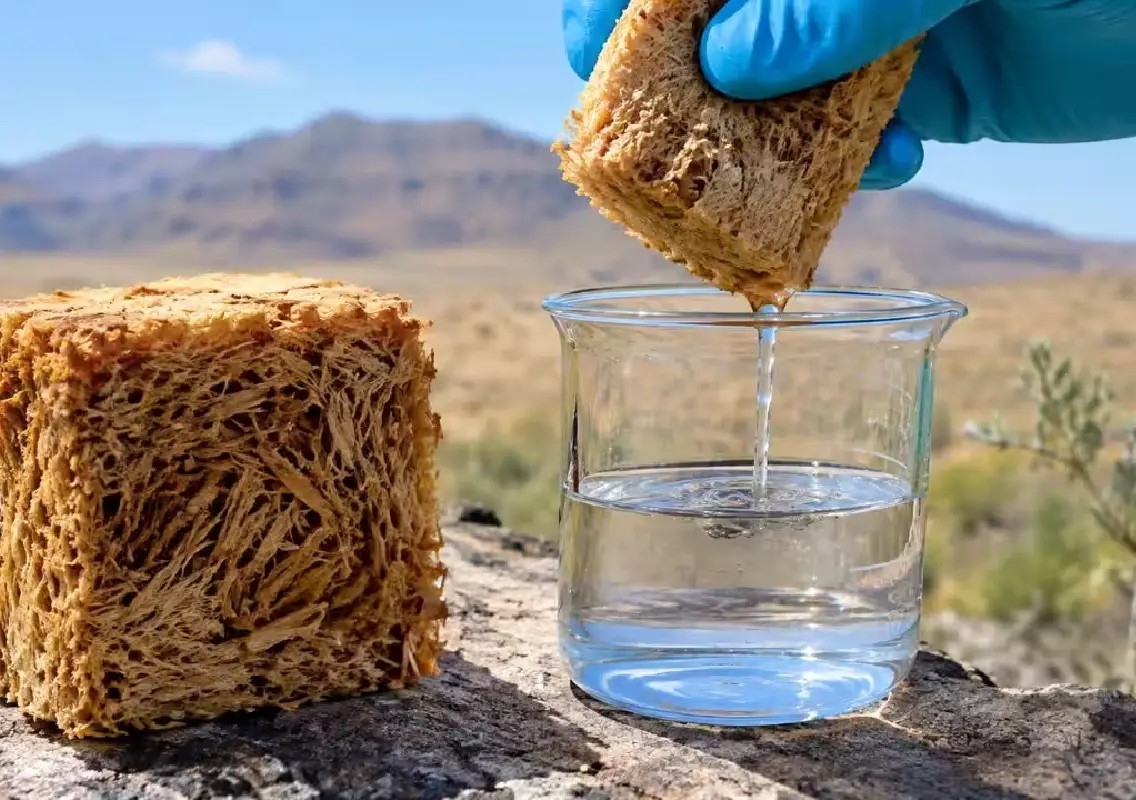


Global : Scientists have developed a wood-based sponge capable of extracting water from extremely dry air, potentially opening a new approach to water harvesting in arid and water-stressed regions. The material was reported to produce up to 1.72 litres of water per kilogram per day, even when relative humidity falls to about 15%.
The development is significant because atmospheric water harvesting is often difficult in dry environments. Conventional systems can require considerable energy or perform poorly when humidity levels are low. The wood-based material offers a potentially simpler route by using the natural structure of wood as the foundation for a highly absorbent sponge.
Turning wood into a water-harvesting material
Wood naturally contains a network of microscopic channels. Scientists have explored ways of modifying these structures to improve their ability to interact with moisture in the atmosphere.
The newly developed sponge uses wood as its base and is engineered to capture water molecules from humid air. Once moisture is collected, it can subsequently be released and gathered as liquid water.
The approach takes advantage of a renewable, naturally occurring material while seeking to overcome one of the biggest challenges in atmospheric water harvesting: extracting meaningful quantities of water when the surrounding air contains very little moisture.
Performance at just 15% humidity
One of the most notable aspects of the research is the material’s reported performance under extremely dry conditions.
At 15% relative humidity, atmospheric water harvesting becomes particularly challenging because the quantity of moisture present in the air is very low. Yet the wood-based sponge was reported to generate as much as 1.72 litres per kilogram per day under suitable conditions.
This performance could be particularly relevant to dry and desert environments, where conventional water sources may be scarce and atmospheric humidity can remain low.
Potential for water-stressed regions
Access to clean water is a growing challenge in many parts of the world. Climate change, population growth, groundwater depletion and prolonged drought can increase pressure on existing water supplies.
Atmospheric water harvesting could provide an additional source of water in locations where conventional infrastructure is difficult or expensive to establish.
A lightweight, wood-based material could potentially be incorporated into decentralised water-generation systems for households, remote communities or emergency applications. However, further development would be required before such technology could be deployed widely.
Energy efficiency remains important
The energy required to collect and release atmospheric water is an important consideration for any water-harvesting technology.
Systems that rely heavily on cooling or mechanical processes can become expensive to operate, particularly in remote areas. Materials that passively absorb moisture and can release it with relatively low energy input could therefore have an advantage.
The wood-based sponge represents an effort to develop materials that can work effectively under challenging atmospheric conditions while potentially reducing the complexity of water collection systems.
From natural material to advanced technology
The research also demonstrates how natural materials can inspire solutions to modern environmental challenges.
Wood is abundant and has a complex porous structure that can be adapted for technological applications. By modifying that structure and introducing water-attracting properties, researchers can transform a familiar material into a device capable of performing a specialised function.
Such research is part of a wider scientific effort to develop sustainable materials for water purification, atmospheric water harvesting and other environmental applications.
A promising step, but more work remains
The reported performance of the wood-based sponge is encouraging, particularly because it operates at humidity levels as low as 15%. Nevertheless, laboratory performance does not automatically translate into large-scale commercial deployment.
Researchers will need to examine factors such as long-term durability, water quality, scalability, material cost and performance under changing environmental conditions.
The technology will also need to demonstrate that it can produce water economically compared with other available sources.
If these challenges can be addressed, wood-based atmospheric water harvesting could become a useful supplementary technology for regions facing severe water shortages.
The research offers a striking example of how scientists are looking beyond traditional water sources. By drawing moisture directly from the atmosphere, even in exceptionally dry conditions, the wood-based sponge could eventually contribute to new strategies for improving water availability in some of the world’s most water-stressed environments.