







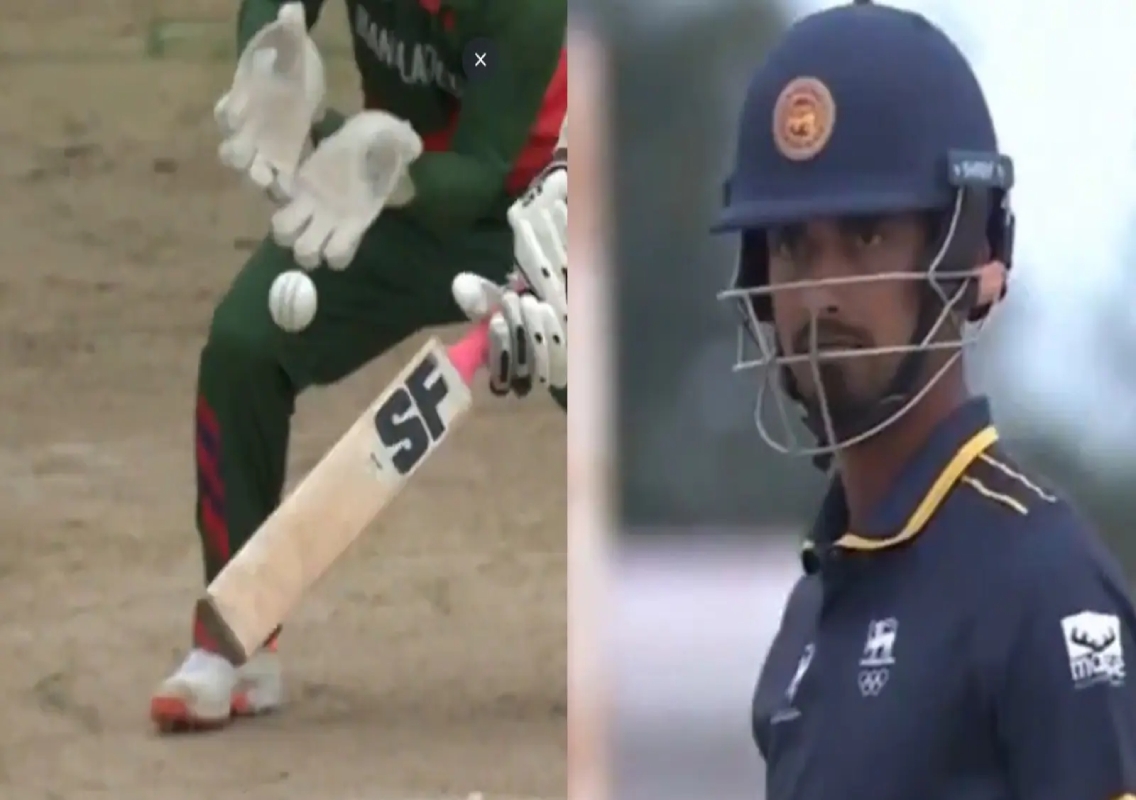


Nisshin: A controversial dismissal in the Asian Games 2026 men’s cricket bronze-medal match between Sri Lanka and Bangladesh sparked debate on Saturday after Sri Lanka batter Nuwanidu Fernando was given out despite television replays appearing to show that he had not edged the delivery.
The incident took place during Sri Lanka’s innings at Korogi Sports Park in Nisshin, Japan, where Sri Lanka were playing Bangladesh for the bronze medal after losing their respective semi-finals.
Sri Lanka eventually posted 165/9 in 20 overs, with Tharindu Ratnayake top-scoring with 65. Bangladesh’s bowlers Mahedi Hasan, Saif Hassan and Mustafizur Rahman took three wickets each.
Nuwanidu Fernando dismissal causes controversy
The contentious moment came in the fourth over of Sri Lanka’s innings.
Bangladesh spinner Aliss Al Islam appeared to induce an edge from Fernando, with wicketkeeper Litton Das completing the catch behind the stumps. The umpire immediately raised his finger, prompting Bangladesh players to celebrate the wicket.
Fernando, however, appeared to have made no contact with the ball.
Television replays subsequently showed a visible gap between the bat and the delivery as it passed the batter. The footage suggested that the ball had travelled directly through to the wicketkeeper rather than taking an edge from Fernando’s bat.
Because the match was being played without the Decision Review System (DRS), Fernando had no opportunity to challenge the on-field decision.
The batter was therefore required to leave the field despite the subsequent replay appearing to raise significant questions about the dismissal.
DRS unavailable at Asian Games venue
The absence of DRS became a major talking point following the incident.
The Asian Games cricket tournament is being played in Japan, where cricket infrastructure is still developing. The Korogi Sports Park venue does not have DRS facilities, meaning umpires’ on-field decisions cannot be reviewed through the technology normally available in major international cricket competitions.
In matches where DRS is available, a batter or fielding side can request a review of certain decisions. Ball-tracking and other replay technology can then assist the third umpire in determining whether an edge was made, whether a batter was trapped leg before wicket or whether other dismissals were valid.
Without the system, an on-field decision remains final unless the umpires themselves are able to correct it under the applicable playing conditions.
The Fernando incident therefore highlighted the difference in technological support between the Asian Games competition and top-level international cricket.
Sri Lanka post 165/9
Despite the early controversy, Sri Lanka continued their innings and reached 165/9 from their allotted 20 overs.
Ratnayake provided the major contribution with the bat, scoring 65 runs. His innings helped Sri Lanka recover and build a competitive total after the side lost wickets during the middle stages.
For Bangladesh, Mahedi Hasan, Saif Hassan and Mustafizur Rahman finished with three wickets each. Their combined bowling effort restricted Sri Lanka from posting an even larger total.
The bronze-medal match was being played after Sri Lanka suffered a heavy defeat against India in the second semi-final.
India had defeated Sri Lanka in semi-final
Sri Lanka entered the bronze-medal match after losing to defending champions India in the semi-final on October 1.
India scored 169/7 in 20 overs, with Ishan Kishan remaining unbeaten on 80 from 46 balls. The left-hander struck five sixes and four fours, while 15-year-old Vaibhav Sooryavanshi contributed 38 from 21 deliveries.
Sri Lanka’s chase then collapsed dramatically. India dismissed the side for just 45 in 9.5 overs, winning the match by 124 runs.
Jasprit Bumrah and Axar Patel claimed two wickets apiece, while Abhishek Sharma also took two wickets. The defeat sent Sri Lanka into the bronze-medal play-off against Bangladesh.
Bangladesh also missed out on final
Bangladesh had been eliminated by Pakistan in the other semi-final.
Their match was affected by weather and reduced to 13 overs per side. Pakistan won by six wickets to book their place in the gold-medal match against India.
The result meant that Bangladesh and Sri Lanka had to contest the third-place match, while India and Pakistan advanced to the final.
India and Pakistan meet for gold
The bronze-medal contest took place on the same day as the much-anticipated men’s cricket final between India and Pakistan at the Asian Games.
India entered the final as the defending champions after winning the men’s cricket gold medal at the 2023 Hangzhou Asian Games. Pakistan were looking to secure their first men’s Asian Games cricket gold medal.
The final was also scheduled at Korogi Sports Park, making the venue the centre of attention for both medal matches on Saturday.
Technology remains a talking point
The disputed Fernando dismissal has once again highlighted the importance of review technology in modern cricket.
While DRS has become an established feature of major international matches, its availability depends on the tournament, venue, equipment and playing conditions. The Asian Games cricket competition is being conducted in a setting where such technology is not available at the venue.
For Sri Lanka, the incident was particularly significant because Fernando’s dismissal occurred early in the innings and the replay appeared to contradict the original on-field decision.
The episode also demonstrated why television coverage can generate additional debate even when players and teams have no formal mechanism to request a review.
As cricket continues to expand in countries where the sport is still developing, the availability of advanced officiating technology is likely to remain an important consideration for organisers and participating teams.