


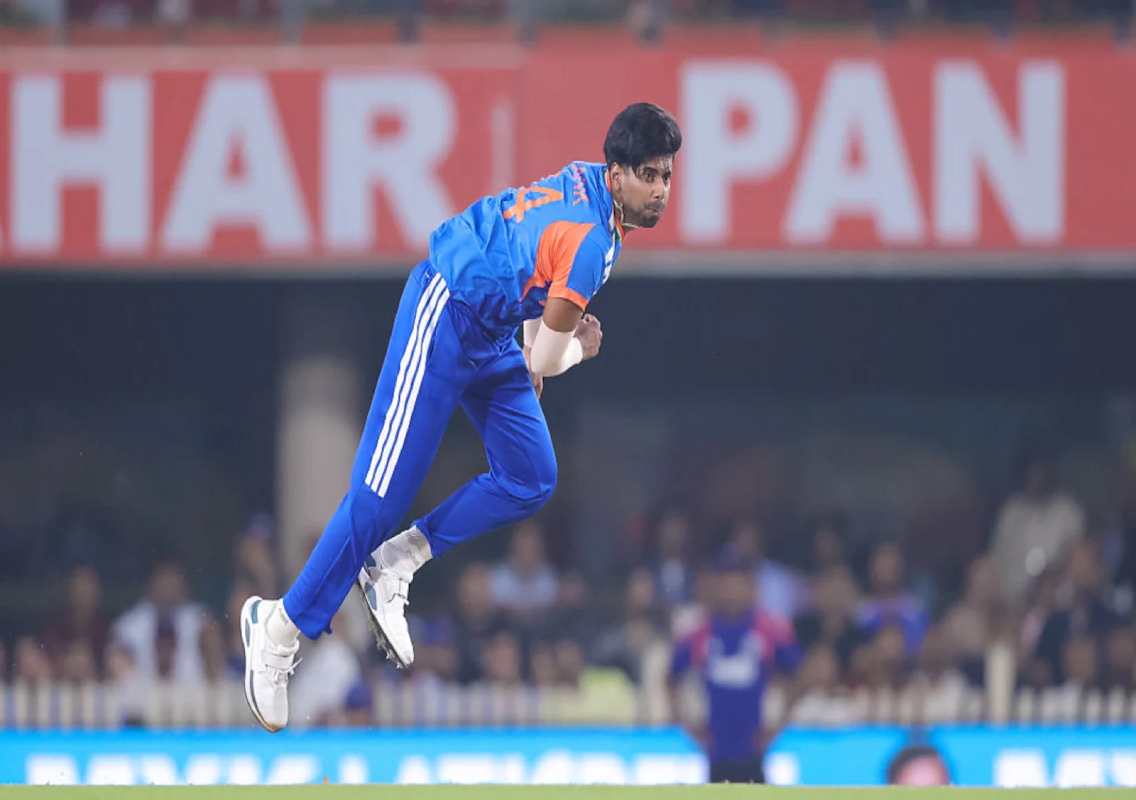


Young Indian fast bowler Mayank Yadav has been advised to complement his express pace with accuracy, control and effective execution of bowling plans ahead of India’s T20I series against New Zealand, beginning on October 22, 2026. Former India bowling coach Bharat Arun believes that pace can become a major weapon only when a bowler consistently executes the right plans.
Mayank, who has clocked a speed of 156.7 kmph during his career, has emerged as an option for India in the shortest format as the team manages Jasprit Bumrah’s workload ahead of the 2027 ODI World Cup.
The young pacer has taken nine wickets in six matches against Zimbabwe and the West Indies, bowling a total of 22 overs. One of his notable performances came in Ranchi, where he returned figures of 3-36.
Speaking to IANS during a virtual interaction facilitated by Sony Sports Network, Arun said Mayank’s speed was an asset but stressed that direction and execution would be equally important as he prepares to bowl in unfamiliar conditions in New Zealand.
Bharat Arun explains what Mayank Yadav must improve
Arun, who worked with Mayank at Lucknow Super Giants during IPL 2026, said he was pleased to see the young fast bowler operating at a good pace against the West Indies. However, he cautioned against placing too much emphasis on speed alone.
According to Arun, Mayank needs to focus on where he bowls and how effectively he carries out his plans. He acknowledged that relatively few bowlers can generate the kind of pace Mayank does, but said consistency in execution would determine how dangerous he becomes.
Arun also pointed out that failure is part of sport. What matters is a bowler’s ability to execute his intended plans successfully more often than not.
For Mayank, the challenge will be to combine his natural speed with control and the ability to deliver the right lengths. Doing so could make his pace significantly more effective against international batters.
Mayank’s performance against the West Indies
Mayank’s recent performances have strengthened his case as a fast-bowling option for India. In the Ranchi match, he dismissed Nicholas Pooran and Shimron Hetmyer with short deliveries before bowling Rovman Powell with a delivery clocked at 149.5 kmph.
The performance demonstrated his ability to use short-pitched bowling and high speed to trouble batters. However, the upcoming New Zealand series will present a different challenge, as Mayank has not played competitive cricket in the country.
Arun’s advice highlights the importance of adapting his approach to the conditions rather than relying exclusively on pace. Maintaining accuracy and varying his deliveries could be crucial against batters who are quick to identify a bowler’s strengths.
New Zealand conditions pose a challenge for Indian bowlers
Arun said Indian fast bowlers would need to adjust to New Zealand’s conditions, including the possibility of swing, the direction of the wind and the dimensions of individual grounds.
He explained that conditions in New Zealand differ from those in India and South Africa. While the white ball may swing for a limited period, bowlers cannot depend on movement alone to succeed in limited-overs cricket.
Arun noted that the ball may swing for four or five overs at most in New Zealand’s white-ball matches, compared with the shorter period of movement generally seen in India.
He believes variations will play a decisive role in both T20 and one-day cricket. Batters can assess a bowler’s strengths quickly and adjust their approach accordingly, making surprise deliveries and changes of pace important tools.
For Mayank and the rest of India’s bowling attack, the ability to adapt and introduce different options could prove as important as generating high speeds.
Bharat Arun backs Bhuvneshwar Kumar’s return
Arun also welcomed veteran pacer Bhuvneshwar Kumar’s return to the T20I team after an absence of around four years. He believes Bhuvneshwar’s current form, ability to move the ball and international experience could benefit India.
The former bowling coach said the right-arm pacer could also share his knowledge of New Zealand conditions with the younger members of the bowling attack, helping them prepare their strategies for the series.
Arun dismissed age and the length of Bhuvneshwar’s international absence as decisive concerns, arguing that selection should depend on whether a player is performing well and can deliver for the team.
He expressed confidence in Bhuvneshwar’s ability to continue playing at the international level over the next couple of years, pointing to his recent form and bowling skills. Arun also suggested that conditions in South Africa could suit the experienced pacer.
Mohammed Siraj urged to regain his bowling rhythm
Arun also discussed Mohammed Siraj’s recent struggles to rediscover his best form following the Test series in Sri Lanka. Siraj had taken a rare two-month break from cricket before that series.
Arun said temporary dips in form are common among both batters and bowlers. He added that returning after an extended break can take time, as small issues may affect a player’s performance.
While acknowledging that he did not know the details of Siraj’s workload or training programme during the break, Arun expressed confidence that the experienced fast bowler could return to form.
He identified rhythm as one of Siraj’s greatest strengths and said working with his coach to regain it would be important to restoring his previous level of performance.
New Zealand’s pace attack could test India
Arun described New Zealand as one of the most competitive teams in world cricket and warned that playing the side in its home conditions would be difficult for India.
New Zealand’s selection of a pace-heavy squad for the T20I series suggests that fast bowling could play a significant role. Arun said the conditions and the possibility of extra grass on the pitches could offer assistance to the pacers.
He also referred to the use of short and back-of-a-length deliveries as a possible approach against Indian batters, following England’s success with that strategy in a T20I series.
Arun stressed that India’s team management would need to consider the conditions carefully. If the Indian side could practise on surfaces resembling those expected during the matches, it would help the team prepare more effectively.
Hardik Pandya’s absence and India A’s preparations
Arun expressed disappointment over Hardik Pandya’s prolonged absence as the all-rounder continues to face setbacks in his return to action. He described Pandya as a high-quality all-rounder whose absence would be felt by the team, while acknowledging that India would have to work with the players available.
Preparations for India’s future Test assignments will also include an India A tour of New Zealand, led by Dhruv Jurel, featuring three red-ball matches. The tour is intended to help players become familiar with local conditions before the Test matches in Wellington and Christchurch.
The group includes Akash Deep, Mukesh Kumar, Auqib Nabi, Washington Sundar and Manav Suthar.
Arun also addressed concerns about the India A tour overlapping with the first phase of the Ranji Trophy, which could leave state teams without some of their leading Test players.
He argued that sending players overseas before major international series had helped Indian cricket in the past by allowing them to acclimatise to unfamiliar conditions. He added that the absence of some established players could create opportunities for other cricketers to feature in domestic competitions.
According to Arun, the growing depth of Indian cricket means such tours can benefit the national team while also providing opportunities for emerging players.
As India prepares for the New Zealand T20I series, Mayank’s ability to combine his exceptional speed with accuracy and tactical variation will be an important area to watch.