


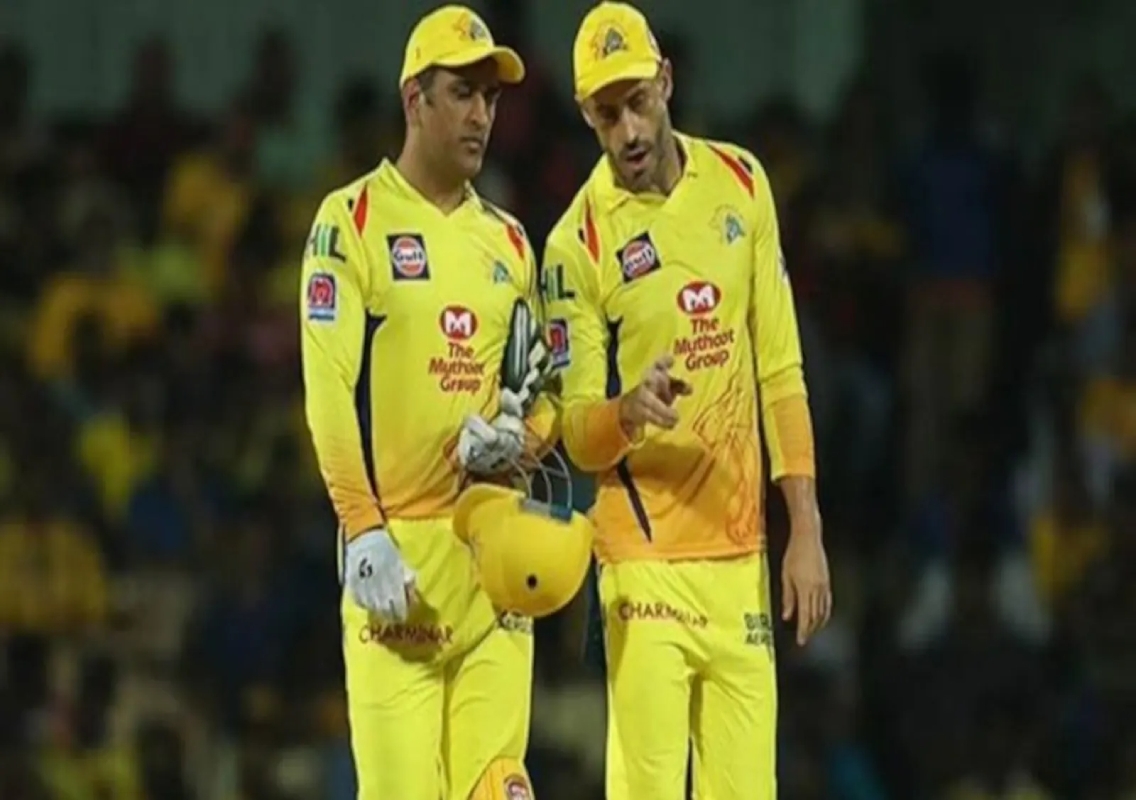


Chennai: Former South Africa captain Faf du Plessis has revealed what he considers the biggest leadership strength of legendary Indian cricketer MS Dhoni, saying the former India captain’s ability to read a match instinctively while remaining calm under pressure is something he wants to learn from.
Du Plessis, who spent several seasons playing alongside Dhoni at Chennai Super Kings (CSK) in the Indian Premier League (IPL), shared his observations during an appearance on the Prakhar Gupta Podcast. He explained that Dhoni’s strength lies not simply in preparing detailed plans before a match, but in understanding situations as they unfold and making decisions based on what he sees on the field.
The former South African skipper’s comments offer insight into the leadership approach of Dhoni, widely known by the nickname ‘Captain Cool’. His ability to remain composed during tense situations, assess opposition players and make timely tactical adjustments has been a defining feature of his captaincy.
Dhoni’s instinctive approach sets him apart
According to du Plessis, Dhoni does not depend excessively on plans made before a match. Instead, he trusts his understanding of the game and reacts to developments on the field.
Du Plessis highlighted Dhoni’s ability to read both the match situation and the players involved, describing this instinctive approach as his former teammate’s biggest strength.
He explained that Dhoni could remain calm while assessing changing circumstances and make decisions based on what was happening in front of him. This combination of cricketing awareness and composure, du Plessis believes, is a quality worth learning from.
For a captain, the ability to adapt is particularly important in limited-overs cricket, where a single over, a change in bowling or a sudden partnership can alter the direction of a match. A rigid strategy may not always work when the opposition changes its approach.
Dhoni’s style demonstrates the value of recognising such changes and responding without allowing pressure to dictate decisions. Du Plessis said he wants to incorporate this quality into his own captaincy.
‘Captain Cool’ and the importance of staying calm
Dhoni’s composure has long been associated with his leadership. Whether managing a close finish, setting fields against an aggressive batter or deciding when to introduce a particular bowler, he has earned a reputation for maintaining a measured approach.
Du Plessis’ observations suggest that this calmness is closely connected to Dhoni’s tactical awareness. Remaining composed can allow a captain to assess options more clearly instead of reacting impulsively to a setback.
It can also influence the rest of the team. Bowlers operating under pressure may benefit from a captain who communicates clearly, backs decisions and adjusts plans without creating panic.
Dhoni’s leadership with CSK provided du Plessis with an opportunity to observe these qualities at close quarters. Their time together helped the South African understand how a captain can combine preparation with the flexibility to respond to circumstances during a match.
The lesson, as du Plessis described it, is not simply to imitate Dhoni’s mannerisms. It is to develop the ability to understand the game, trust judgement and remain composed when the stakes are high.
Du Plessis’ experience with Chennai Super Kings
Du Plessis joined CSK early in his IPL career and spent several seasons with the franchise before moving to Royal Challengers Bengaluru in 2022. During his time with the Chennai-based side, he experienced Dhoni’s leadership and was part of a successful team environment.
The former South Africa captain played 154 IPL matches and scored 4,773 runs. His experience across international cricket and the IPL has given him opportunities to work with different leadership styles and assess what makes a captain effective.
Playing under Dhoni allowed him to see how decisions were made beyond the public view of a match. Rather than focusing only on results, du Plessis observed the thinking behind tactical choices and the way the former India captain handled changing situations.
Those lessons are relevant to captains at every level. Leadership styles differ, and what works for one individual may not necessarily work for another. However, the ability to learn from experienced leaders and adapt useful qualities to one’s own approach can help a captain develop.
Du Plessis’ remarks underline that distinction: Dhoni’s influence lies not in providing a formula that every captain must copy, but in demonstrating how awareness, calmness and instinct can work together.
Dhoni’s cricketing brain remains a major asset
Dhoni’s impact on cricket extends beyond his achievements as a wicketkeeper-batter. His reading of the game, understanding of opposition batters and tactical decisions have frequently been discussed by former teammates and cricket experts.
His instinctive approach does not mean that planning has no place in his method. Rather, du Plessis’ comments indicate that Dhoni values the ability to adjust plans according to developments during a match.
In T20 cricket, where captains have limited time to respond to changing conditions, such judgement can be particularly valuable. Decisions involving bowling changes, field placements and match-ups often need to be made quickly, with the captain balancing statistical information against what is happening on the ground.
Du Plessis’ admiration reflects the value he places on that combination of experience and instinct. He wants to take the lesson forward in his own leadership rather than attempt to reproduce Dhoni’s entire style.
Du Plessis also recalls Steve Smith controversy
The report also referred to du Plessis’ recollection of the 2018 ball-tampering controversy involving former Australia captain Steve Smith during the Test series against South Africa.
Du Plessis said he empathised with Smith when the Australian accepted responsibility following the incident in Cape Town. The episode had prompted widespread criticism and significant disciplinary consequences for members of the Australian team.
Smith received a one-Test suspension from the International Cricket Council, while Cricket Australia imposed a 12-month suspension on Smith and David Warner. Cameron Bancroft received a nine-month suspension.
Du Plessis’ recollection showed how his own experiences as an international captain shaped his understanding of the pressures faced by leaders. However, his principal message about Dhoni remained focused on cricketing instinct, composure and the ability to make decisions as a match develops.
A lesson in leadership beyond cricket
Du Plessis’ assessment of Dhoni highlights a broader principle of leadership: preparation is important, but the ability to respond intelligently when circumstances change can be just as valuable.
Dhoni’s approach has given teammates an opportunity to observe how calm decision-making and a strong understanding of people can influence performance. For du Plessis, the former India captain’s instinctive reading of a match is the quality he most wants to carry into his own leadership.
His comments add to the recognition Dhoni has received from former teammates who have worked closely with him. They also reinforce why the former India captain continues to be discussed as a significant influence on leadership in modern cricket.