







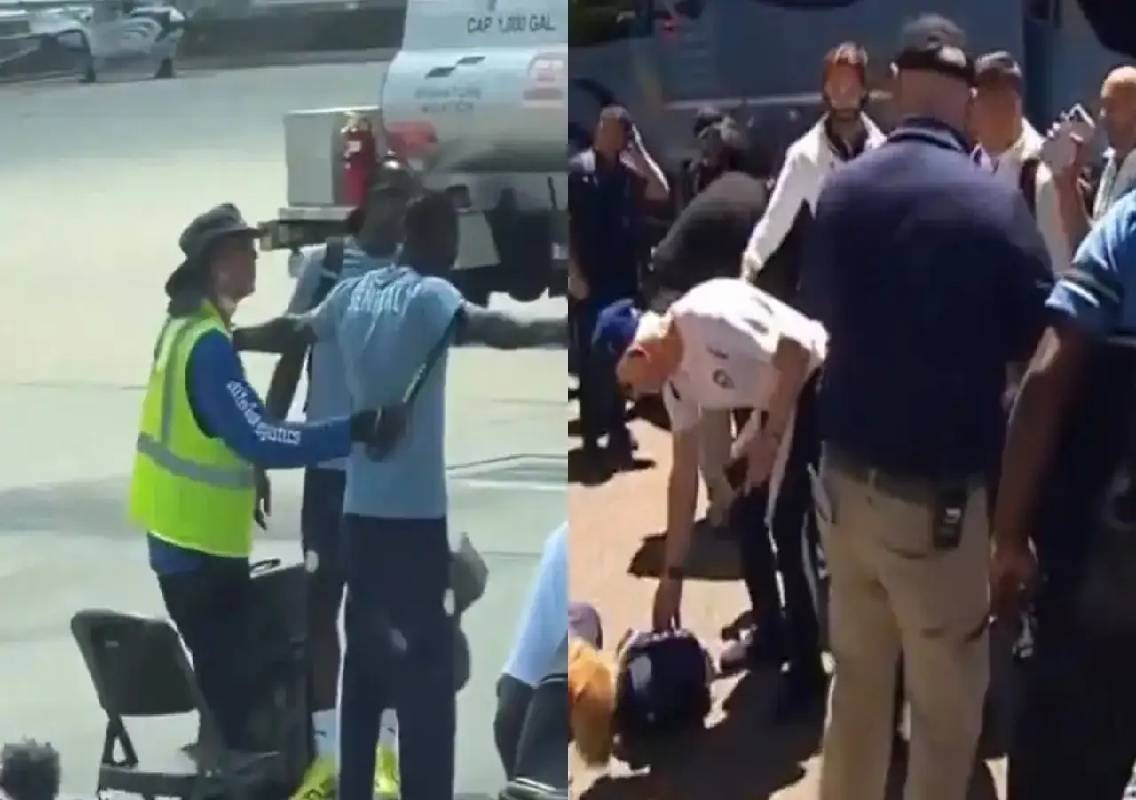


New York: Fresh controversy has emerged ahead of the 2026 FIFA World Cup after players from Senegal and Uzbekistan were reportedly subjected to stringent security checks in the United States, triggering criticism from fans and observers who questioned the treatment of visiting athletes.
The incident comes just days before the start of the 2026 FIFA World Cup, which is being jointly hosted by the United States, Mexico and Canada. Images circulating on social media appeared to show Senegalese players undergoing detailed inspections upon arrival in the United States, while members of Uzbekistan’s squad reportedly faced extensive checks before entering a training venue in New York.
Security procedures spark backlash
According to reports and visuals shared online, Senegal’s players were subjected to thorough screening procedures on the airport tarmac after landing in the country. Their luggage was also reportedly inspected in detail by security personnel.
Meanwhile, members of Uzbekistan’s national football team allegedly underwent strict security checks before entering the Icahn Stadium in New York City. Reports suggested that security personnel, along with detection dogs, were involved in the screening process.
The images quickly attracted widespread attention on social media platforms, where many football fans expressed concern over the manner in which the players were treated. Critics argued that athletes arriving to participate in one of the world’s biggest sporting events should be welcomed in a manner that reflects the spirit of international competition.
Several users questioned whether similar procedures were being applied uniformly to all participating teams, while others described the searches as excessive and unnecessary.
Growing concerns before tournament kick-off
The latest controversy adds to a series of challenges that have emerged ahead of the World Cup. With millions of fans expected to travel across North America during the tournament, concerns regarding visa approvals, entry requirements and border procedures have become a recurring topic of discussion.
Observers have pointed out that international sporting events often require special coordination between governments, organisers and participating teams to ensure smooth travel and movement for players, officials and supporters.
As the tournament approaches, scrutiny has intensified over how different national teams and football delegations are being treated upon arrival. Critics argue that any perception of unequal treatment could affect the image of the competition and create unnecessary distractions for players preparing for crucial matches.
Visa and travel issues also draw attention
Beyond the recent security checks, several other incidents have reportedly raised concerns among participating nations.
Reports indicate that fans and media representatives from some African and Asian countries have experienced difficulties in obtaining visas. In certain cases, travellers reportedly received only single-entry visas despite needing to move between multiple host nations during the tournament.
Another case that attracted attention involved Omar Artan, a highly regarded referee from Somalia. Reports suggested that despite possessing valid travel documentation and being included in FIFA’s panel of match officials, he was unable to enter the United States and subsequently returned home.
Similarly, Iraq’s team photographer Talal Salah was reportedly denied entry, while Iraqi forward Aymen Hussein was said to have been detained and questioned for several hours after arrival.
These developments have fuelled debate about whether existing immigration and security procedures are compatible with the demands of a global sporting event involving teams and supporters from every continent.
FIFA faces pressure for response
The spotlight is now on FIFA, which has so far not publicly addressed the specific allegations surrounding the treatment of the Senegal and Uzbekistan squads.
Football supporters and analysts have called on the governing body to ensure that all participating teams receive equal treatment and are able to focus on their sporting commitments without unnecessary disruptions.
With the opening match approaching, organisers will be keen to shift attention back to the football itself. However, the latest controversy highlights the logistical and diplomatic challenges that accompany a tournament of this scale.
Conclusion
As the 2026 FIFA World Cup gets underway, the treatment of players, officials and supporters remains under close scrutiny. While security remains a priority for host nations, critics argue that procedures must be implemented in a manner that respects the dignity of international athletes and preserves the inclusive spirit of the world’s biggest football tournament.