







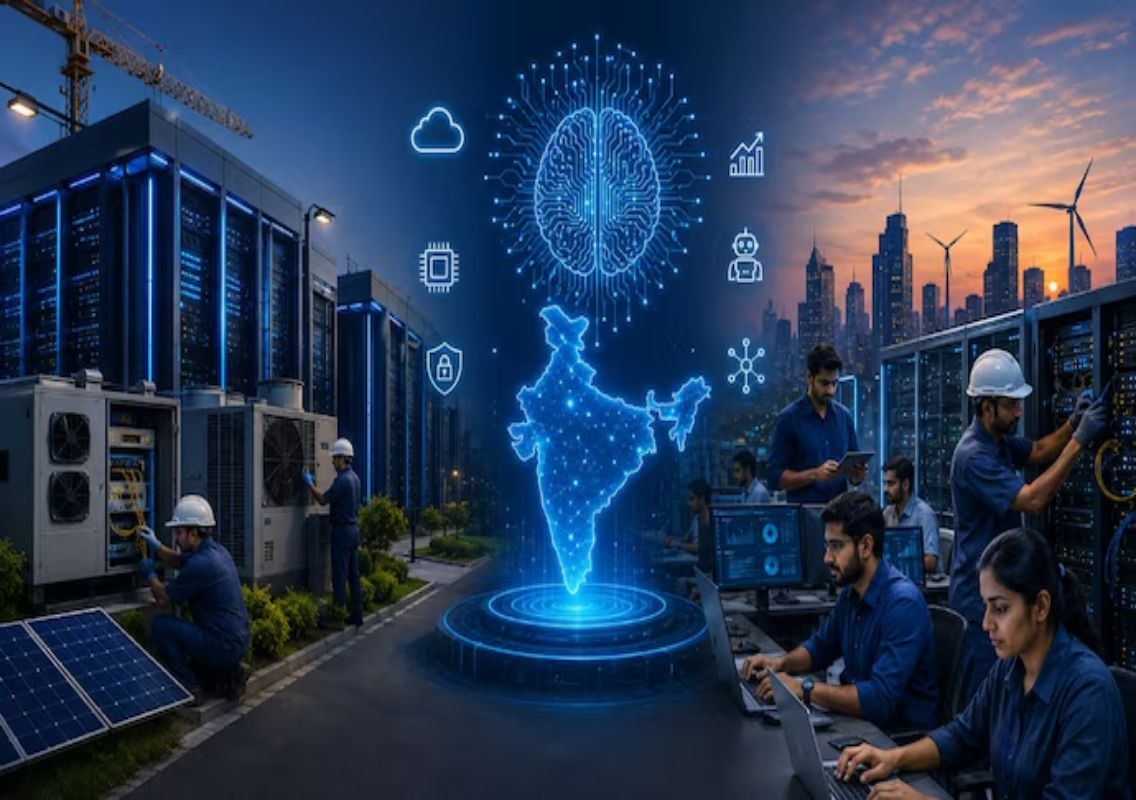


New Delhi: India is witnessing a rapid surge in investments in data centres and artificial intelligence (AI) infrastructure, a trend that experts believe could trigger the next major technology and employment boom in the country. Backed by policy support, private investments, and rising digital demand, India is positioning itself as a key global hub for next-generation computing infrastructure.
The transformation marks a shift from traditional infrastructure such as roads and factories to high-tech facilities filled with servers, GPUs, fibre networks, and advanced cooling systems that power the digital economy.
Rapid growth in data centre capacity
India’s data centre capacity has expanded significantly over the past five years. According to the Ministry of Electronics and Information Technology, capacity has increased from 375 megawatts (MW) in 2020 to over 1,500 MW in 2025.
This growth is expected to accelerate further. Investment firm Morgan Stanley estimates that India’s data centre capacity could increase nearly six times to 10.5 gigawatts (GW) by 2031, reflecting the scale of demand driven by digital services and AI adoption.
The expansion highlights a fundamental shift in how data infrastructure is viewed — from a back-end utility to a core pillar of economic growth.
Data localisation and policy push
One of the key drivers behind the data centre boom is India’s push for data localisation. Policies such as the Digital Personal Data Protection (DPDP) Act require companies to store Indian user data within the country, reducing reliance on overseas servers.
Regulatory measures from institutions like the Reserve Bank of India (RBI) and the Securities and Exchange Board of India (SEBI) have further reinforced this trend by mandating local storage for sensitive financial and user data.
The government has also introduced incentives to attract global investment. The Union Budget 2026–27 announced a 20-year tax holiday for foreign cloud service providers operating from Indian data centres, a move expected to significantly boost capital inflows into the sector.
AI driving infrastructure demand
Beyond regulation, the rapid adoption of AI is fuelling unprecedented demand for high-performance computing infrastructure. AI systems require powerful GPUs, large-scale data processing capabilities, and specialised cooling technologies, which traditional IT setups cannot support.
Experts note that AI is accelerating the need for advanced infrastructure across industries, from finance and healthcare to manufacturing and governance. The rise of Indian-language AI models is also increasing the need for local computing capacity to train and deploy such systems effectively.
Industry leaders point out that while cloud computing laid the foundation, AI is now acting as the catalyst for large-scale expansion.
Major investments from industry leaders
The data centre boom has attracted substantial investments from both Indian conglomerates and global technology giants.
Adani Group has announced plans to invest approximately $100 billion in renewable-powered, AI-ready data centres by 2035. Similarly, Reliance Industries has committed around $120 billion towards building digital and AI infrastructure.
Global companies are also expanding their presence. Google recently initiated work on a large AI hub near Visakhapatnam, supported by AdaniConneX and Nxtra by Airtel.
Meanwhile, Microsoft has announced multi-billion-dollar investments in India, including a major data centre project in Hyderabad. Amazon Web Services has also committed $12.7 billion towards expanding its cloud infrastructure in India by 2030.
These investments signal India’s ambition to evolve from a digital consumer market into a global AI infrastructure powerhouse.
Emerging employment opportunities
The growth of data centres is expected to create a new wave of employment opportunities, similar to the IT services boom of the 1990s and early 2000s.
Unlike traditional software roles, the new ecosystem demands specialised skills such as hyperscale infrastructure management, GPU clustering, cybersecurity, power systems engineering, and advanced cooling technologies.
Globally, companies are already facing shortages of skilled professionals in these areas. In the United States, for instance, there is a growing demand for fibre technicians and data centre engineers.
Experts believe India could soon face a similar talent gap, which in turn will drive demand for training programmes and skill development initiatives. Emerging areas such as digital interconnection, multi-cloud networking, and secure data movement are expected to become critical skill sets in the coming years.
Challenges in scaling infrastructure
Despite the strong growth momentum, industry experts caution that India is still in the early stages of building a robust data centre ecosystem.
Compared to mature markets like the United States, Singapore, and parts of Europe, India remains in what is described as an “infrastructure acceleration phase.” This means that while investments are increasing, several foundational aspects need further development.
Key challenges include strengthening electricity grids, improving fibre connectivity, developing semiconductor supply chains, and ensuring efficient cooling solutions for large-scale facilities.
Policy coordination and long-term planning will also be essential to sustain growth and compete globally.
Conclusion
India’s data centre and AI infrastructure boom represents a significant shift in the country’s economic trajectory. With strong policy backing, massive investments, and growing demand for digital services, the sector is poised to become a major driver of growth and employment.
While challenges remain, the direction is clear. Just as India emerged as a global leader in IT services, it is now positioning itself as a key hub for AI and data infrastructure. If managed effectively, this transformation could define the next phase of India’s digital economy and create millions of new opportunities.