







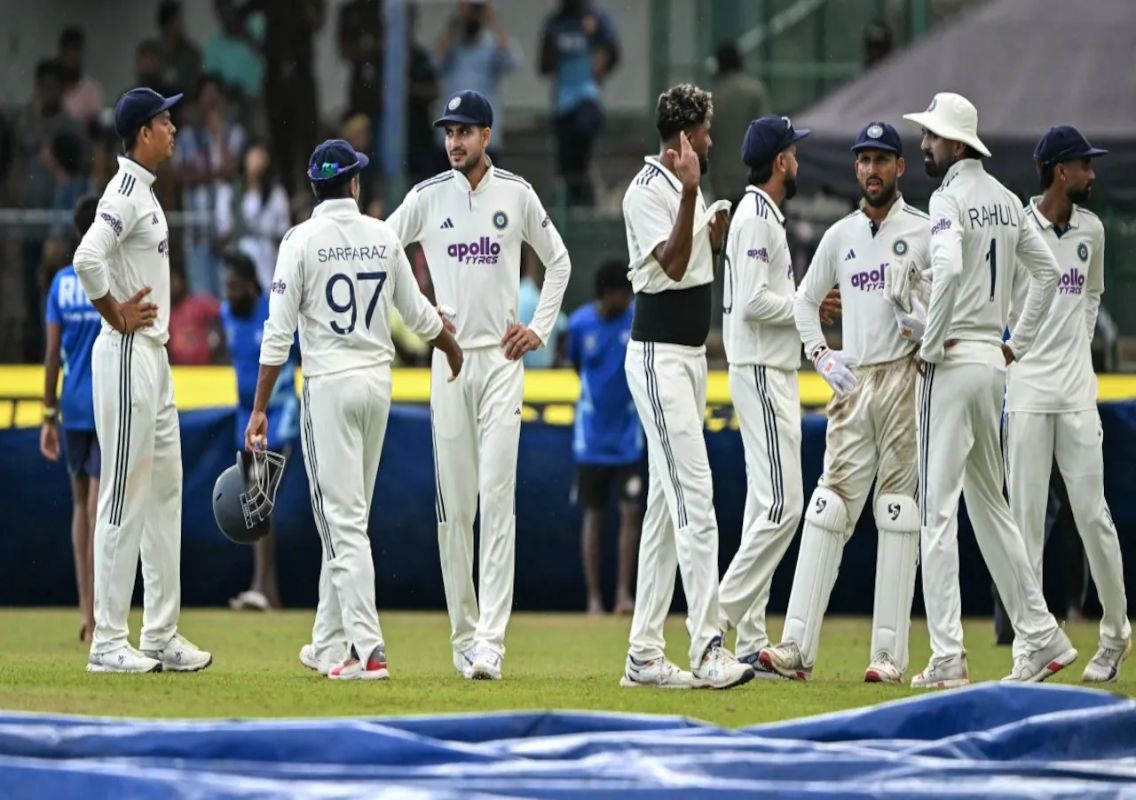


Colombo: India remained in a commanding position against Sri Lanka on Day 3 of the second Test at the Sinhalese Sports Club, but rain threatened to disrupt the visitors’ push for another comprehensive victory. India had declared their first innings at 503/9, leaving Sri Lanka with a huge deficit after the hosts ended Day 2 at 8/2.
The match began with India firmly in control after a dominant batting performance. Dhruv Jurel’s unbeaten 115 was the standout contribution, while Devdutt Padikkal had earlier scored 117. Rishabh Pant added a quick 63, and captain Shubman Gill also contributed a half-century as India built a formidable total.
Sri Lanka’s difficult position became even more apparent when they lost two wickets before the close on Day 2. Lahiru Udara was dismissed for one by Prasidh Krishna, while Manav Suthar removed nightwatchman Prabath Jayasuriya for two. Sri Lanka were left at 8/2, still 495 runs behind India.
India start Day 3 with a huge advantage
India entered the third day with almost complete control of the contest.
After winning the toss and choosing to bat, the visitors produced a massive first-innings score of 503/9 declared. The decision to declare gave India maximum time to bowl Sri Lanka out and potentially force the follow-on.
The size of India’s total was built around contributions from several batters rather than one individual alone.
Devdutt Padikkal scored 117, providing the foundation during the first innings. Jurel then produced one of the most important knocks of the match, remaining unbeaten on 115.
Pant’s 63 added further momentum, while Gill’s half-century ensured India maintained a strong scoring rate.
Jurel’s century was particularly significant because it came from No. 7. He became only the second Indian batter after Hardik Pandya to score a Test century from No. 7 or lower in Sri Lanka. Pandya had scored 108 at Pallekele in 2017.
Dhruv Jurel delivers under pressure
Jurel’s unbeaten century was one of the defining moments of India’s innings.
The wicketkeeper-batter came into the second Test under scrutiny, but responded with a composed performance. His 115 not out provided India with the stability required to push their total beyond 500.
His innings was particularly valuable because India had already lost several wickets by the time he reached the middle order.
Rather than attempting to score aggressively throughout, Jurel constructed his innings carefully and ensured that India’s lower order could contribute around him.
His performance also strengthened India’s depth in the batting department.
Sri Lanka face an enormous deficit
Sri Lanka’s task became extremely difficult even before Day 3 began.
The hosts needed to overcome a 495-run deficit after India’s declaration. Their problems were compounded by the early dismissals of Udara and Jayasuriya.
Kamil Mishara was unbeaten on five at the close of play and had the responsibility of helping Sri Lanka rebuild their first innings.
The immediate objective for the hosts was to survive India’s attack and reduce the deficit.
However, India’s bowling attack had already demonstrated its effectiveness in the series.
Manav Suthar was especially dangerous after his sensational performance in the first Test in Galle, where he claimed a match-winning 10-wicket haul.
Manav Suthar remains a major threat
Suthar’s emergence has been one of the biggest stories of India’s tour.
The left-arm spinner took 10 wickets in the opening Test as India defeated Sri Lanka by 165 runs in Galle.
He then struck again late on Day 2 of the Colombo Test by dismissing Prabath Jayasuriya.
His ability to extract assistance from the surface has given India another potent spin option alongside the experienced Ravindra Jadeja.
With Sri Lanka already under pressure, Suthar’s role could become crucial as the pitch develops.
Rain becomes India’s biggest concern
While India’s position on the field was strong, weather conditions threatened to slow their progress.
Rain had already interrupted play during the second day, and forecasts indicated the possibility of further showers in Colombo on Tuesday.
According to the weather update cited by NDTV Sports, cloudy conditions and showers were expected, with the probability of precipitation forecast at 82 per cent.
For India, lost playing time could become the biggest obstacle.
The visitors need sufficient overs to dismiss Sri Lanka, enforce the follow-on if appropriate and potentially complete another victory.
A rain-affected Test could therefore reduce India’s opportunity to capitalise on their enormous first-innings advantage.
India look to impose the follow-on
With Sri Lanka trailing by 495 runs, India’s immediate objective is to bowl the hosts out for a total substantially below 303.
If Sri Lanka are dismissed for less than India’s first-innings total, India would have the option of enforcing the follow-on.
The decision would depend on the match situation, weather conditions and the condition of the pitch.
A follow-on could allow India to keep Sri Lanka under continuous pressure and avoid giving the hosts an opportunity to recover during a separate fourth innings.
However, with rain threatening the match, India may also need to consider how best to use the available overs.
Kuldeep Yadav’s absence adds another talking point
India made one notable change to their bowling combination for the second Test.
Kuldeep Yadav was unavailable for selection because of an infection, with Saransh Jain making his Test debut in his place.
Captain Shubman Gill confirmed the change before the match.
Saransh’s inclusion gives India another spin-bowling option, while the team also has Jadeja and Suthar available.
The absence of Kuldeep has attracted attention because the spinner was used sparingly in the first Test, prompting former India batter Mohammad Kaif to question whether Gill had enough faith in him.
India carry momentum from Galle
India’s dominant position in Colombo follows their convincing victory in the opening Test.
The visitors defeated Sri Lanka by 165 runs in Galle, with Suthar taking 10 wickets and playing a central role in the win.
That result gave India a 1-0 lead in the two-Test series and strengthened their position in the ongoing World Test Championship campaign.
A second consecutive victory would allow Gill’s side to complete a 2-0 series sweep.
The team has already shown that it can combine strong batting performances with effective spin bowling on Sri Lankan pitches.
Sri Lanka need a major turnaround
For Sri Lanka, the second Test is rapidly becoming a battle for survival.
After being reduced to 8/2, the hosts need a substantial partnership to prevent India from gaining complete control.
Their batters will have to negotiate India’s seamers and spinners for long periods while also attempting to reduce the deficit.
The task is particularly challenging because India can attack with multiple bowling options.
Prasidh Krishna has already taken an early wicket, while Suthar has shown his ability to strike quickly.
Jadeja’s experience adds another layer of pressure for the Sri Lankan middle order.
The significance of India’s 503/9 declaration
India’s decision to declare at 503/9 underlined their confidence.
The visitors could have continued batting to accumulate an even larger total, but doing so would have reduced the amount of time available to take Sri Lankan wickets.
By declaring, India effectively transferred responsibility to their bowlers.
The early breakthroughs justified the decision, with Sri Lanka immediately losing two wickets.
India will now hope that their bowlers can continue making breakthroughs before rain becomes a decisive factor.
What Day 3 could mean for the Test
If India manage to bowl Sri Lanka out quickly, the match could move towards a result well before the scheduled final day.
A follow-on would increase the pressure on the hosts and potentially give India a route to another innings victory.
However, interruptions could change the equation.
Every lost session reduces the number of overs available to India and increases the possibility that Sri Lanka can survive long enough to force a draw.
That makes the weather forecast almost as important as the cricket on Day 3.
Conclusion
India remain firmly in command of the second Test in Colombo after declaring at 503/9 and reducing Sri Lanka to 8/2 by the end of Day 2.
Dhruv Jurel’s unbeaten 115, Devdutt Padikkal’s 117, Rishabh Pant’s 63 and Shubman Gill’s half-century helped India establish a massive advantage.
Sri Lanka began Day 3 495 runs behind, with Kamil Mishara at the crease after early wickets for Prasidh Krishna and Manav Suthar.
India’s biggest challenge now is not the size of their advantage but the amount of playing time available. With rain forecast in Colombo, Gill’s side will want to make the most of every over and press for a result.
If the weather stays away, India have an excellent opportunity to enforce the follow-on and move towards a series-clinching victory. If rain continues to interrupt play, however, Sri Lanka could gain valuable time and keep their hopes of saving the Test alive.