







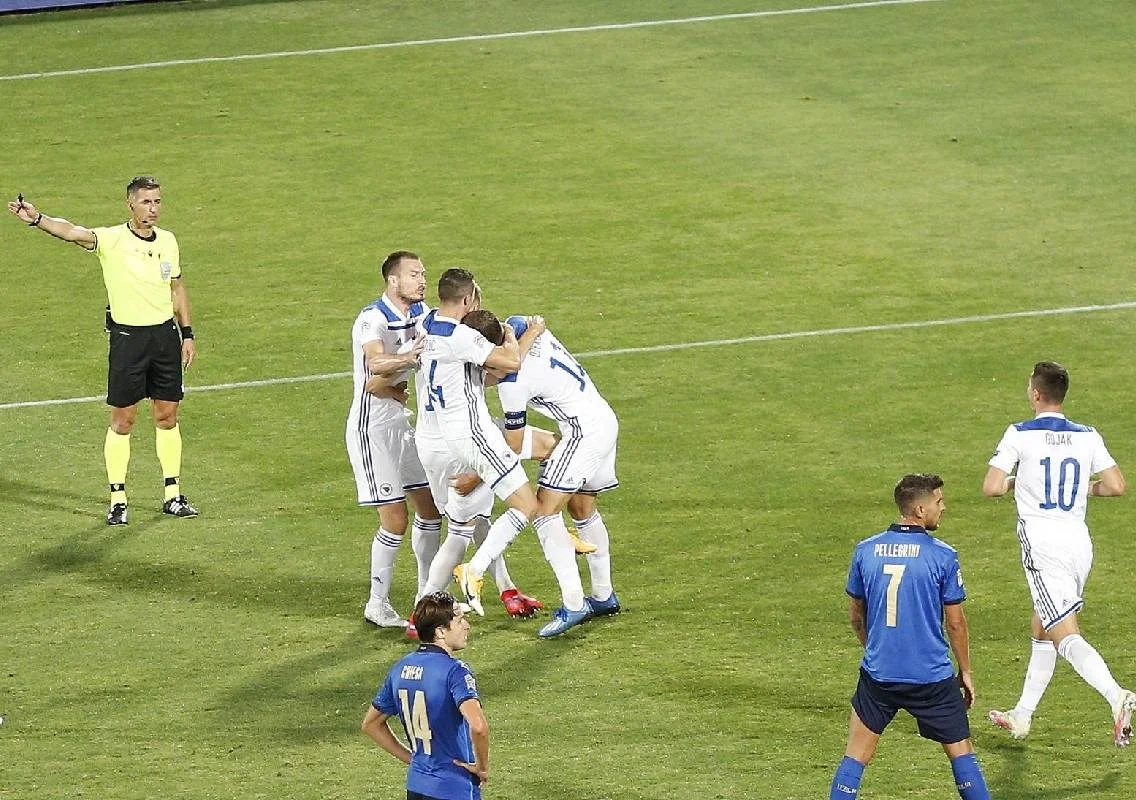


Zenica: In one of the biggest upsets in recent football history, Italy national football team failed to qualify for the FIFA World Cup for the third consecutive time after a heartbreaking penalty shootout loss to Bosnia and Herzegovina national football team.
The defeat in Zenica left players and fans stunned, as goalkeeper Gianluigi Donnarumma sank to his knees in disbelief after failing to stop the decisive penalty. The result marks a historic low for a nation that has lifted the World Cup trophy four times, most recently in 2006.
Shock result stuns football world
Italy’s elimination has sent shockwaves across global football, with the team missing out on the tournament for the third straight edition — an unimaginable scenario for one of the sport’s traditional powerhouses.
Italian media described the defeat as a “third apocalypse”, underlining the emotional and cultural significance of football in the country. For many younger fans, this will be the first time they have never seen Italy compete at a World Cup.
Defender Leonardo Spinazzola admitted the team was struggling to process the result. “We still don’t believe it… it’s upsetting for everyone,” he said after the match.
From favourites to failure
Italy entered the playoff as clear favourites, boasting a squad filled with players from top European clubs. However, finishing second in their qualifying group behind Norway forced them into the high-pressure playoff route.
After overcoming Northern Ireland, Italy faced Bosnia in a decisive clash — a tie widely considered favourable on paper. The team even appeared confident ahead of the match.
But football often defies expectations.
Match turns after red card
Italy started strongly, taking the lead in the 15th minute through forward Moise Kean. The early goal suggested a comfortable win was on the cards.
However, the match changed dramatically when defender Alessandro Bastoni was sent off before half-time. Reduced to 10 men, Italy struggled to maintain control as Bosnia increased pressure.
The hosts equalised in the 79th minute through Haris Tabaković, forcing the game into a penalty shootout. Italy missed twice from the spot, allowing Bosnia to secure a historic qualification.
Two decades of decline
Italy’s latest failure adds to a worrying trend. The team last played a World Cup knockout match in 2006 — the year it lifted the trophy. Since then, performances have steadily declined.
They were eliminated in the group stages in both 2010 and 2014, and shockingly failed to qualify for the 2018 and 2022 editions. Now, the 2026 World Cup will also take place without the Azzurri.
The only major success in recent years came when Italy won UEFA Euro 2020, defeating England in the final. However, that triumph now appears to have masked deeper structural issues within Italian football.
Pressure mounts on management
Head coach Gennaro Gattuso, appointed last year, now faces uncertainty over his future. While his leadership brought some unity to the squad, results have not improved.
Attention is increasingly turning towards the Italian Football Federation, with president Gabriele Gravina facing growing calls to step down.
Critics argue that the problems go beyond coaching, pointing to systemic issues such as poor youth development, declining domestic leagues, and lack of long-term planning.
Wider issues in Italian football
Italy’s struggles reflect a broader decline in its football ecosystem. Once dominant in Europe, Serie A clubs are no longer among the continent’s strongest.
Although Inter Milan reached the 2025 Champions League final, they suffered a heavy defeat to Paris Saint-Germain, highlighting the gap between Italian clubs and Europe’s elite.
Concerns over investment in grassroots development and youth talent have also been raised, with experts warning that the country risks falling further behind without major reforms.
Political and public reaction
The shocking exit has triggered strong reactions beyond the football community. Italian politicians have demanded accountability, calling the result a reflection of deeper failures in the sport’s governance.
Former Prime Minister Matteo Renzi described the situation as a sign that Italian football has “failed”, emphasising the sport’s importance to national identity.
Conclusion
Italy’s failure to qualify for a third consecutive World Cup marks a historic low for one of football’s most decorated nations. While the immediate disappointment is immense, the bigger challenge lies ahead — rebuilding a system that has clearly lost its way.
For millions of fans, the absence of the Azzurri on the world stage is becoming an unsettling reality. Unless significant changes are made, Italy risks prolonging its exile from football’s biggest tournament.