







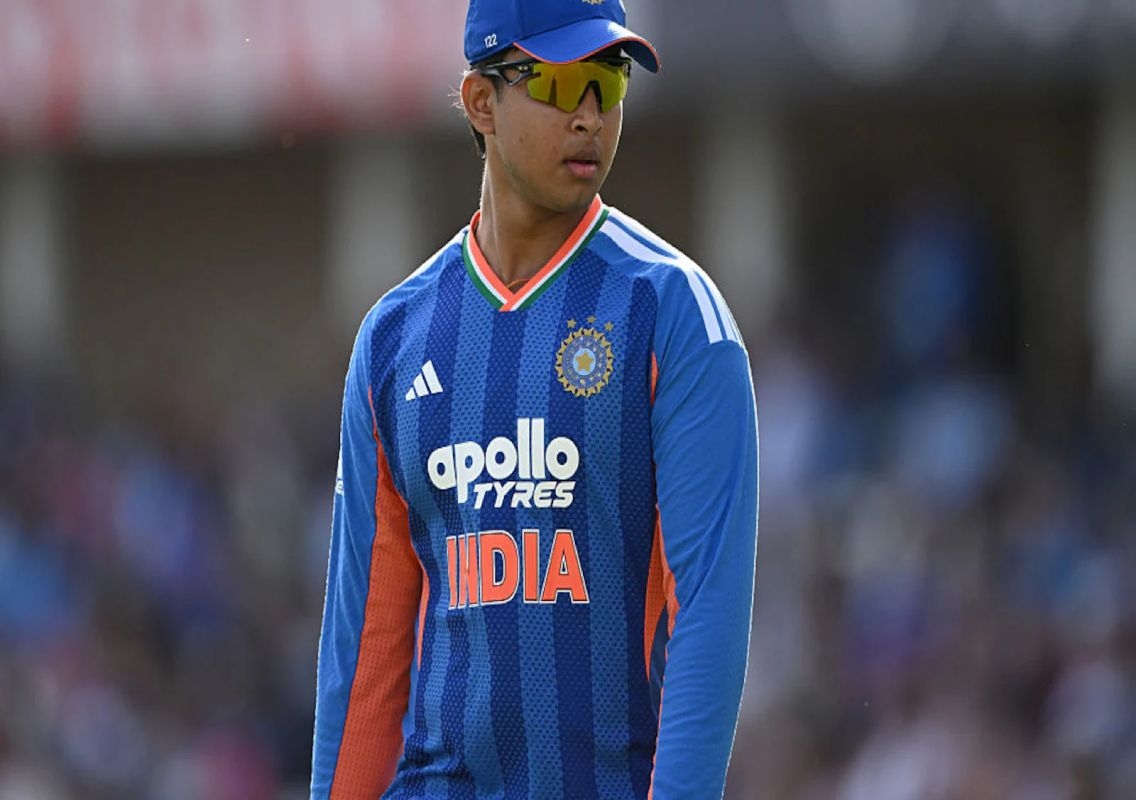


Mumbai: Former England spinner Monty Panesar has raised doubts over Vaibhav Sooryavanshi’s ability to make the transition from T20 cricket to Test cricket, arguing that the young India batter may not yet possess the technique required for the longest format.
Sooryavanshi, only 15, has rapidly become one of the most talked-about young batters in world cricket. His aggressive approach has already produced eye-catching performances in T20 cricket, while he has also begun making his mark in red-ball domestic cricket.
The teenager has played six T20Is for India and is yet to make his Test debut. According to Panesar, however, succeeding in Test cricket would require a different set of technical skills from those that have helped Sooryavanshi make an impact in the shortest format.
Monty Panesar raises Test cricket concerns
Speaking on the Beyond23 Cricket Podcast, Panesar said he could not currently see Sooryavanshi making a successful transition to Test cricket.
The former England spinner also compared the challenge with that faced by players capable of performing consistently across formats. He pointed to England batter Harry Brook as an example of a player who has established himself at the highest level in both Test and T20 cricket.
Panesar’s assessment was direct.
“I can’t see Sooryavanshi transitioning to Test cricket. Harry Brook is the only one right now who’s in the top 10 in Tests and T20Is. But I just don’t think Sooryavanshi has got the technique.”
The comments are an assessment of Sooryavanshi’s current readiness rather than a definitive statement about his future. At 15, the left-hander has considerable time to develop his red-ball game and build experience against different bowling conditions.
Sooryavanshi’s impressive rise in T20 cricket
Sooryavanshi’s rise has largely been driven by his extraordinary performances in T20 cricket. He first attracted widespread attention through his performances in the Indian Premier League and subsequently earned a place in India’s senior T20I setup.
His first T20I series against England did not produce major returns, with scores of 14, 13 and 15. However, he responded strongly during India’s three-match T20I series against Zimbabwe.
The youngster scored 151 runs across the three matches, including two half-centuries, and was named Player of the Series. His performances underlined his ability to score rapidly against international bowling attacks.
His numbers across different levels also show the contrast between his white-ball impact and his comparatively limited red-ball record. NDTV’s player statistics list him with 193 runs in six T20Is at an average of 32.17 and a strike rate of 189.22. In first-class cricket, he has 399 runs from 17 innings at an average of 23.47.
Those first-class numbers are still based on a relatively small sample, particularly considering Sooryavanshi’s age.
Duleep Trophy record offers another perspective
Bengaluru recently provided an important glimpse of Sooryavanshi’s ability in red-ball cricket.
Playing for East Zone against Central Zone in the Duleep Trophy semi-final, the teenager scored 92 off 81 balls. His innings contained seven fours and seven sixes and helped East Zone make a rapid start alongside experienced opener Abhimanyu Easwaran.
More importantly, Sooryavanshi became the youngest player to score a half-century in Duleep Trophy history. He reached the milestone at the age of 15 years and 157 days, breaking a record that had stood for 57 years.
The previous record belonged to Laxman Singh, who had scored a Duleep Trophy fifty at the age of 16 years and 23 days in 1969.
Sooryavanshi’s 92 also showed that his attacking style can be effective in red-ball cricket. However, his dismissal eight runs short of a century meant he missed an opportunity to add another significant record to his growing list of achievements.
Michael Clarke offers a contrasting view
Panesar’s assessment is not the only view surrounding Sooryavanshi’s long-term prospects.
Former Australia captain Michael Clarke has backed the youngster’s potential to become an all-format cricketer. Clarke cited the examples of Virat Kohli and AB de Villiers, both of whom succeeded in Test cricket while also becoming highly accomplished T20 players.
Clarke said that players can still develop the ability to perform across all three formats and suggested that Sooryavanshi could potentially make that transition.
He also pointed out that the youngster’s willingness to pursue Test cricket would itself be an important factor.
The differing opinions underline the uncertainty surrounding Sooryavanshi’s red-ball future. While Panesar has questioned whether his current technique is suited to Test cricket, Clarke believes the possibility of developing into an all-format player remains open.
Test cricket remains a future challenge
For now, Sooryavanshi’s international career remains focused on T20 cricket. His six T20I appearances have already provided evidence of his ability to handle the international stage, but he has not yet played Test cricket.
His domestic red-ball performances suggest there is at least a foundation for further development. The 92 in the Duleep Trophy semi-final was particularly significant because it came against senior domestic opposition and helped him break a long-standing age record.
At the same time, Test cricket presents challenges that extend beyond scoring quickly. Batters have to manage long spells, changing conditions, movement off the pitch, defensive techniques and sustained concentration over potentially several sessions.
Sooryavanshi has plenty of time to work on those aspects of his game. Whether he eventually becomes a Test cricketer will depend on his development, opportunities and his own ambitions.
For now, Panesar’s comments have added another layer to the discussion surrounding one of India’s most closely watched young batting prospects.