







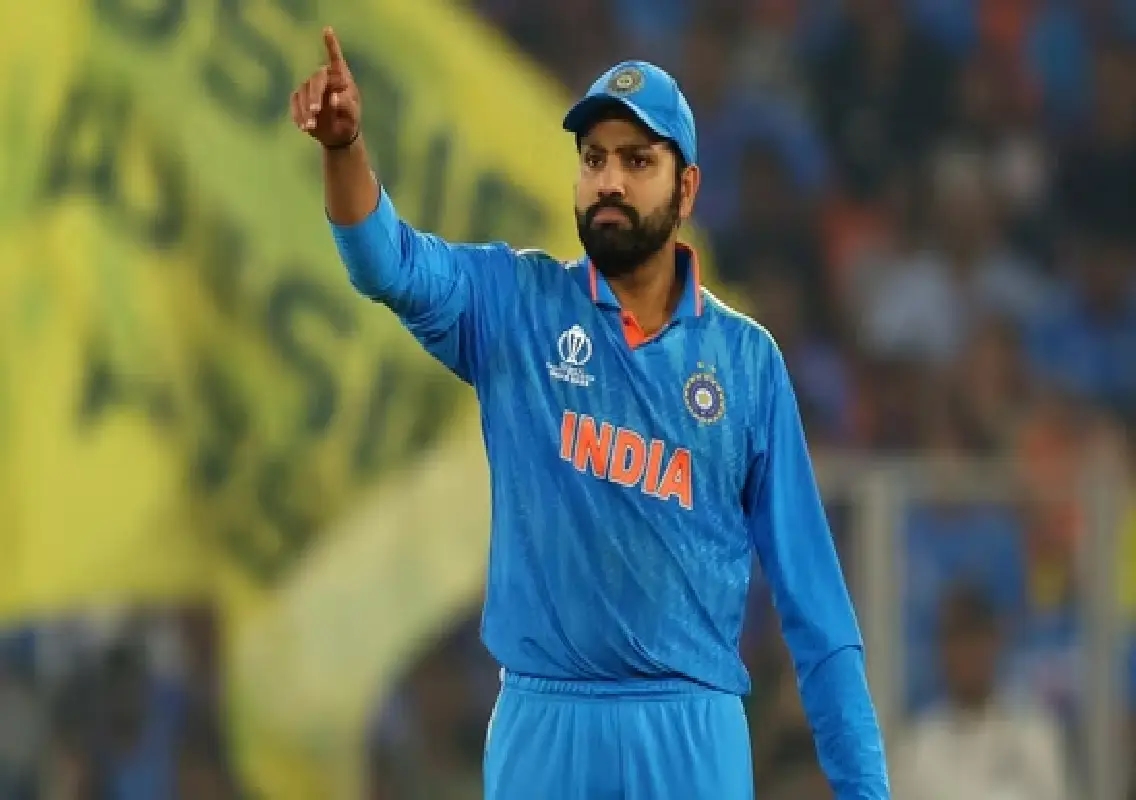


Hyderabad: Former India captain Rohit Sharma has revealed that he sensed something special about Tilak Varma the very first time the young batter walked into the Mumbai Indians dressing room, citing his mindset, temperament and fearless approach to pressure situations as standout qualities.
Speaking on JioStar’s Captain Rohit Sharma’s Roadmap for T20 World Cup, Rohit reflected on his early interactions with Tilak during the 2022 and 2023 Indian Premier League seasons, when he was leading Mumbai Indians. According to Rohit, what set Tilak apart was not just his talent, but the clarity and confidence with which he communicated his intent.
‘Send me up the order, I’ll do the job’
Rohit recalled how Tilak, despite being young and relatively new to top-level cricket, never shied away from responsibility.
“Whenever he spoke to me, he would just say, ‘I’ll do it. Please send me up the order, I’ll do the job.’ I’m talking about the 2022 and 2023 seasons, when I was captain,” Rohit said.
He added that Tilak’s conversations came from an “innocent place” but carried strong cricketing sense. “He has that mindset and attitude, which is superb, and he is mad about cricket,” Rohit noted, underlining the youngster’s hunger to be involved in crucial moments.
Temperament under pressure stands out
One of the defining moments Rohit highlighted was Tilak Varma’s knock against Pakistan in the Asia Cup, which he described as “unbelievable”.
“So much pressure, wickets falling at the other end, so much noise in the stadium, a tournament final no less,” Rohit said, emphasising the context in which Tilak delivered. He pointed out that such performances are often the clearest indicators of a player’s temperament rather than raw statistics.
“I know it’s still early days, but he is showing that he is a big-match player. Whenever the team is in trouble, not just once, he has got them out of trouble a few times now,” Rohit added.
Understanding flexibility in the batting order
Rohit also spoke at length about the importance of flexibility in the batting order, a concept he believes is often misunderstood by fans and commentators alike.
“When it comes to flexibility, people need to understand what it really means and how to use it properly,” he said. According to Rohit, in a modern T20 side, eight or nine of the 11 players are capable of batting, but that does not mean constant reshuffling.
“The two guys at the top will stay constant, since they are the openers. After that, you just need a little bit of flexibility,” he explained.
Rohit stressed that the top three positions should ideally remain undisturbed, with adjustments made only after that, depending on match situations and bowling match-ups.
Match-ups over rigid roles
The former captain highlighted the importance of analysing bowlers and sending in batters who are better suited to counter specific threats.
“After that, who is coming on to bowl? If the batter going in next doesn’t have a good record against him, then let’s send another one who can take him down. That’s where the match-ups come in,” Rohit said.
He clarified that such decisions were not made impulsively during matches. “Before the game, we used to sit and discuss these things with the players. Rahul bhai (Rahul Dravid) also loved discussing all this,” he said.
Players were informed in advance about possible changes in the batting order so that they were mentally prepared. Rohit emphasised that adaptability is a non-negotiable trait at the international level.
“You can’t come into Team India saying that you can only bat in one position. Then it becomes a little difficult to manage,” he said.
Changing the mindset in knockouts
Rohit also reflected on India’s struggles in knockout matches over the years and the shift in philosophy he tried to bring about, particularly regarding intent during collapses.
“I’ve always believed that I would only make changes in the batting order when I genuinely felt it was necessary,” he said, adding that batters were largely doing what was asked of them, but something was missing.
According to Rohit, that missing element was mindset. “When you’re 20 for 3, what do you do? That little extra yard we needed to go, all of us needed to go, that wasn’t happening,” he said.
He explained that the traditional rebuild philosophy often led to conservative batting and sub-par totals. “It’s fine if 20 for 3 becomes 20 for 4. Get dismissed for 50, no problem, but we will play with the right intent,” Rohit said, stressing the need to maintain attacking momentum.
Letting go of fear
Rohit admitted that he consciously tried to remove the fear of failure from players’ minds, even in high-stakes tournaments like the World Cup.
“That fear of getting out, I just wanted to throw that out,” he said. He pointed out that India had tried multiple approaches over the last 10 or 11 years without success in major finals.
“What will I do with a score of 120, or 140-150, with that rebuild philosophy? I wanted us to get to 170-180,” Rohit said, acknowledging the difficulty but backing the ambition.
Lessons from the final
Reflecting on a World Cup final scenario, Rohit explained how this mindset translated into results. “We were 30 for 3. The two guys in the middle, Axar Patel and Virat Kohli, had a brilliant partnership,” he said.
India eventually posted 176, a total Rohit described as “a good score”. “With the bowlers that we had, I thought we could defend it,” he said, underlining the importance of intent-driven batting in modern T20 cricket.
Conclusion
Rohit Sharma’s reflections offer insight into his leadership philosophy and his eye for talent, with Tilak Varma emerging as a prime example of a player who combines skill with temperament. As India continues to shape its T20 future, such attributes — fearlessness, adaptability and clarity of role — could prove decisive in the biggest matches.