







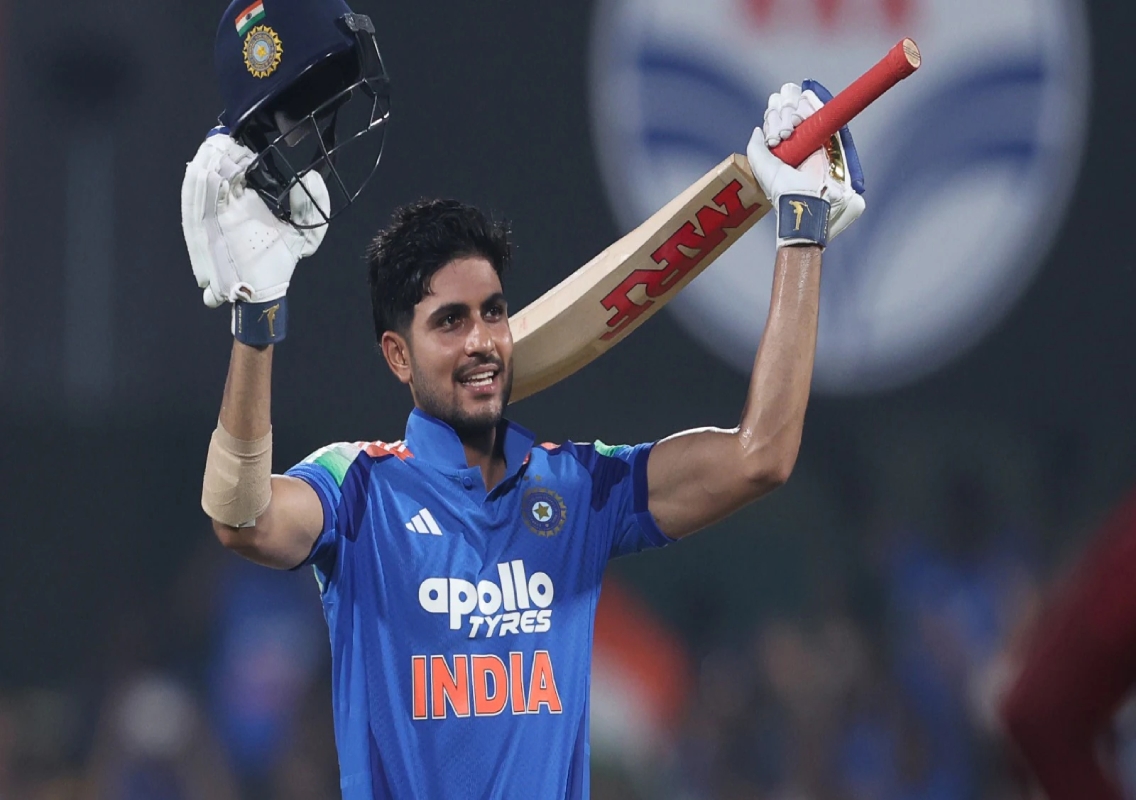


Guwahati: India captain Shubman Gill scripted history at the Barsapara Cricket Stadium on Wednesday, September 30, by smashing the fastest double century in men’s ODI cricket during the second ODI against the West Indies. Gill reached the landmark in just 117 balls and went on to remain unbeaten on 223 as India completed a record chase of 406 with eight wickets in hand.
Gill’s extraordinary innings not only powered India to a series-clinching victory but also saw him break a world record previously held by fellow Indian batter Ishan Kishan. Kishan had scored a double century in 126 balls against Bangladesh in Chattogram in 2022. Gill bettered that mark by nine deliveries, producing one of the most remarkable individual performances in ODI cricket.
Gill breaks Ishan Kishan’s record
Gill walked out to open India’s innings after the West Indies had posted a huge 405 for seven in their 50 overs. Rather than being overwhelmed by the demanding target, India immediately attacked the West Indies bowling attack.
Gill reached his century in only 62 balls before accelerating further. He brought up his double century from 117 deliveries, setting a new record for the fastest 200 in men’s ODI cricket. He eventually finished unbeaten on 223 from 133 balls, with the innings featuring 24 fours and seven sixes.
The performance also made Gill only the second batter in men’s ODI history to score more than one double century. Rohit Sharma remains the only other player to achieve the feat, having registered three ODI double hundreds. Gill’s first double century came against New Zealand in Hyderabad in January 2023, when he scored 208 off 149 balls.
Record chase led by Gill and Rohit
Gill received outstanding support from former India captain Rohit Sharma at the other end. The opening pair completely transformed India’s chase, adding 255 runs for the first wicket in just 26.2 overs.
Rohit scored 101 and registered his 35th ODI century before being dismissed. His aggressive contribution ensured that India remained comfortably ahead of the required run rate throughout the chase.
After Rohit’s dismissal, Virat Kohli and Ruturaj Gaikwad joined Gill as India continued towards the target. India eventually reached 406 for two in 43.3 overs, winning with 39 balls remaining. The result gave India an unassailable 2-0 lead in the three-match ODI series against the West Indies.
The successful chase was India’s highest in ODI cricket, adding another record to an already extraordinary evening in Guwahati. Reuters also reported that the chase was the second-highest successful run chase in ODI history.
West Indies post first 400-plus ODI total
The West Indies had appeared to put themselves in an extremely strong position after producing their first 400-plus total in ODI cricket. They scored 405 for seven after being asked to bat first.
John Campbell provided the initial impetus, smashing 101 from 68 balls. Captain Shai Hope followed with 104 off 94 balls, while Amir Jangoo added 114 from 77 deliveries. The three centuries made it an unusual and record-filled innings, with the West Indies maintaining a scoring rate of around eight runs an over for large portions of their innings.
Campbell’s century came from only 65 balls, according to NDTV’s match coverage, while Jangoo also reached his hundred rapidly and finished with 114. The West Indies’ total surpassed their previous highest ODI score of 389 against England in 2019.
India’s bowling attack faces questions
India’s bowling attack had a difficult evening on a flat Guwahati surface. In the absence of Jasprit Bumrah, who was on Asian Games duty, and Mohammed Siraj, the Indian team gave opportunities to several bowlers as part of its preparations for the 2027 ODI World Cup.
Auqib Nabi conceded 84 runs in 8.5 overs, while Gurnoor Brar took two wickets despite conceding 96 runs. Prasidh Krishna picked up one wicket for 45 runs from five overs.
India’s spinners provided greater control. Kuldeep Yadav finished with two wickets for 65 runs and reached the significant milestone of 200 ODI wickets during the match. Ravindra Jadeja also claimed two wickets for 75 runs.
There was also an injury concern for India when all-rounder Naman Dhir twisted his ankle after bowling 6.1 overs and had to leave the field.
A landmark night for Gill
Gill’s 223 not out was more than a record-breaking individual score. It became the highest individual score by an Indian batter in a successful ODI run chase, while his 117-ball double century established a new benchmark for the fastest 200 in the format.
His century in 62 balls also added another landmark to the innings. According to match coverage, Gill registered the fastest ODI century by an Indian captain, continuing his remarkable run of form in the series.
The Guwahati match also produced an extraordinary statistical spectacle, with five centuries scored across the two innings. The West Indies had three centurions — Campbell, Hope and Jangoo — while India had Gill and Rohit. The combined 811 runs further underlined the batting-dominated nature of the contest.
For Gill, however, the most significant numbers were 117 and 223. The first represents the number of balls he needed to break the ODI double-century record; the second represents the unbeaten score that carried India through a 406-run chase.
India will now head into the third and final ODI with the series already secured 2-0. The focus will turn to whether Gill can continue his exceptional run and whether India’s bowling combination can produce a stronger performance ahead of the team’s longer-term preparations for the 2027 World Cup.