







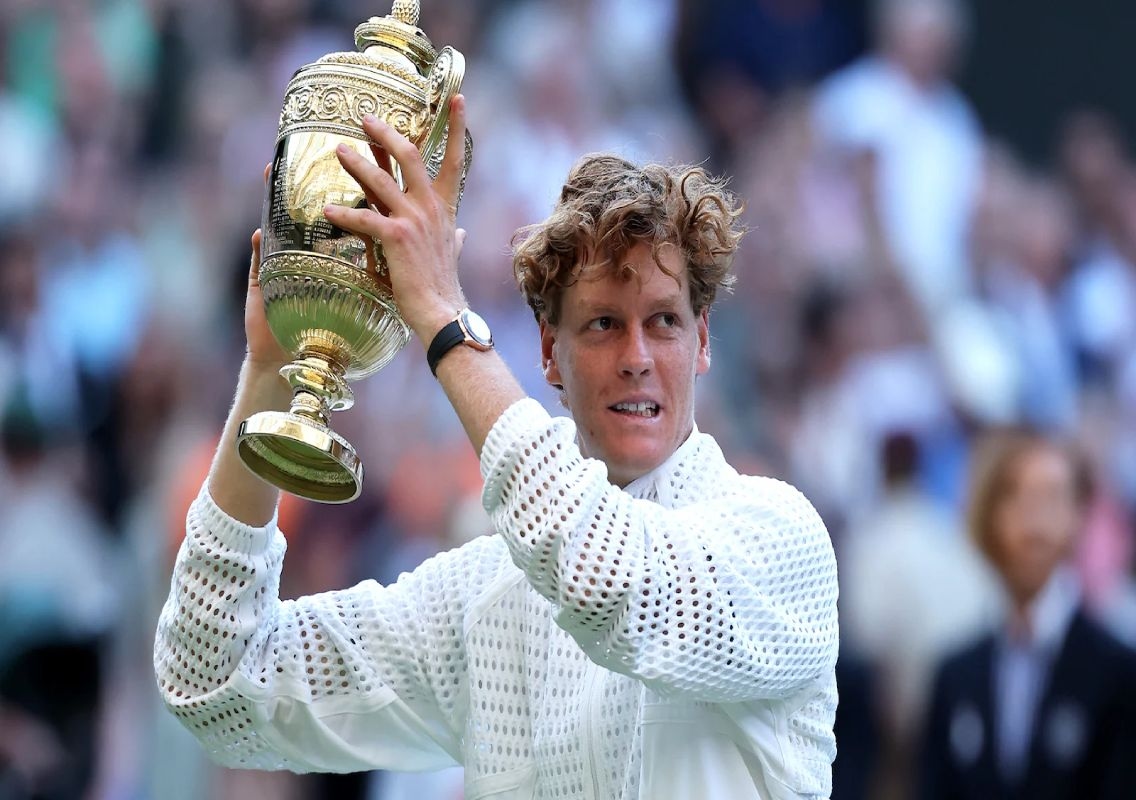


London: Jannik Sinner has firmly established himself as the dominant force in men’s tennis after defeating Alexander Zverev in the Wimbledon Championships 2026 final. The Italian star clinched his second consecutive Wimbledon title with a 6-7, 7-6, 6-3, 6-4 victory, taking his Grand Slam tally to five at just 24 years of age.
In an era featuring contrasting styles and personalities, Sinner’s rise alongside Carlos Alcaraz has defined the current generation, while veteran Novak Djokovic continues to remain competitive at the highest level.
A unique blend in a sport of extremes
Modern tennis is often characterised by two physical archetypes. On one side is Alcaraz, known for his explosive athleticism and ability to turn rallies into high-speed chases. On the other is Djokovic, whose unmatched flexibility and defensive skills allow him to retrieve seemingly impossible shots.
Sinner, however, doesn’t neatly fit into either category.
Instead, the World No. 1 has built his success on what many analysts describe as “controlled violence”—a precise, relentless baseline game that overwhelms opponents without unnecessary flair.
The secret: early contact and baseline control
One of Sinner’s biggest strengths lies in his positioning. He stays close to the baseline and takes the ball early—often on the rise—cutting down his opponent’s reaction time.
By striking the ball at its highest point, Sinner prevents rivals from pushing him back and keeps them under constant pressure. His shots return faster and heavier, leaving opponents with little room to recover or reset during rallies.
This aggressive court positioning allows him to dictate play from the very first strike.
Rare balance: equal power on both wings
A defining feature of Sinner’s game is his ability to generate equal power from both his forehand and backhand—something rarely seen even among elite players.
Most top tennis stars have a stronger side that opponents try to exploit under pressure. Sinner, however, eliminates that weakness entirely.
His symmetrical shot-making changes the geometry of rallies. Opponents cannot rely on cross-court exchanges to find safety, as both wings deliver flat, penetrating shots with consistent pace and accuracy.
This makes his game unpredictable and extremely difficult to counter.
Mental strength sets him apart
Beyond technique and physical attributes, Sinner’s mental approach is a key factor in his success.
Unlike more expressive players, he maintains a calm and composed demeanour on court. Even under pressure, he rarely shows frustration or deviates from his strategy.
This emotional control allows him to stay focused and execute his game plan with precision, gradually wearing down opponents over time.
The future of men’s tennis
With Alcaraz currently sidelined due to injury and Djokovic nearing the twilight of his career, Sinner has taken full advantage to cement his position at the top.
His victory over Zverev not only highlights his current dominance but also signals a shift in the balance of power in men’s tennis.
While Alcaraz brings explosive flair and Djokovic embodies defensive mastery, Sinner’s methodical and relentless style offers a new blueprint for success in the sport.
As the next generation continues to evolve, one thing is clear—Jannik Sinner is not just winning titles; he is redefining how modern tennis is played.