


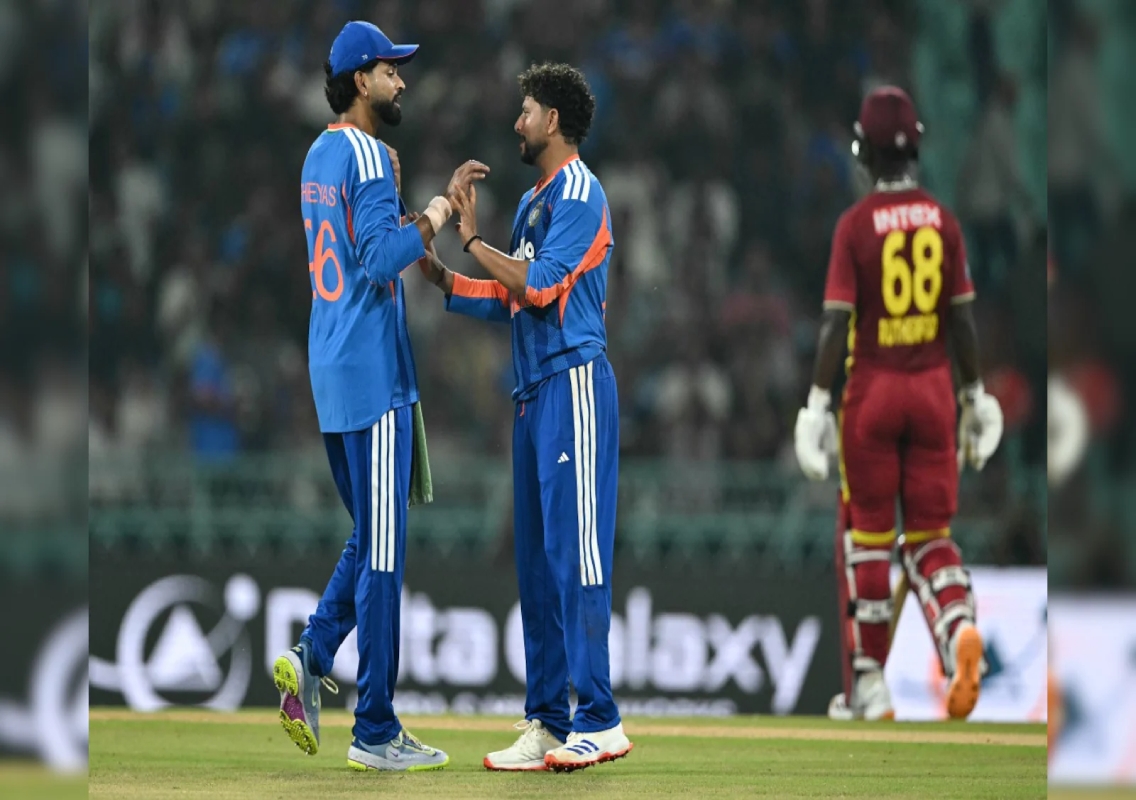


Indore: India’s decision to leave Kuldeep Yadav out of the playing XI for the third T20I against the West Indies was influenced by the team’s need for additional pace-bowling options and greater batting depth, according to former India opener Aakash Chopra.
India fielded Arshdeep Singh, Prince Yadav and Mayank Yadav as specialist fast bowlers, with Nitish Kumar Reddy providing another pace-bowling option. The selection paid off as India secured a 14-run victory in Indore, taking a 2-1 lead in the five-match series.
Batting first, India scored 223 runs in 20 overs, powered by Abhishek Sharma’s explosive 69 off 30 balls. The West Indies fought back during the chase through Kamil Pooran’s 42 and Shimron Hetmyer’s 43 but finished at 209/7.
Aakash Chopra explains India’s pace-bowling strategy
Speaking on Star Sports, Chopra explained that India needed enough fast-bowling resources to cover both the opening overs and the closing stages of the innings.
He said relying on only two specialist pacers in white-ball cricket could create difficulties, particularly when the team needed to use a bowler’s overs strategically after taking early wickets.
“You will have to actually play a bowler that allows you to bowl at the top and the tail. If you go with only two pacers, it’s going to be a problem in white-ball cricket,” Chopra said.
He explained that using Arshdeep Singh for additional overs early in the innings could leave the team short of options at the death, especially if wickets fell during the powerplay.
According to Chopra, the presence of three specialist fast bowlers gave India greater flexibility in managing their bowling resources across the innings.
Prince Yadav provides an option at the death
Chopra highlighted the different roles played by Mayank Yadav and Prince Yadav in India’s pace attack.
Mayank is primarily a new-ball bowler, while Prince offers an additional option for the closing overs through his ability to bowl yorkers and generate reverse swing.
Chopra said having Prince in the XI allowed India to distribute the overs more effectively instead of relying heavily on a limited number of specialist pacers.
He also described Nitish Kumar Reddy as a utility bowler and noted that Naman Dhir was continuing to develop as a player.
The combination, according to Chopra, provided the team management with more flexibility when planning its bowling strategy.
Why Kuldeep Yadav missed out
The inclusion of Prince Yadav and Nitish Kumar Reddy came at the expense of spinner Kuldeep Yadav and all-rounder Shivam Dube.
Chopra argued that the team’s fast bowlers did not provide enough batting support to comfortably fill the No. 8 position. This limitation, he said, influenced the decision to leave Kuldeep out despite the spinner’s potential usefulness.
“The fact is that because none of your three fast bowlers can bat at No. 8, you end up compromising Kuldeep Yadav,” Chopra said.
He suggested that India could have accommodated Kuldeep if the pace attack had included a bowler capable of contributing more substantially with the bat.
Chopra cited Harshit Rana, Deepak Chahar and Shardul Thakur as examples of players who could offer additional batting support alongside their bowling.
His assessment was that the lack of such an option created a selection dilemma for the Indian team management.
Chopra believes Kuldeep could have been useful
Chopra also felt Kuldeep would have been a valuable option in the third T20I, particularly because there was no dew during the match.
He pointed to the performance of the spinners and identified Roston Chase as the pick of the bowlers, reinforcing his view that spin could have played an important role in the conditions.
“Kuldeep would have been very useful today (Sunday). There was no dew today,” Chopra said.
However, he maintained that the team’s limited batting depth among the specialist fast bowlers remained a concern. In his view, that issue would continue to influence selection decisions as India balanced its bowling requirements with the need for runs lower down the order.
India take a 2-1 lead in the series
India’s 14-run win in Indore gave the hosts a 2-1 advantage in the five-match T20I series against the West Indies.
The team’s selection highlighted the challenge of balancing specialist bowling options with batting depth. While the additional fast bowlers provided flexibility across different phases of the innings, their limited batting ability meant India had to make a difficult choice regarding Kuldeep’s inclusion.
Chopra’s analysis underlined how the composition of the lower order can influence the selection of specialist bowlers, even when a spinner could prove useful under the prevailing conditions.