







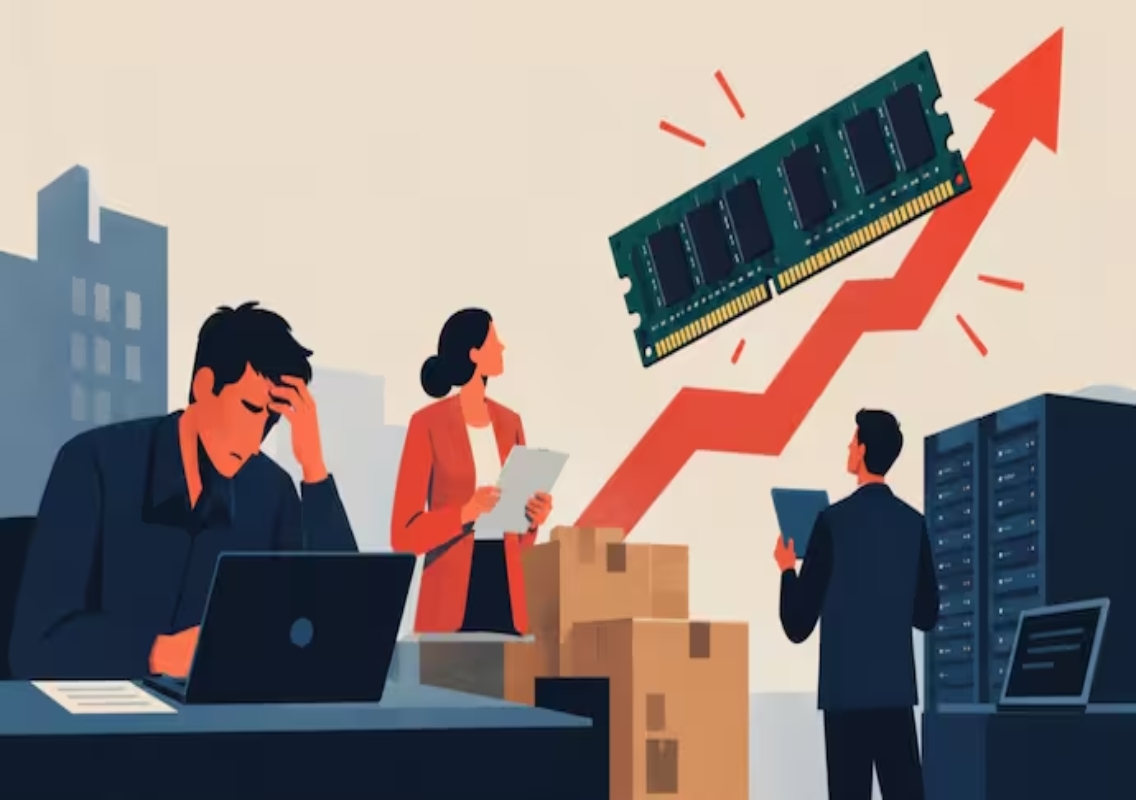


New Delhi: India’s technology-driven businesses are facing a new cost challenge as an artificial intelligence-led surge in demand for computer memory pushes up prices of RAM and NAND storage. Industry executives say the impact is particularly difficult for Indian companies because hardware supply chains are still developing and much of the equipment is priced in US dollars.
Memory prices have reportedly increased by as much as 500 per cent over the past year, according to India Today’s report, putting pressure on companies that depend heavily on servers, laptops, networking equipment and other IT infrastructure. The increase is being linked to the enormous demand generated by AI data centres and the limited availability of memory components.
The problem is no longer limited to technology manufacturers. Businesses using their own servers, cloud infrastructure or AI-powered software are also beginning to feel the impact through higher operating and procurement costs.
Why India is feeling the memory crunch
The cost pressure is more pronounced in India because the country’s technology hardware supply chain is still maturing. Vishal Sirohi, CEO of AI infrastructure company Island Computing, said Indian companies face an additional challenge because hardware prices are largely dollar-denominated.
A weaker rupee can therefore make imported memory modules and other IT components even more expensive for Indian buyers. For companies operating their own servers, memory has consequently become a significant cost consideration rather than a relatively minor component of the technology budget.
RAM and NAND memory are used across a wide range of electronic products. Smartphones, laptops, desktops, servers and data-centre equipment all depend on memory components. As a result, prolonged increases in memory prices can eventually affect both enterprise technology spending and consumer electronics.
The situation also comes at a time when businesses are already increasing their investment in artificial intelligence, making the cost of computing infrastructure an increasingly important consideration.
IT hardware sales come under pressure
The memory shortage is also affecting companies that sell IT hardware. Yogesh Agrawal, co-founder of Consistent Infosystems, told India Today Tech that some segments of the market have recorded sales declines of around 30–40 per cent because of the sharp increase in RAM prices.
Businesses purchasing computers and other equipment are becoming more cautious as higher component costs make it difficult to maintain existing budgets. The volatility in memory prices is also making inventory planning more complicated for hardware companies.
For smaller businesses, the challenge can be particularly significant because they may have less negotiating power with suppliers and fewer alternatives when equipment needs to be replaced.
Companies may therefore delay purchases, extend the operating life of existing devices or look for infrastructure models that allow them to share computing resources more efficiently.
AI software is also becoming more expensive to run
The impact is not restricted to physical hardware. SaaS companies are also facing higher costs as AI becomes an increasingly important part of their products.
Tapan Acharya, chief revenue officer at HR technology company Keka, said the cost of running AI features has moved from being a relatively insignificant expense to a clearly visible line item.
This is changing how companies assess new AI features. Businesses are increasingly asking whether an AI-powered function can deliver measurable savings or productivity improvements before allocating additional resources to it.
That could lead to a more selective approach to AI development. Instead of adding AI features simply because they are technologically possible, companies may prioritise tools that directly improve productivity, reduce manual work or generate revenue.
Companies look for ways to reduce memory consumption
With memory becoming more expensive, businesses are exploring ways to achieve more computing output from the hardware they already have.
Sirohi said one response is to move workloads towards shared and pooled infrastructure, where resources can be used more efficiently. Such systems can potentially reduce the amount of memory required to deliver the same business outcome.
The shortage could therefore have an unexpected effect on software development. Developers may increasingly have to consider memory efficiency when designing applications rather than assuming that additional memory will remain relatively inexpensive.
This could encourage greater use of efficient programming languages, resource pooling and optimisation techniques. It may also influence how cloud infrastructure and enterprise applications are designed in the coming years.
Businesses advised to avoid panic buying
Industry executives suggest that companies should respond to the crisis through better planning rather than panic purchasing.
For hardware, businesses could extend device replacement cycles and negotiate longer-term agreements with suppliers. Such measures may provide greater predictability at a time when memory prices remain volatile.
On the AI side, companies are being encouraged to focus on applications that already demonstrate clear commercial value rather than assuming computing costs will automatically decline in the future.
This approach could become increasingly important for Indian businesses, particularly smaller enterprises that have limited technology budgets and may not be able to absorb sudden increases in infrastructure expenditure.
How long will the RAM crisis last?
There is currently no clear answer on when memory prices will return to earlier levels.
Acharya cautioned that the future depends largely on the balance between AI infrastructure demand and memory supply. If AI investment continues to grow rapidly, memory could remain scarce and expensive for years. Some industry expectations suggest the pressure could potentially continue beyond 2030.
The other possibility is that AI infrastructure spending eventually exceeds the revenue generated by AI businesses, resulting in a market correction similar to those seen after previous technology investment booms.
Agrawal, meanwhile, said memory prices are already at elevated levels and further increases cannot be ruled out in the near term. He also noted that it remains difficult to predict when the shortage will ease.
A wider challenge for India’s technology economy
The RAM shortage highlights a less visible consequence of the global AI boom. While artificial intelligence is creating new products, services and productivity opportunities, it is also increasing demand for the physical infrastructure needed to run those systems.
For India, the combination of high global demand, developing hardware supply chains and currency-related costs could make the impact more pronounced. Companies may consequently need to rethink hardware procurement, software efficiency and the economics of deploying AI.
The immediate outcome may not be a uniform increase in prices across every technology product or business. However, sustained memory inflation could continue to put pressure on margins and force companies to become more disciplined about how they use computing resources.
For now, there is no definite timeline for the RAM shortage to end. What appears increasingly clear is that memory has moved from being a background component of the technology industry to a strategic cost factor for businesses operating in the AI era.