







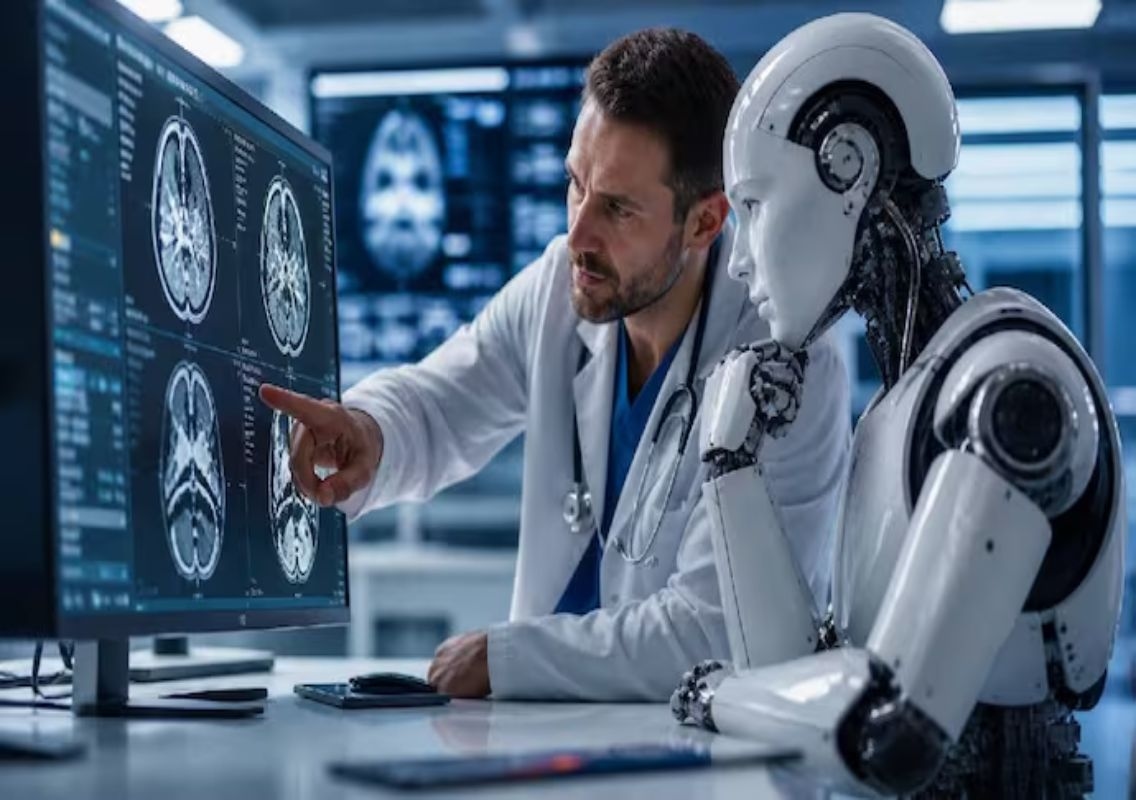


Boston: A major new study by Harvard Medical School and Beth Israel Deaconess Medical Center has found that advanced artificial intelligence systems can match or even outperform doctors in certain emergency-room decision-making tasks.
The findings mark a significant step forward in the use of AI in healthcare, particularly in clinical reasoning — a core skill used by physicians to diagnose and treat patients.
AI vs doctors: what the study found
Researchers tested large language models, including systems developed by OpenAI, against human physicians across a range of real-world clinical scenarios.
The results showed that at multiple stages of medical decision-making, the AI:
- Matched or exceeded doctors in diagnostic accuracy
- Performed strongly in identifying likely conditions
- Suggested appropriate next steps in treatment
In some cases, the AI model even outperformed experienced physicians.
Emergency room experiment
One of the most notable parts of the study involved 76 real emergency room cases.
Doctors and AI systems were given the same patient data — without any pre-processing — and asked to:
- Prioritise care
- Suggest diagnoses
- Decide on ICU admissions
Independent physicians, unaware of which responses came from humans or AI, evaluated the outputs.
The findings revealed that the AI system performed on par with or better than doctors, particularly in early-stage decision-making.
Researchers admitted they were surprised by how well the system performed under real-world conditions.
Why this matters
Clinical reasoning is one of the most complex aspects of medicine. If AI can assist or enhance this process, it could:
- Improve speed and accuracy in emergency care
- Support doctors in high-pressure environments
- Help standardise medical decision-making
This is especially relevant in emergency departments, where quick and correct decisions can save lives.
Not a replacement for doctors
Despite the promising results, researchers stress that AI is not ready to replace human doctors.
Concerns remain, including:
- AI suggesting unnecessary tests
- Potential risks to patient safety
- Lack of accountability in autonomous systems
Experts emphasise that human oversight is essential.
“Humans should remain the ultimate baseline for safety and evaluation,” researchers noted.
The road ahead
The study highlights AI’s potential as a support tool rather than a substitute. Future steps will involve:
- Rigorous clinical trials
- Integration into hospital workflows
- Careful monitoring of safety outcomes
As AI continues to evolve, its role in healthcare is expected to expand — but always alongside human expertise.
For now, the message is clear: AI may be getting smarter, but doctors are still indispensable.