







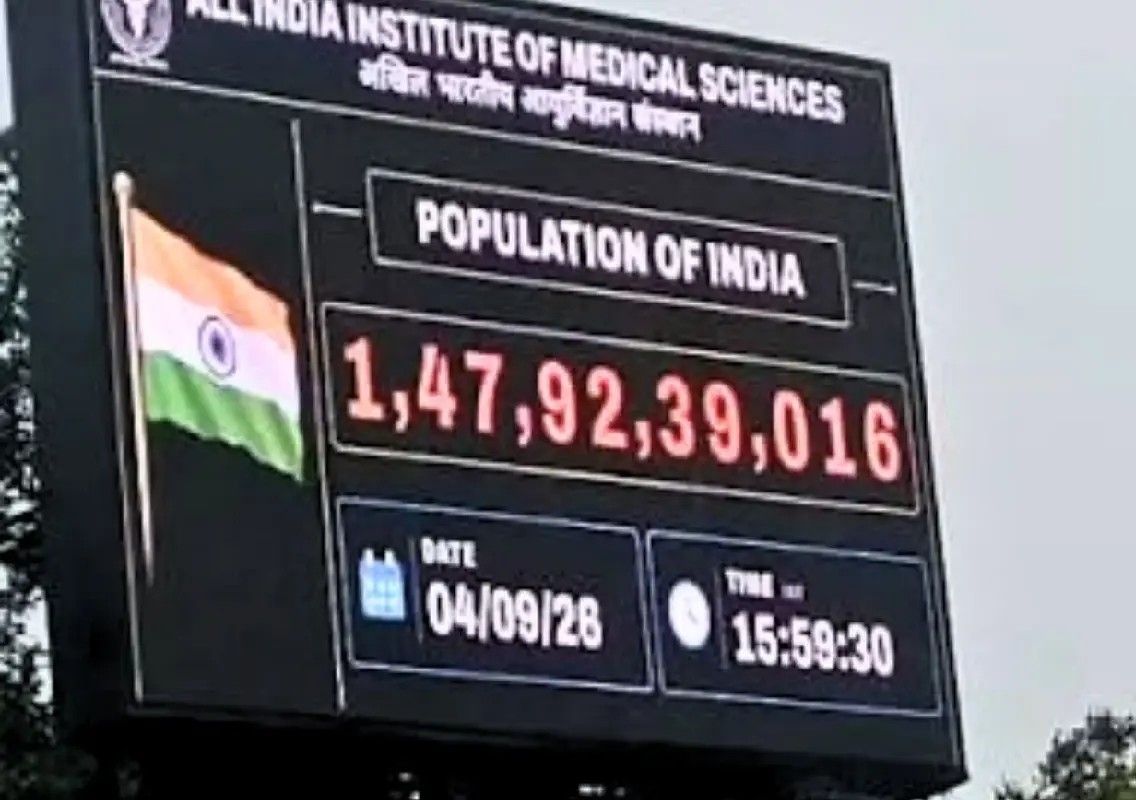


A digital population clock at the All India Institute of Medical Sciences (AIIMS) in Delhi has gone viral after videos showed the number on its screen changing continuously. The display has prompted a simple but fascinating question: does AIIMS actually receive information every time a baby is born somewhere in India?
The answer is no. The clock is not a live national birth-tracking system. It uses demographic data and statistical projections to estimate how India’s population changes over time.
The clock uses population estimates, not live births
India has official systems for recording births and deaths, including the Civil Registration System (CRS). However, these records are not transmitted to the AIIMS display every time a birth takes place.
Instead, a population clock starts with a known or estimated population at a particular point and applies demographic rates to calculate projected changes. The expected annual change can then be mathematically distributed across days, hours, minutes and seconds, making the figure appear to move continuously.
A changing number does not mean a new baby
When the display increases by one, it does not mean that a particular baby has just been born.
The changing digits represent the movement of a statistical estimate. Similarly, a decrease would not necessarily correspond to a particular death being reported at that exact moment.
India’s last completed Census was conducted in 2011, recording a population of about 121.1 crore. Population projections and demographic surveys are therefore important for understanding the country’s changing population between census exercises.
Why the AIIMS display looks so precise
Computers can calculate population estimates to several decimal places and update the display every second. That precision, however, should not be confused with an exact headcount.
The viral AIIMS clock is best understood as a demographic awareness tool that turns population statistics into something people can watch changing in real time.