







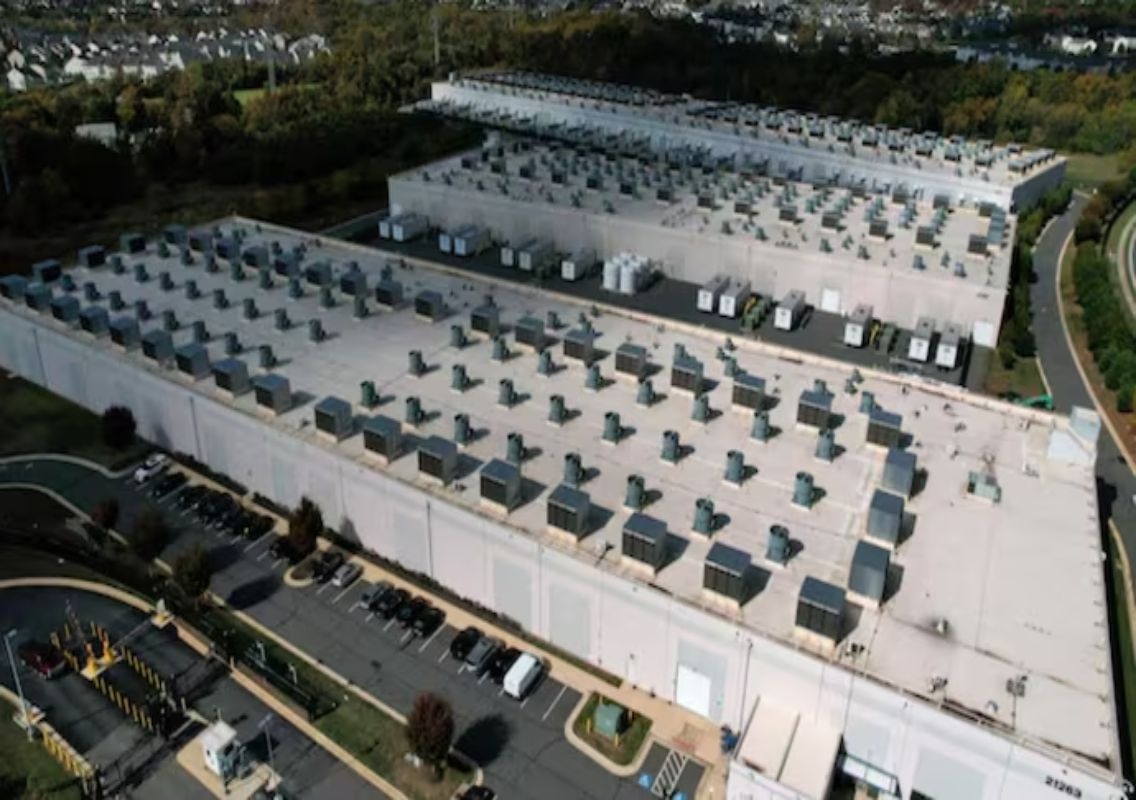


Seattle: Amazon has revealed that its global data centre operations consumed more than 9 billion litres of water in 2025, marking the first time the company has publicly disclosed such figures. While the number appears substantial, the company has defended its operations, claiming its facilities are more water-efficient than those run by rivals such as Microsoft, Google and Meta.
The disclosure comes amid growing global scrutiny over the environmental impact of data centres, particularly as demand surges due to artificial intelligence (AI) and cloud computing.
Water consumption figures and efficiency claims
According to Amazon, its data centres used approximately 2.5 billion gallons of water in 2025, equivalent to over 9 billion litres. Despite expansion in its infrastructure, the company stated that water usage at sites it directly owns and operates fell by around 2 per cent compared to 2024 levels.
Amazon also attempted to contextualise its consumption by highlighting efficiency metrics. It claimed that its data centres used approximately 0.12 litres of water per kilowatt-hour of electricity, which it says is lower than comparable figures for competitors.
However, the comparison has limitations. While Amazon’s data reflects its overall operations, some competitor figures—particularly those of Google—focus specifically on AI-driven data centres, which tend to consume more water due to high-performance computing requirements.
Additionally, Amazon’s figures do not include indirect water usage, such as water consumed during construction or by power plants supplying electricity to its facilities.
Rapid expansion and future projections
Reports suggest that Amazon operates around 924 data centres globally. A previously leaked internal memo from 2022 projected that the company’s annual water consumption could rise to 7.7 billion gallons by 2030, although Amazon has not officially confirmed or addressed this estimate.
The rapid growth of data centres is closely tied to the expansion of AI technologies, which require vast computational resources and, consequently, significant cooling infrastructure. Most data centres rely on water-based cooling systems during peak heat conditions, although companies are increasingly exploring alternative methods.
Amazon stated that its facilities rely on outside air cooling for about 90 per cent of the time, using water-based systems only during the hottest periods of the year.
Rising public concern over environmental impact
Public sentiment towards data centre expansion has become increasingly cautious. A recent Reuters poll found that while one in three Americans supports data centre construction in general, only 14 per cent would be comfortable with such a facility being built near their homes.
Concerns largely centre around water consumption and electricity usage, particularly in regions already facing water scarcity.
Global projections further highlight the scale of the issue. The United Nations University Institute for Water, Environment and Health has estimated that the water footprint of data centres could reach 9.3 trillion litres by 2030. This volume would be sufficient to meet the annual domestic water needs of approximately 130 crore people in sub-Saharan Africa.
Comparisons with domestic water usage
In response to criticism, Amazon has compared its water usage to other forms of consumption. The company noted that Americans use approximately 3.3 trillion gallons of water annually for lawns and gardens—over 1,300 times more than what its data centres consume.
While this comparison aims to put the figures into perspective, critics argue that industrial water usage has a different impact, particularly when concentrated in specific regions.
Push towards becoming water positive
Amazon has reiterated its commitment to sustainability, stating that it aims to become “water positive” by 2030. This means the company intends to return more water to communities than it consumes in its direct operations.
According to the company, it has already achieved about 75 per cent of this goal. Efforts include:
- Using reclaimed or treated wastewater instead of potable water
- Deploying water-efficient cooling technologies
- Investing in community water restoration projects
Amazon reported that 26 of its sites currently operate using 100 per cent reclaimed water, with an additional 130 facilities contracted to adopt similar practices globally.
Increasing regulatory and legal scrutiny
The disclosure comes at a time when governments and local authorities are demanding greater transparency from technology companies.
In the United States, the city of The Dalles in Oregon recently agreed to release records related to Google’s water consumption following a legal battle. Meanwhile, Utah has passed legislation requiring certain new data centre projects to publicly disclose their annual water usage.
Seattle has also implemented a one-year moratorium on new data centre developments, reflecting growing concerns among policymakers and residents.
Conclusion
Amazon’s revelation of its data centre water usage marks a significant step towards transparency in an industry often criticised for its environmental impact. While the company maintains that its operations are more efficient than those of its competitors, questions remain about the broader sustainability of large-scale data infrastructure.
As demand for AI and cloud services continues to rise, balancing technological advancement with environmental responsibility will become increasingly critical. Amazon’s progress towards becoming water positive may set a benchmark, but sustained scrutiny and regulatory oversight are likely to shape the future of data centre operations worldwide.