







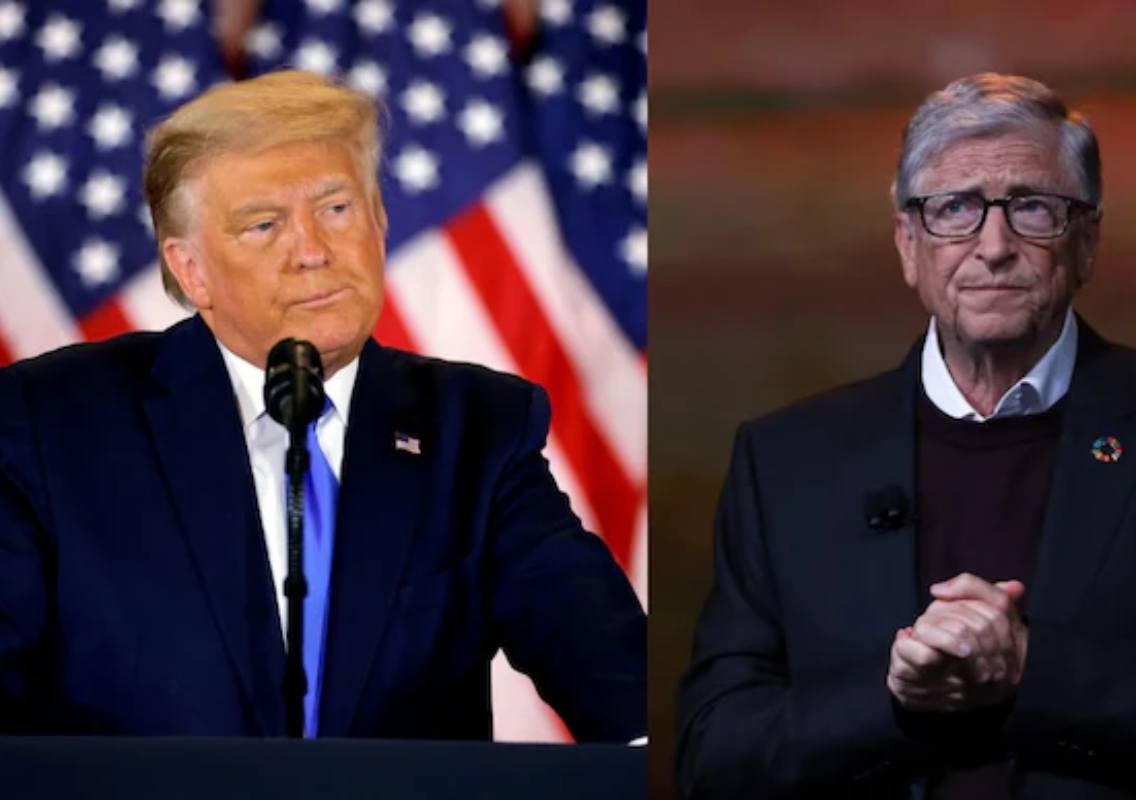


Washington: Microsoft co-founder Bill Gates has pushed back against US President Donald Trump’s position on artificial intelligence, arguing that calls for stronger AI safeguards are not a hoax and would not necessarily put the United States at a disadvantage against China.
Gates made the comments in an interview with NBC’s Meet the Press as debate intensifies in the US over how quickly advanced AI systems should be developed and what safeguards governments should require. He said countries should have an interest in putting safety measures in place and rejected Trump’s argument that regulation could allow China to gain an advantage in the AI race.
The disagreement comes as several technology leaders and AI researchers have raised concerns about the risks posed by increasingly capable AI systems, while Trump has argued that the US should not slow its development because of competition with China.
Bill Gates rejects Trump’s ‘hoax’ claim
Gates was responding to Trump’s recent criticism of calls for greater restrictions and a slowdown in AI development.
Trump has described concerns about AI as part of what he called a conspiracy that could benefit China. He has also dismissed warnings about the technology’s potential risks as a “hoax”, arguing that slowing US development could allow Chinese companies to move ahead.
Asked about Trump’s description of the concerns, Gates gave a direct response.
“It’s not a hoax at all,” Gates said.
He also rejected the argument that China would necessarily refuse to adopt safeguards if the US introduced them.
“All countries should want the safeguards in place,” Gates told NBC. “So anyone that says, ‘Well, you know, China won’t put these safeguards in place’ — I totally disagree with that.”
Gates said he believed China would also have an interest in preventing malicious uses of advanced AI, particularly because increasingly powerful systems could potentially be used to cause large-scale harm.
Gates wants to discuss AI directly with Trump
Gates said he would like to speak directly with Trump about the issue and explain why he believes safeguards would not prevent the US from maintaining its technological position.
“I hope that, given my life’s work in the field, my saying how unique and different this is and how concerned I am will add to what he’s hearing from other people,” Gates said, according to reports of the NBC interview.
Gates has argued that the discussion should not be framed solely as a competition between the US and China. In his view, governments can require monitoring and safety measures while allowing AI development to continue.
He said sophisticated AI models should be monitored and their activities recorded, rather than relying only on an emergency mechanism to shut down a system after something goes wrong.
“The United States ought to make sure this is done. China will want to do this,” Gates said.
Gates calls for mandatory AI oversight
Gates also called for governments and law-enforcement authorities to become more directly involved in deciding what safeguards should apply to advanced AI systems.
“You need law enforcement and the politicians to get into the discussion about what safeguards and monitoring look like,” he said. “And that has to be a required thing.”
His comments go beyond calls for a simple emergency “kill switch”. Gates said such a mechanism alone would not be sufficient because oversight is also needed during the development and operation of sophisticated AI systems.
He has warned that increasingly capable AI could be used by malicious actors for cyberattacks, fraud, disinformation and other forms of large-scale harm. In a recent NBC interview, Gates said AI was powerful enough to drive events that could potentially cause “a billion deaths”.
Gates has not called for AI development to stop altogether. Instead, his position is that governments should require safeguards and monitoring while allowing the technology to continue developing.
Trump argues against slowing US AI development
Trump’s position is centred on maintaining US leadership in AI and avoiding regulations that he believes could constrain American companies.
He has repeatedly linked the debate over AI safeguards to competition with China, arguing that excessive restrictions on US developers could give Chinese companies an opportunity to catch up.
On September 26, Trump said the US was not going to put the “brakes” on AI development despite growing calls from some technology executives and lawmakers for stronger safeguards.
The disagreement reflects a broader divide in the technology sector and Washington over how governments should approach advanced AI. Some technology executives have called for greater oversight of frontier AI, while others have warned that heavy regulation could hinder innovation and American competitiveness.
China has also pushed back against recent US calls for an AI slowdown. Chinese officials and state-linked commentators have characterised some American proposals as an attempt to restrict China’s technological development, adding another layer to the debate over global AI governance.
Trump meets Anthropic CEO Dario Amodei
The debate comes as Trump has begun engaging directly with one of the technology executives who has been among the more prominent voices warning about advanced AI risks.
Trump held a private dinner with Anthropic CEO Dario Amodei at the White House on September 27. The meeting was their first one-on-one encounter and followed months of tensions between Anthropic and the Trump administration over AI safety and the use of the company’s technology by the US military.
The White House did not release details of what was discussed during the dinner.
Amodei has called for greater caution around the development of increasingly capable AI systems, putting him closer to Gates’s position on the need for stronger safeguards. Trump, meanwhile, has maintained that the US must continue advancing rapidly to preserve its technological lead over China.
Trump is also expected to meet other leading technology executives as Washington continues discussions on AI safety, innovation and regulation.
AI regulation debate enters a critical phase
The Gates-Trump disagreement highlights two different approaches to the future of AI policy.
Gates argues that mandatory safeguards and monitoring can coexist with continued technological development. He believes the US can introduce such measures without sacrificing its position in the global AI race and expects other countries, including China, to have reasons to adopt comparable protections.
Trump has instead emphasised the need to protect America’s competitive position and has warned against measures that could slow US companies while competitors continue advancing.
The issue is likely to remain a major policy debate as AI systems become more capable and increasingly integrated into areas ranging from business and cybersecurity to government and critical infrastructure.
For Gates, the central question is not whether AI development should stop, but whether governments can establish effective safeguards before increasingly powerful systems create risks that are harder to manage.
The final shape of US AI policy will depend on discussions among the White House, lawmakers, technology companies and researchers. For now, Gates’s public challenge to Trump’s position adds another prominent voice to an increasingly contested debate over how to balance AI innovation, national competitiveness and safety.