


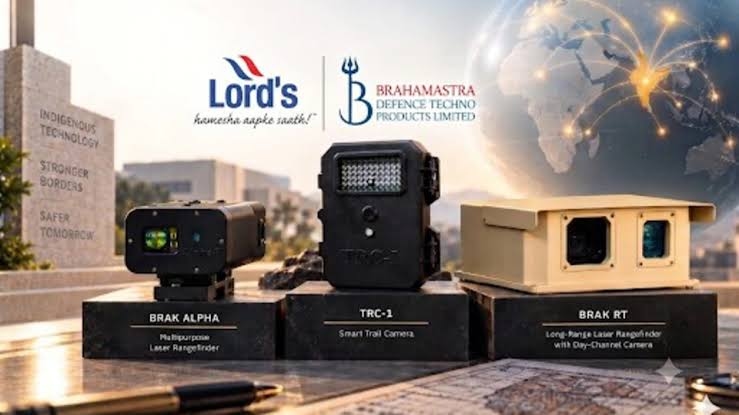


Navi Mumbai: Brahamastra Defence Techno Products Limited, part of Lord’s Mark Industries Limited, is looking to take its indigenous defence technology portfolio to international markets after three years of focused research and development. The company is positioning its products as part of India’s growing efforts to strengthen domestic defence manufacturing under the Make in India and Atmanirbhar Bharat initiatives.
The company’s showcased portfolio includes three flagship products: BRAK RT, a long-range laser rangefinder with a day-channel camera; BRAK Alpha, a multipurpose laser rangefinder; and TRC-1, a smart trail camera designed for field-surveillance applications.
Lord’s Mark Industries says its investment in Brahamastra reflects a long-term strategy to move beyond conventional manufacturing and develop proprietary technologies in India. The company aims to build specialised products with potential applications in domestic and international markets.
The broader portfolio includes holographic and reflex sights, telescopic sights, thermal imaging sights, handheld thermal imagers, day-and-night surveillance systems, anti-drone systems and other optoelectronic equipment.
Three flagship products lead Brahamastra’s portfolio
Brahamastra’s three highlighted products focus on distance measurement, target detection, orientation data and surveillance. Their stated specifications indicate an emphasis on applications that require accurate measurements and reliable operation in demanding field conditions.
BRAK RT: Long-range laser rangefinder
The BRAK RT combines laser-based distance measurement with a dedicated day-observation camera in a single instrument. Its stated maximum measuring range is 20,000 metres, or 20 kilometres, making it the longest-range product among the three showcased systems.
According to the specifications provided by the company, the instrument offers distance accuracy of up to one metre (1σ) and can detect up to five targets. It also incorporates GPS and orientation sensors to provide positional and directional information.
The device has an IP68-rated construction, which is intended to support operation in demanding environmental conditions. Combining measurement and day-channel observation in one instrument is a central feature of its design.
Such equipment can support applications where users need to assess distances and obtain visual information about targets. However, its suitability for specific defence requirements would depend on technical evaluation and the relevant procurement standards.
BRAK Alpha: Multipurpose laser rangefinder
The BRAK Alpha is designed to combine distance measurement with target detection and orientation information. Its stated measuring range is between 10 metres and 5,000 metres.
The company lists a distance accuracy of up to 0.5 metres (1σ), along with the ability to detect up to five targets. The device also includes GPS, azimuth measurement and inclination sensing.
These features are intended to provide users with distance, location and directional information through a single system. Its multipurpose design could make it relevant to field applications where accurate measurements and orientation data are required.
The BRAK Alpha complements the longer-range BRAK RT, offering a different measurement range and accuracy specification within the company’s rangefinder portfolio.
TRC-1: Smart trail camera for surveillance
The third flagship product, TRC-1, is a smart trail camera designed for field surveillance. It combines motion-triggered imaging with day-and-night capture capabilities.
Its stated specifications include still-image resolution of 5 megapixels or higher, 1080p video recording and a minimum 120-degree field of view. The camera also uses invisible infrared illumination with a stated range of up to 10 metres for night-time capture.
Developed and manufactured in Navi Mumbai, Maharashtra, the TRC-1 incorporates a management system featuring role-based permissions and audit records. According to the product description, video is intended to remain stored on the camera rather than being centrally retained by the management platform.
This approach is designed to give users control over access and records while supporting field-surveillance requirements. The company describes the product as having no equivalent products anywhere else in the world. That is a company claim and would require independent market assessment to establish exclusivity.
Wider portfolio targets defence and surveillance requirements
Beyond the three flagship products, Brahamastra is developing a broader range of optoelectronic equipment. Its portfolio includes holographic and reflex sights, telescopic sights, thermal imaging sights and handheld thermal imagers.
The company is also focusing on day-and-night surveillance systems and anti-drone technologies. These categories are increasingly relevant to defence and security applications that require observation, monitoring and detection across different environmental conditions.
The wider product range reflects Lord’s Mark Industries’ ambition to establish Brahamastra as a specialised indigenous technology platform. Rather than relying only on conventional manufacturing, the strategy centres on research, product development and the creation of proprietary systems within India.
The company’s stated objective is to contribute to domestic defence capabilities while exploring opportunities to supply specialised technologies to overseas markets.
Defence electro-optics market offers growth opportunities
Brahamastra’s expansion plans come as demand for military electro-optical and infrared technologies continues to grow. These systems are used in applications such as night operations, border surveillance, target detection and monitoring across land, air and naval platforms.
According to MarketsandMarkets, India’s military electro-optics and infrared (EO/IR) market is projected to increase from US$1.19 billion in 2026 to US$1.78 billion by 2030, registering a compound annual growth rate (CAGR) of 10.4%.
The projected growth reflects increasing requirements for advanced optical equipment and infrared-based capabilities as defence platforms undergo modernisation.
Globally, the military electro-optical and infrared systems market is projected to grow from US$9.09 billion in 2025 to US$10.77 billion by 2031, according to Mordor Intelligence. The report estimates a CAGR of 2.87% over the period.
Demand for advanced sensors, optical systems, long-range targeting equipment and surveillance technologies is creating opportunities for specialised developers. For companies such as Brahamastra, this could provide avenues to explore international partnerships, product deployment and exports.
However, entering overseas defence markets involves more than developing products. Technical qualifications, regulatory approvals, export-control requirements and procurement procedures will influence whether the company’s products can be adopted by international customers.
Lord’s Mark outlines its Make in India vision
Dr Sachidanand Upadhyay, Founder, Managing Director and Chief Executive Officer of Lord’s Mark Industries Limited, said the company’s interest in technology and commitment to the Make in India vision led it to begin the initiative three years ago.
“Our love and enthusiasm for technology and belief in the Make in India vision led us to embark on this journey three years ago. We saw an opportunity to harness India’s engineering talent and research capabilities to develop world-class indigenous defence technologies with global relevance,” Upadhyay said.
He added that the company’s objective was to move beyond meeting domestic requirements and develop products that demonstrate India’s technological capabilities internationally.
“Our vision has always been to go beyond fulfilling domestic needs and create products that reflect India’s technological strength on the international stage. Brahamastra’s evolving portfolio is a step in that direction, with the potential to open new markets and establish India as a recognised contributor to specialised defence technology,” he said.
The company views the development of Brahamastra’s portfolio as part of a broader effort to build indigenous research and manufacturing capabilities. Its three years of research and development have led to the products now being presented for potential market opportunities.
Focus on indigenous research and international expansion
Through its investment in Brahamastra Defence Techno Products Limited, Lord’s Mark Industries is pursuing a strategy centred on domestic research, advanced product development and international market exploration.
The company’s immediate focus is on presenting its rangefinder, surveillance and optoelectronic products to potential customers and partners. Its longer-term ambition is to establish a stronger presence in specialised defence technology categories.
The move also reflects the wider push to increase India’s role in defence manufacturing and reduce dependence on imported technologies. Indigenous development can create opportunities for local engineering, research and manufacturing, while potentially opening export markets.
For Brahamastra, the next phase will involve translating its product development efforts into market adoption. International opportunities will depend on technical validation, regulatory compliance and procurement requirements.
With its three flagship products and wider optoelectronics portfolio, the company is seeking to establish itself as an Indian developer of specialised defence technologies and take its manufacturing ambitions beyond the domestic market.