


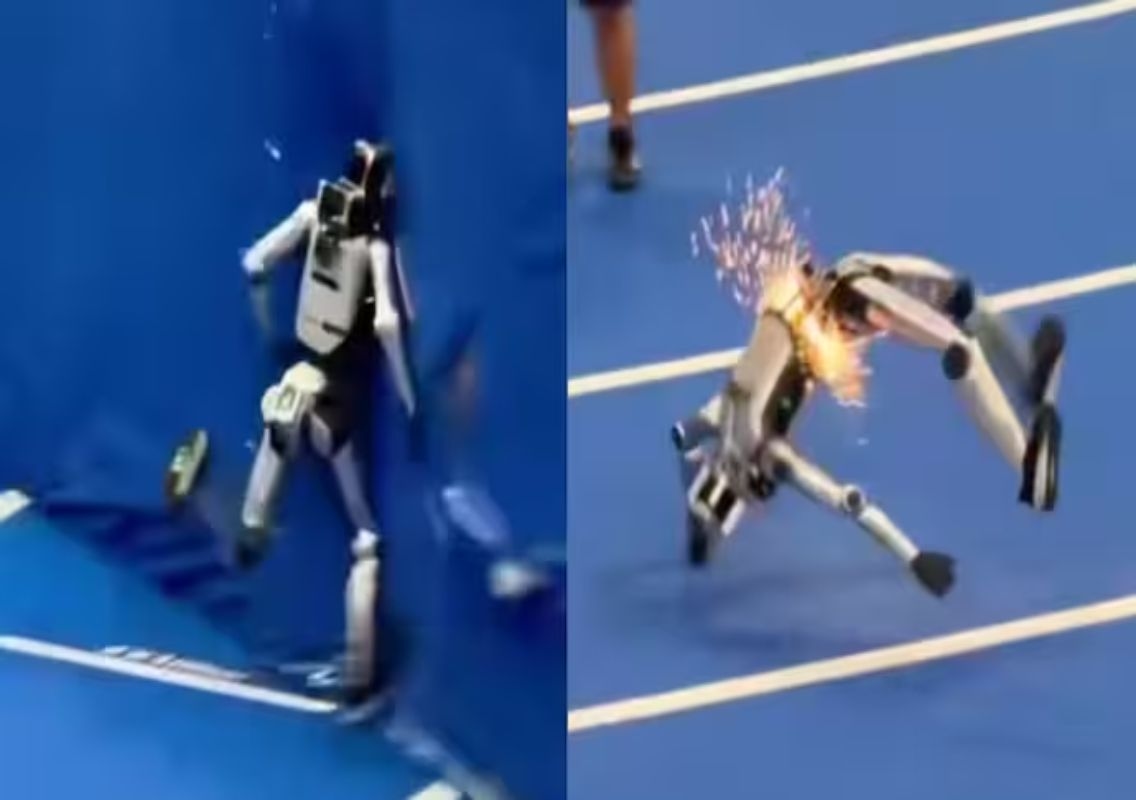


Beijing: A Chinese humanoid robot has grabbed attention online after a video showed it running at remarkable speed before crashing into a safety wall and appearing to shut down. The incident has once again highlighted the rapid progress being made in humanoid robotics in China, while also showing the practical challenges engineers face when machines are pushed towards their performance limits.
The robot was reportedly demonstrated during a test involving a Unitree G1 humanoid robot, a machine designed for research and development in areas including movement, balance and human-robot interaction. In the video, the robot can be seen accelerating rapidly across an indoor testing area before losing control and hitting a protective barrier. (India Today)
The spectacular crash has attracted attention because of the speed at which the robot moves immediately before the collision. Rather than demonstrating only slow walking or carefully controlled steps, the footage shows a humanoid machine attempting a much more aggressive running movement.
The incident is a reminder that achieving human-like movement in robots is not simply a matter of increasing motor power. A humanoid robot needs to coordinate its legs, torso, sensors and control systems in real time while maintaining balance.
Robot’s high-speed run ends in crash
The video shows the humanoid robot beginning its run inside a controlled environment.
As it accelerates, the robot’s legs move rapidly and its body appears to maintain a forward-running posture. The machine continues moving at high speed until it reaches the end of the test area.
It then crashes into a safety wall.
The impact appears to bring the demonstration to an abrupt end, with the robot subsequently lying motionless.
The footage has been widely shared because of the unusual combination of impressive speed and a dramatic failure.
For robotics researchers, however, such incidents are not necessarily surprising. Testing a machine at the limits of its physical capabilities can reveal weaknesses in balance control, braking, motion planning and mechanical design.
A robot that can move quickly in a straight line still needs to be able to stop safely and maintain stability when something changes unexpectedly.
Why running is difficult for humanoid robots
Walking and running are fundamentally different challenges for a humanoid machine.
During normal walking, a robot generally maintains relatively controlled contact with the ground. Running introduces periods when both feet may leave the ground, making balance considerably more difficult.
The robot must calculate where and when to place its feet while constantly adjusting its body position.
Even a small error can cause the machine’s centre of mass to move outside the area where it can safely recover.
Humans perform these calculations naturally through a combination of the brain, nervous system, muscles and sensory feedback. Robots need sensors, processors, actuators and control algorithms to replicate aspects of the same process.
At high speeds, there is less time available to correct an error.
That makes high-speed humanoid running one of the more technically demanding areas of robotics.
Unitree G1 is built for humanoid robotics research
The robot seen in the video has been identified as a Unitree G1, a humanoid platform developed by Chinese robotics company Unitree.
The G1 is designed as a compact humanoid robot for research, development and experimentation.
Its capabilities include walking, movement and interaction with its surroundings, with the platform designed to support developments in areas such as artificial intelligence and robotics.
Humanoid platforms such as the G1 are increasingly being used by researchers and developers because they provide a physical body through which AI systems can learn to interact with the real world.
Instead of simply processing information on a computer screen, an embodied AI system needs to understand physical concepts such as balance, movement, distance and contact.
Speed is becoming a major robotics focus
Humanoid robot development has accelerated rapidly in recent years.
Companies in China, the United States and other countries are competing to build robots capable of performing increasingly complex physical tasks.
Speed is one aspect of this competition.
Robots that can walk, run and move quickly could eventually be useful in industrial environments where rapid movement is required.
However, speed alone is not enough.
A useful humanoid robot must also be reliable, energy-efficient, safe and capable of operating for extended periods.
A machine that runs extremely quickly but frequently falls or crashes would have limited practical value outside a controlled demonstration.
The latest video illustrates this difference clearly.
The importance of balance and control
One of the biggest engineering challenges in humanoid robotics is maintaining balance.
A humanoid robot has a relatively tall body supported by two comparatively small contact areas.
When it moves, its centre of gravity constantly changes.
Robotic control systems therefore have to make rapid adjustments to the position of the legs, hips and upper body.
Sensors can provide information about acceleration, orientation, joint position and contact with the ground.
The robot’s control software then uses that information to determine how its actuators should respond.
At low speeds, the system may have enough time to make corrections.
At high speeds, the margin for error becomes much smaller.
A failed correction can result in a fall or collision within a fraction of a second.
Crashing can be part of the testing process
Although the crash makes for dramatic footage, failures are an important part of robotics development.
Engineers routinely test robots under conditions that are more demanding than normal operation.
Such tests can reveal problems that are difficult to identify through computer simulations alone.
For example, a robot may behave perfectly in a simulation but encounter unexpected mechanical vibrations or changes in friction when tested on a real surface.
Real-world testing also helps engineers understand how components respond to repeated stress.
A crash can therefore provide useful data about what went wrong and how future versions of the system can be improved.
Of course, controlled testing requires appropriate safety measures, particularly when robots are moving at high speed.
Safety barriers are essential
The presence of a safety wall in the demonstration is significant.
When large or fast-moving robots are tested, engineers need to ensure that a malfunction does not endanger people nearby.
A protective barrier can prevent a robot from leaving its designated testing area.
Other safety measures can include emergency stop systems, restricted testing zones and remote controls.
These precautions become increasingly important as robots become faster and more powerful.
A humanoid robot weighing several tens of kilograms and moving rapidly can generate significant impact forces.
Safety therefore has to develop alongside robot performance.
China is investing heavily in humanoid robots
The incident also comes against the backdrop of China’s growing humanoid robotics industry.
Chinese robotics companies and technology firms have invested heavily in developing machines capable of walking, running and manipulating objects.
The country has also placed significant emphasis on robotics and advanced manufacturing as part of its broader technology strategy.
Humanoid robots are increasingly being presented as potential tools for factories, warehouses and other industrial environments.
Chinese manufacturers have been developing both research platforms and robots intended for commercial applications.
The rapid pace of development has resulted in frequent demonstrations of increasingly advanced movement capabilities.
From demonstrations to real-world applications
The ultimate test for humanoid robots will not be how fast they can run for a few seconds.
Instead, companies will need to demonstrate that robots can perform useful tasks reliably over long periods.
Factories, warehouses and other industrial environments require consistency.
A robot might need to pick up objects repeatedly, navigate around people and equipment, respond to unexpected obstacles and recover from minor disturbances.
It must also consume an acceptable amount of energy and require manageable maintenance.
This means that advances in areas such as battery technology, actuators, artificial intelligence and control systems will be just as important as raw speed.
AI is becoming central to robot development
Modern humanoid robots are increasingly being developed alongside advances in artificial intelligence.
AI systems can help robots interpret visual information, recognise objects and plan actions.
When combined with physical control systems, these capabilities could allow robots to perform tasks that are difficult to program manually.
The challenge is ensuring that AI-based decision-making works safely in the unpredictable physical world.
A robot may understand what it wants to do but still need precise motor control to execute the action.
The Unitree demonstration highlights the gap that can exist between impressive movement capability and reliable physical execution.
Why the video has attracted attention
The video is particularly striking because the robot demonstrates both progress and failure within a few seconds.
The rapid run provides a glimpse of how far humanoid locomotion has advanced.
The crash immediately afterwards shows why engineers cannot focus solely on speed.
For the general public, the footage may look like a malfunction.
For robotics researchers, it can be viewed as an example of the challenges involved in pushing a complex mechanical system beyond conventional walking speeds.
That combination has made the clip particularly popular on social media.
What comes next for humanoid robots
Future humanoid robots are expected to become more capable in several areas.
Engineers are working on improved actuators, lighter materials, better batteries, more sophisticated control systems and stronger perception capabilities.
These developments could allow robots to move faster while maintaining greater stability.
Another major goal is improving recovery.
Instead of simply falling when something goes wrong, future robots could potentially recognise instability early and change their movement to avoid a collision.
They could also learn how to stop or change direction more effectively.
These capabilities would be crucial if humanoid robots are eventually expected to work alongside humans.
The bigger lesson from the crash
The dramatic Unitree test demonstrates an important reality about robotics.
Building a machine that can imitate a human movement is only the beginning.
The difficult part is making that movement reliable, repeatable and safe.
Running requires a robot to coordinate numerous systems simultaneously, and increasing speed reduces the time available for error correction.
The crash therefore does not necessarily undermine the technology behind the demonstration. Instead, it illustrates the engineering challenges that remain as researchers push humanoid robots towards more dynamic movement.
Conclusion
The Chinese humanoid robot demonstration has attracted widespread attention after a Unitree G1 was filmed running at high speed before crashing into a safety barrier and appearing to shut down. The incident offered a dramatic glimpse of the progress being made in robotic movement while also highlighting the difficulties associated with high-speed humanoid locomotion. (India Today)
For humanoid robots, speed is only one measure of technological progress. Maintaining balance, reacting to unexpected changes, stopping safely and repeating movements reliably are equally important.
As China and other countries continue to invest in humanoid robotics, demonstrations such as this are likely to become more common. Some will showcase major breakthroughs, while others will inevitably end in spectacular failures. Both outcomes can provide engineers with valuable information as the technology moves from laboratory demonstrations towards real-world applications.