


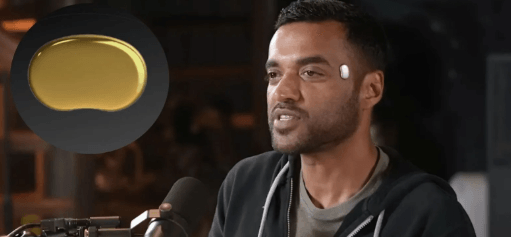


New Delhi: Deepinder Goyal, the entrepreneur who stepped down from his leadership role at Eternal, has revealed more details about Temple, his new wearable technology venture that aims to change how people interact with personal AI assistants.
Describing the project as an attempt to build “Humanity’s Last Personal Device”, Goyal said the team is working on a product that combines continuous health monitoring with an artificial intelligence companion. Unlike conventional smartwatches and voice assistants, Temple is being designed without a screen, camera or microphone.
The company wants the wearable to function as a discreet personal assistant while collecting health and wellness information. Instead of requiring users to look at a display or speak into a conventional microphone, the device is designed to use motion sensors to detect vibrations generated by the wearer’s voice.
Goyal said the idea began as a weekend project focused on developing a health wearable while he was still the chief executive of Eternal. An engineering breakthrough during the project encouraged him to return to building full-time and pursue Temple as a dedicated venture.
The first device, Temple 01, is scheduled to ship in early 2027, with both AI and health-monitoring capabilities.
How Temple’s screen-free AI assistant will work
Temple is taking a different approach from conventional personal assistants that depend on microphones, cameras and screens. The wearable is designed to detect the vibrations produced when its user speaks and convert them into text.
The company calls this technology “roomdeaf audio”. Its stated objective is to capture the wearer’s voice without recording conversations taking place elsewhere in the room.
This approach is intended to make interaction more private and less intrusive. Since the device does not have a conventional microphone, it relies on motion sensors to pick up voice-related vibrations.
Users will be able to activate the assistant with a double tap. A subtle vibration will indicate that the device is listening, while another buzz will signal that it has finished processing the interaction.
The idea is to allow people to interact with an AI assistant without taking out their smartphones or looking at a screen. Temple is positioning the wearable as an always-available companion that can help with everyday activities.
Reminders, messages and memory among planned features
Temple is being developed to handle several tasks commonly associated with smartphone-based digital assistants.
Users will be able to capture ideas, set reminders and retain important details through the wearable. It is also designed to help manage everyday tasks and retrieve information when required.
The device is expected to support messaging as well. Users will be able to send messages through the assistant and receive subtle vibration notifications when someone replies.
This interaction model is intended to reduce the need to repeatedly check a phone for notifications. Instead of relying on a display, the wearable will use haptic feedback to communicate important updates.
The company’s broader ambition is to make the device a personal AI companion that can understand and assist with different aspects of daily life. However, the full range of capabilities and how they will work in practice will become clearer as the product moves closer to launch.
Health tracking is a major focus of Temple
Alongside its AI assistant, Temple is placing considerable emphasis on health monitoring. The company says the wearable is designed to track several health and wellness indicators, including:
- Heart rate
- Heart-rate variability (HRV)
- Sleep patterns
- VO2max, an indicator of the body’s ability to use oxygen during exercise
The company also has an extensive development roadmap that includes features beyond those commonly available in basic fitness trackers.
One planned feature is chewing detection, which could help users monitor eating patterns and support calorie tracking. The company is also working towards analysing snoring patterns and identifying different sleep positions.
Other proposed capabilities include rapid eye movement (REM) sleep tracking and continuous monitoring of core body temperature.
These features indicate that Temple wants to develop a wearable that goes beyond counting steps or recording exercise sessions. Its ambition is to build a device capable of collecting a broader range of information about the human body.
However, several of the capabilities are part of the development roadmap and should not be assumed to be available in the first version. The company has not provided a complete list of features that will be ready when Temple 01 begins shipping.
Temple highlights privacy as a key differentiator
Privacy is another major part of Temple’s product proposition. The company says its design is intended to protect conversations and personal information collected through the wearable.
According to Temple, conversations are encrypted end-to-end and are not shared with AI model providers. It also claims that its own team cannot access users’ conversations.
The company further says that user data will not be sold for advertising.
These claims are significant because personal AI assistants may handle sensitive information, including reminders, private thoughts, messages and details about everyday routines. A wearable that is continuously available must establish clear safeguards around what it collects, how that information is processed and who can access it.
Temple’s stated privacy model is intended to address some of these concerns. However, the practical implementation, encryption architecture and independent verification of the company’s claims will be important considerations as the product approaches commercial availability.
From a weekend experiment to a new venture
Goyal said Temple originated as a weekend project when he was still leading Eternal. The initial objective was to build a health-focused wearable, but an engineering breakthrough changed the direction of the project.
That development prompted him to return to building full-time and pursue the idea through Temple.
His description of the venture as an attempt to create “Humanity’s Last Personal Device” reflects an ambition that extends beyond launching another fitness tracker or smart accessory. The company is exploring how a single wearable could combine personal assistance, health information and everyday communication.
Goyal has described Temple as an evolving research project rather than a conventional consumer electronics product. This suggests that the first device is intended to be the starting point for a longer development journey.
Temple 01 launch planned for early 2027
Temple 01 is scheduled to ship in early 2027 with both AI assistant and health-monitoring features. The company has not yet provided a complete picture of its final specifications, pricing or wider commercial availability.
The first version will be an important test of whether Temple’s screen-free interaction model can work in everyday situations. Its ability to recognise the user’s voice through vibrations, provide useful AI assistance and deliver reliable health information will determine how practical the concept is.
The proposed features also raise expectations around accuracy, battery life, comfort and privacy. Continuous health monitoring and an always-available AI assistant will require the wearable to operate reliably without becoming intrusive.
For now, Temple is positioning itself as an attempt to rethink the relationship between people and personal technology. If its approach works as intended, the device could offer an alternative to assistants that depend on smartphones, microphones and displays. Its actual capabilities, however, will become clearer when Temple 01 reaches users in 2027.