







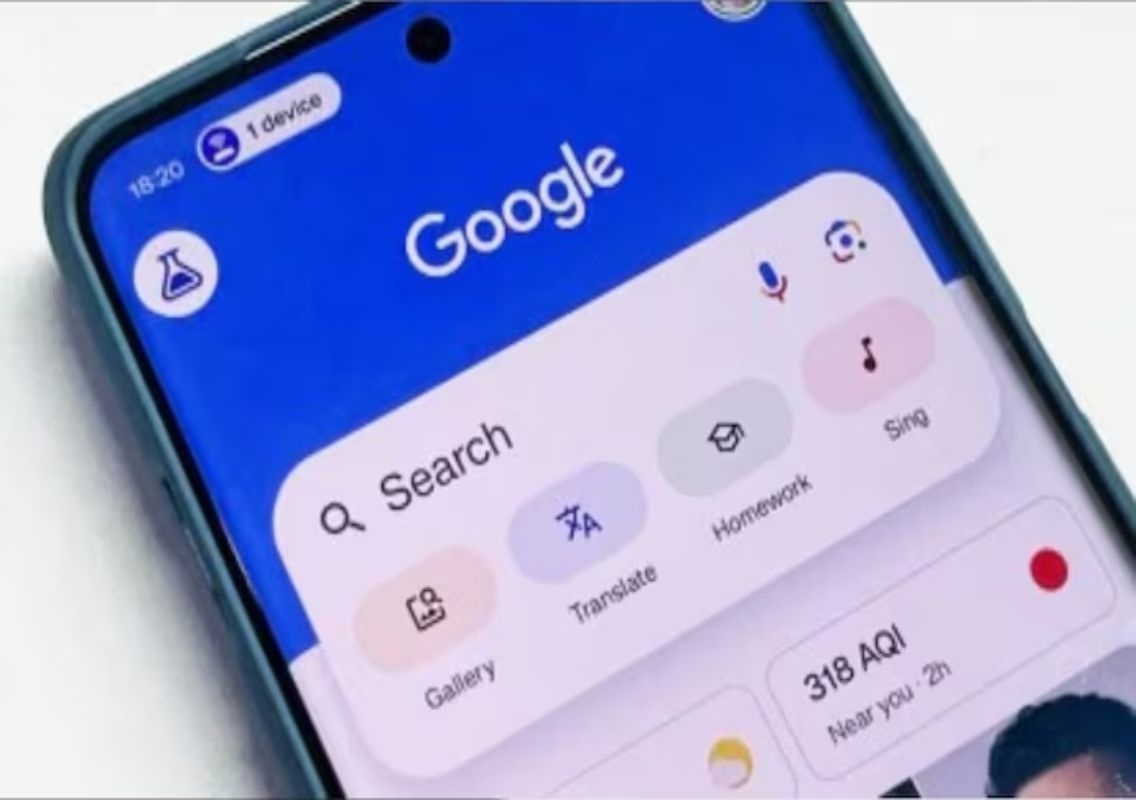


Mountain View: In a landmark shift announced at Google I/O 2026, Google revealed sweeping changes to its Search platform, signalling the end of the traditional “blue links” experience that has defined internet browsing for over 25 years.
The company introduced a new AI-first approach to Search, powered by Gemini 3.5 Flash, which transforms the search engine into a conversational, task-oriented assistant. Instead of simply listing websites, Google Search will now answer questions, perform tasks and continuously monitor information on behalf of users.
End of keyword-based searching
Mountain View: For decades, users relied on typing short keyword phrases into Google and browsing through multiple links to find relevant information. However, this approach is now being gradually replaced by conversational interactions.
Google’s AI Mode, introduced earlier, allows users to ask detailed questions in natural language. The company revealed that AI Mode has already crossed over one billion monthly users, with adoption growing rapidly.
With the latest update, Search now integrates Gemini 3.5 Flash as its default AI model within AI Mode. The system can also suggest smarter queries, helping users refine their searches beyond basic autocomplete functions.
Users can now search using a combination of formats, including text, images, videos, files and even open browser tabs, making the process more intuitive and flexible.
Search becomes conversational and context-aware
Mountain View: One of the most significant upgrades is the ability to hold continuous conversations within Search. Users can now ask follow-up questions directly from AI-generated responses without restarting the search process.
The system retains context from previous queries, enabling more relevant and personalised answers over time. This conversational approach aims to reduce the need to repeatedly refine searches and navigate across multiple pages.
AI Overviews, which summarise information directly within Search, are also becoming more interactive and dynamic, offering deeper insights with fewer clicks.
AI agents will search for users
Mountain View: A key highlight of the announcement is the introduction of Search agents — autonomous AI systems that can perform tasks and monitor information continuously.
These agents can scan various sources, including news platforms, blogs, social media and real-time data feeds, to deliver updates without requiring repeated manual searches.
For example, a user searching for rental properties can set preferences once, and the AI agent will track listings across the internet and notify them when suitable options become available.
This marks a shift from active searching to passive information discovery, where the system works in the background on behalf of the user.
From search engine to task assistant
Mountain View: Google is also expanding Search’s capabilities beyond information retrieval to task execution. Through what it calls “agentic booking”, users can now discover, compare and book services directly within Search.
In certain categories such as home services, beauty and pet care, the platform can even place calls to businesses on behalf of users to check availability or make bookings.
This evolution reflects Google’s broader ambition to transform Search into a tool that not only provides answers but also completes real-world tasks.
Mini apps and real-time dashboards
Mountain View: Among the more advanced features unveiled is the ability for Search to create custom mini applications and dashboards.
Using AI and the company’s Antigravity system, Search can now generate tools such as fitness trackers, event planners or moving checklists based on user queries. These tools can integrate live data, including maps, weather updates and reviews, to provide real-time functionality.
Additionally, Search can produce dynamic visual outputs such as charts, tables and simulations, allowing users to interact with complex information instead of simply reading about it.
Personalised intelligence in Search
Mountain View: Google also introduced “Personal Intelligence”, a feature that connects Search with other Google services such as Gmail and Photos to deliver highly personalised responses.
By analysing user data securely, Search can provide context-aware suggestions tailored to individual preferences, schedules and activities.
This marks a significant step towards making Search a deeply personalised experience, moving away from a one-size-fits-all model.
Conclusion
Mountain View: The changes announced at Google I/O 2026 represent one of the most significant transformations in the history of internet search. By replacing traditional blue links with AI-driven answers, agents and interactive tools, Google is redefining how users access and interact with information.
As Search evolves into a proactive assistant capable of understanding, predicting and acting on user needs, the future of browsing may look less like searching and more like having a conversation with an intelligent system.