


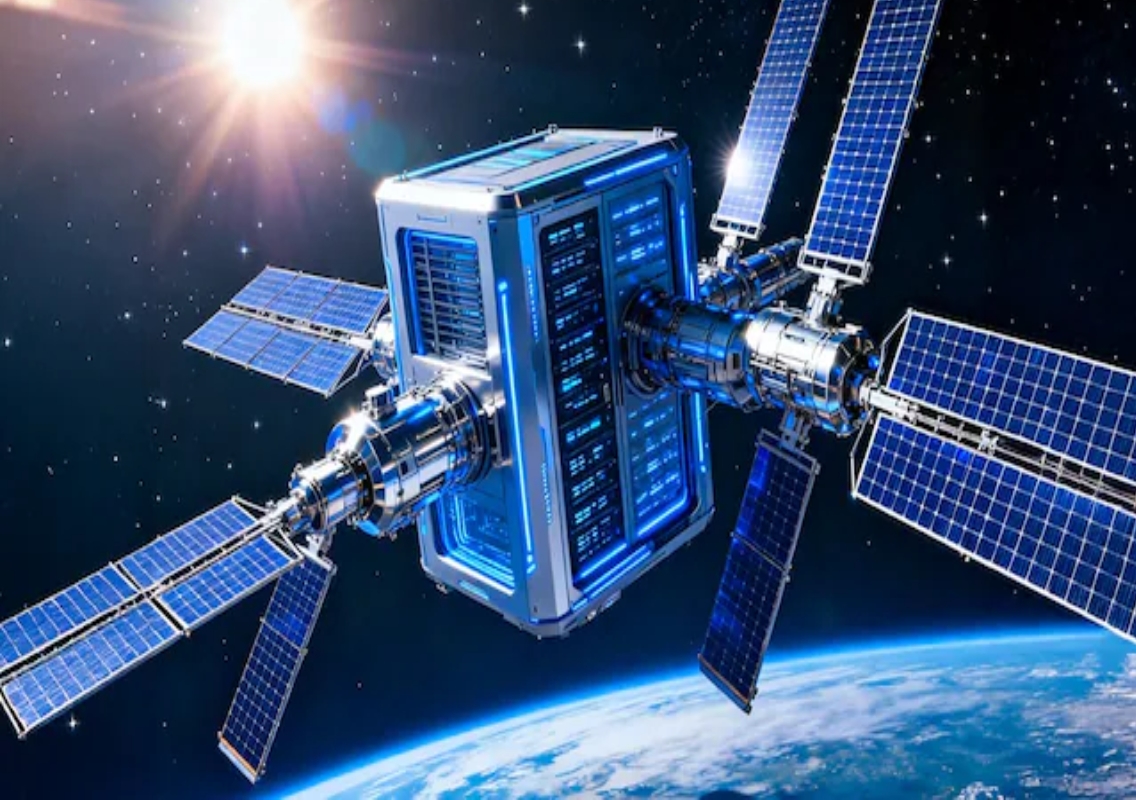


New Delhi: Google has successfully run its first artificial intelligence (AI) workload on a satellite in orbit, bringing its ambitious plan to build space-based data centres a step closer to reality. However, the early experiment has exposed a major engineering challenge: the satellite does not generate enough electricity to operate all its AI processors together.
The prototype is part of Google’s Project Suncatcher, a research initiative exploring whether networks of solar-powered satellites could eventually provide computing capacity for AI workloads. The satellite has received a command from engineers on Earth, processed an AI prompt and transmitted a complete response back.
Google CEO Sundar Pichai described the achievement as a “hello world” milestone for the project. The successful test demonstrates that AI computing can be performed in orbit, but the technology remains at an early experimental stage.
Google’s satellite completes its first AI test
The prototype satellite was launched on October 1, 2026, aboard a SpaceX Falcon 9 rocket, alongside more than 100 other spacecraft. It then underwent several weeks of commissioning and system checks before completing its first AI task.
For the initial demonstration, engineers sent a prompt asking the satellite to generate a haiku about space. The onboard system used Gemma 4, an AI model developed by Google DeepMind and pre-loaded onto the spacecraft.
The satellite generated a three-line poem and sent the response back to Earth. Google also tested it with space-themed limericks and prompts asking it to report technical information about its operating status and surrounding orbital conditions.
The demonstration is important because it shows that the satellite can receive instructions, run an AI model using onboard computing hardware and return the result without relying entirely on a conventional data centre on Earth.
However, this is not yet a commercial orbital data centre. The current spacecraft is a prototype designed to test the hardware and operating conditions required for Google’s longer-term ambitions.
Power supply is the biggest immediate limitation
The satellite carries four Google Tensor Processing Units (TPUs), the company’s custom processors designed for AI workloads. But its electricity-generation capacity is limited to approximately one kilowatt.
That is not sufficient to operate all four processors simultaneously. The spacecraft can run only one TPU at a time, and even that operation is limited to around 20 minutes.
This restriction creates a significant challenge for the development of space-based computing infrastructure. AI processors require substantial electricity, particularly when handling demanding workloads. A satellite must generate and manage enough power to run its computing hardware while also supporting communication systems, thermal controls and other essential equipment.
The current prototype is therefore testing more than whether an AI model can operate in orbit. It is also helping engineers understand how much energy future satellites will need and how effectively that energy can be generated, stored and distributed.
The limitation does not mean the experiment has failed. Rather, it highlights one of the technical problems Google must solve before orbital computing can be expanded.
Radiation and extreme temperatures create further risks
Electricity is only one part of the challenge. Electronic equipment in space must also withstand conditions that are very different from those inside a terrestrial data centre.
One major concern is radiation. High-energy particles can interfere with electronic circuits and memory, potentially changing stored data. Engineers refer to such unexpected changes as “bit flips”.
A bit flip can corrupt information without necessarily triggering conventional monitoring systems. For AI infrastructure, this creates concerns about the reliability of computations and the integrity of data processed in orbit.
Google has conducted ground-based tests to understand how radiation could affect its TPUs. Those tests indicated that radiation might create greater challenges for AI training workloads than for inference, which involves using an already-trained model to generate responses.
The company now wants to observe how its processors behave under actual space conditions, including radiation exposure and extreme temperature variations.
These tests will help determine whether specialised hardware and protective systems can make orbital AI computing reliable enough for more demanding applications.
Google plans two more satellites in 2027
Google’s next planned step is to launch two additional satellites in 2027, provided the current testing programme progresses successfully.
The proposed spacecraft are expected to have greater power-generation capabilities. They will also help demonstrate optical communication links between satellites.
These links are important to the broader Project Suncatcher vision. Instead of relying on isolated spacecraft, Google wants to explore networks of closely flying satellites that can communicate with one another and coordinate computing tasks.
Optical links could allow satellites to exchange data at high speeds, making it possible to distribute workloads across multiple spacecraft. Such a system would be more ambitious than simply placing a single AI processor on an individual satellite.
The planned 2027 launches are therefore intended to test important building blocks of a connected orbital computing network. They do not represent a confirmed commercial launch schedule for a fully operational space data centre.
Why Google is exploring data centres in space
The rapid expansion of AI has increased demand for computing infrastructure, including specialised processors, electricity, cooling systems and data-centre capacity.
Conventional data centres require substantial land, reliable electricity connections and complex cooling arrangements. As AI workloads grow, technology companies are exploring alternative ways to expand computing capacity.
Google believes that solar-powered satellites could eventually offer advantages in energy generation. In a suitable orbit, solar panels may receive sunlight for longer periods than panels on the ground, potentially reducing dependence on large battery systems.
However, these potential advantages must be weighed against the cost and complexity of launching equipment into space, maintaining it in orbit, handling heat, protecting electronics from radiation and transmitting data between satellites and Earth.
The company has indicated that making space-based AI computing economically viable could take until the 2030s. That timeline reflects the scale of the engineering and commercial challenges involved.
An early experiment, not an immediate replacement for data centres
Project Suncatcher is one of Google’s longer-term research efforts into the future of AI infrastructure. Its first successful orbital AI response is a significant technical milestone, but the satellite’s power limitations show how much work remains.
The planned launches in 2027 will help establish whether improved power generation and satellite-to-satellite communication can support more complex workloads. Radiation resistance, thermal management and the economics of deploying large numbers of spacecraft will also influence the project’s progress.
For now, Google’s experiment has demonstrated that an AI model can process a prompt in orbit and send the answer back to Earth. Turning that demonstration into a scalable network of space-based data centres will require advances in power systems, computing hardware and communications.