









Mountain View: Google is preparing to send its artificial intelligence hardware into space as the company begins the first in-orbit test of Project Suncatcher, a long-term research effort exploring whether large-scale AI computing could eventually be hosted in orbit.
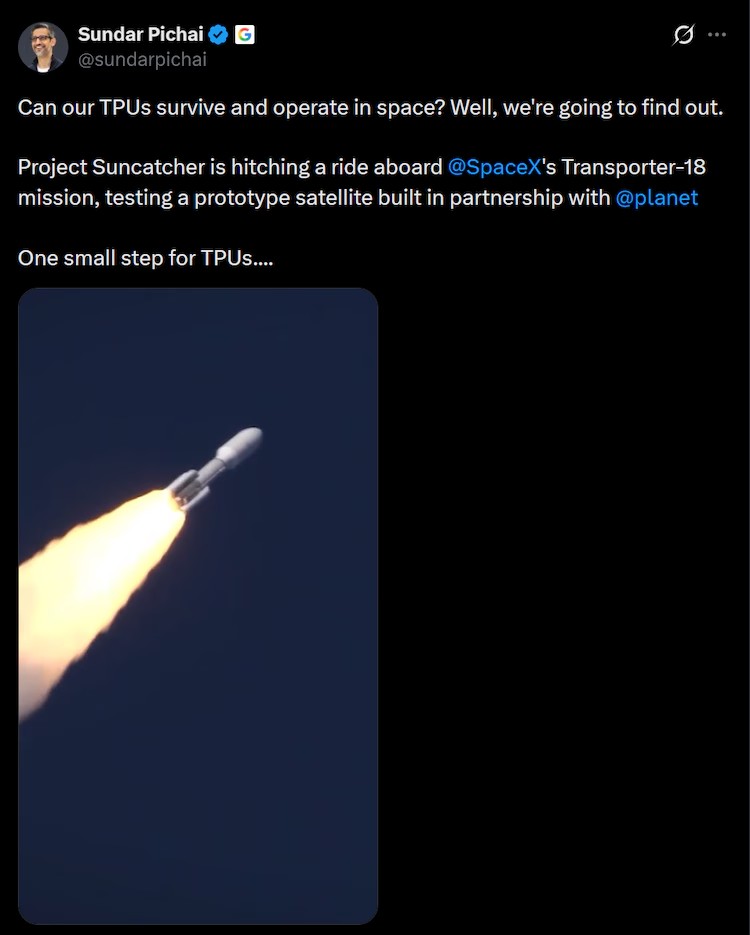
The initial mission will place a prototype satellite carrying Google’s Tensor Processing Units (TPUs) in low Earth orbit aboard SpaceX’s upcoming Transporter-18 rideshare mission. The project is being developed in partnership with Planet and is designed to test whether Google’s AI hardware can operate reliably amid the physical, radiation and thermal challenges of space.
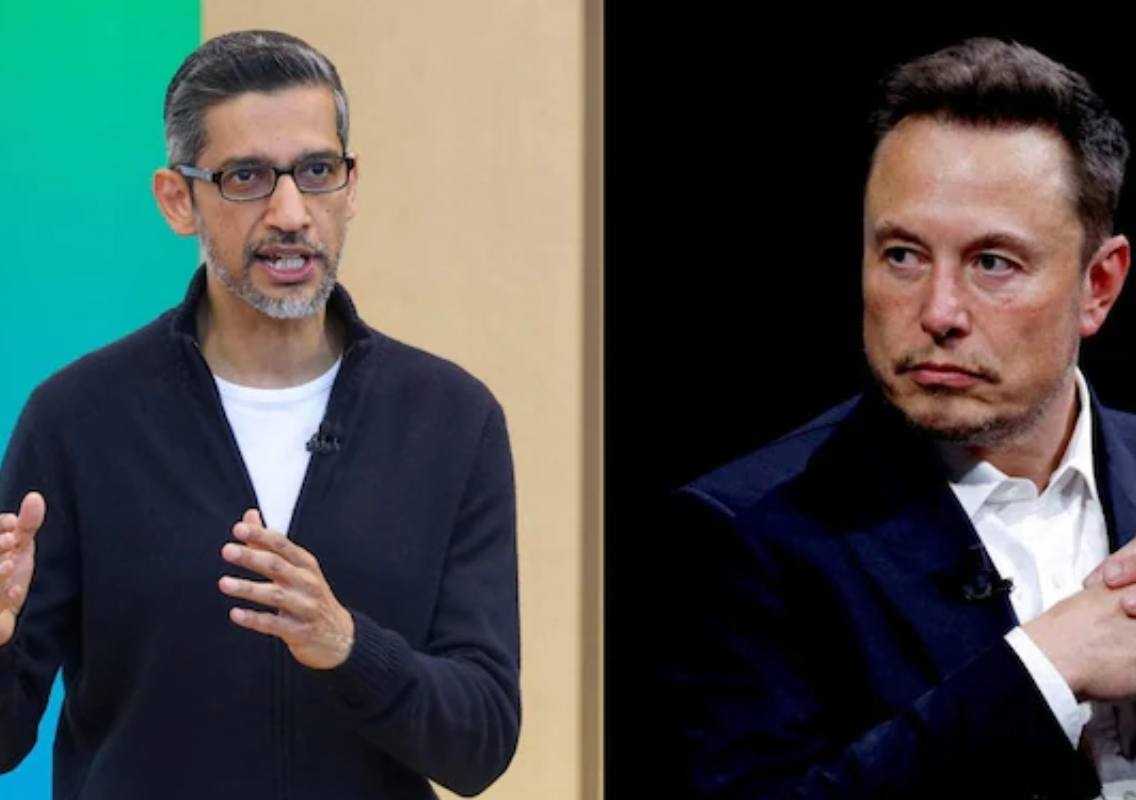
Google CEO Sundar Pichai highlighted the upcoming mission on X with the phrase, “One small step for TPUs….”, echoing the famous words associated with the first Moon landing.
The mission is an early experiment rather than the launch of an operational orbital data centre. Google says the immediate objective is to collect real-world data that can guide the development of future space-based AI infrastructure.
What is Project Suncatcher?
Google introduced Project Suncatcher in 2025 as a research programme examining whether an interconnected network of solar-powered satellites equipped with TPUs could eventually provide scalable machine-learning computing in space.
The company is investigating the idea partly because satellites in low Earth orbit can receive near-constant sunlight. Google says such satellites could potentially generate up to eight times more solar power than comparable solar installations on Earth.
The longer-term concept involves clusters of satellites carrying multiple TPU chips and working together to process larger AI workloads.
However, Google emphasises that this is still a research project. The company has identified several major engineering problems that must be solved before space-based AI computing could become commercially viable.
The first of those questions is straightforward: can Google’s AI chips actually survive and operate in orbit?
First TPU test will examine space conditions
The Transporter-18 mission will give Google an opportunity to collect data that cannot be obtained through laboratory testing alone.
A rocket launch exposes spacecraft to intense vibration and acceleration. Google says a trip to low Earth orbit takes roughly 10 minutes and can subject spacecraft to sustained acceleration of up to 10 times the force of gravity.
Individual components such as TPU chips can experience considerably higher forces, potentially reaching 50 to 100 times the force of gravity.
Google has already carried out vibration testing by shaking the prototype satellite along all three axes to replicate the conditions experienced during launch. The company said the hardware withstood the testing.
The actual orbital mission will provide another layer of information by showing how the components behave during a real launch and while operating in space.
Radiation is another major challenge
Electronic systems operating outside the protection of Earth’s atmosphere face significantly different radiation conditions.
Solar activity and cosmic rays can interfere with electronics and potentially cause errors in computing systems.
Google tested its Trillium TPUs at the University of California, Davis’ Crocker Nuclear Laboratory, where the chips were exposed to radiation while running AI workloads.
According to Google, the initial results showed that the TPUs could withstand a total ionising radiation dose greater than the level they would be expected to receive during a five-year space mission.
Laboratory testing, however, cannot replicate every condition encountered in orbit.
That is why the upcoming mission is important to Project Suncatcher. Google wants to compare laboratory results with actual flight data and identify problems that only emerge during extended operation in space.
Cooling AI chips in space
Keeping powerful AI hardware cool could be one of the biggest challenges in building orbital data centres.
TPUs produce substantial amounts of heat while processing workloads. On Earth, data centres can use airflow and other cooling systems to move heat away from computing equipment.
Space presents a different problem because there is no atmosphere for conventional airflow-based cooling.
Google is therefore testing a cooling system that combines heat pipes with radiators. The company has already tested the technology inside a thermal vacuum chamber designed to simulate the vacuum and thermal conditions of space.
The upcoming mission will help determine how effectively the system can handle the heat generated by the TPUs in actual orbit.
Google plans satellite clusters for future AI workloads
Project Suncatcher goes beyond testing a single satellite.
Google’s longer-term designs envision clusters of satellites, with each spacecraft potentially carrying dozens of TPU chips.
The satellites would have to communicate with one another rapidly enough to operate as a distributed computing system.
That creates another major engineering challenge: high-speed communication between moving satellites.
Google plans to use laser links to connect the spacecraft. The company says future satellites would need to know their own positions as well as the positions of neighbouring satellites with extremely high precision.
The communication system would also need to support very high bandwidth across short distances.
Google plans to test this part of the concept in 2027, when it aims to put two satellites into orbit.
Elon Musk reacts to Google’s space AI plans
Google’s announcement also drew a reaction from Elon Musk, who has repeatedly discussed the possibility of moving computing infrastructure into space.
Musk responded to the announcement on X, saying, “The amount of compute in space will obviously round up to 100 per cent of all compute.”
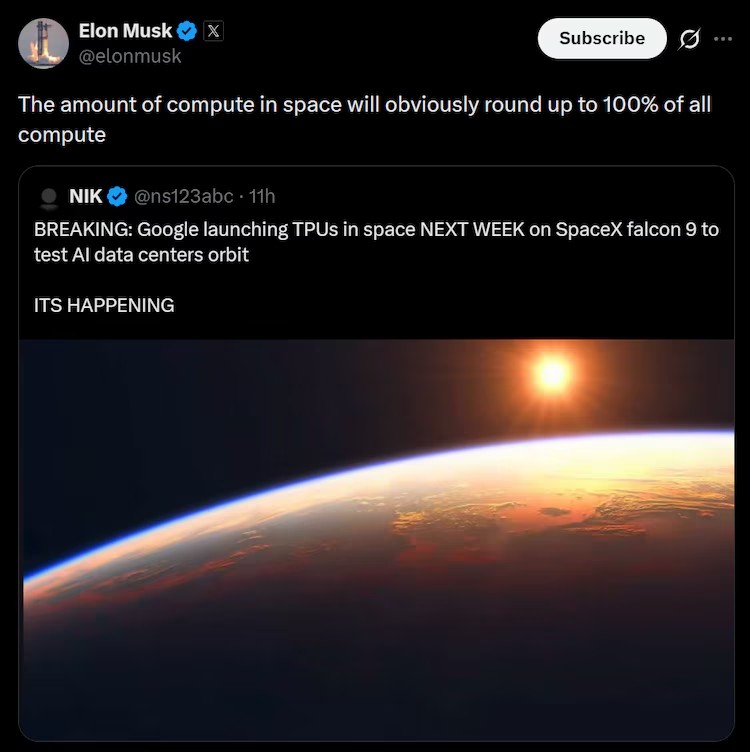
His comment reflects his broader interest in orbital computing and the possibility of using space-based infrastructure to meet the growing electricity requirements of artificial intelligence.
Musk has previously argued that terrestrial power generation could eventually struggle to keep pace with the computing demand created by AI and has promoted space-based computing as a potential long-term solution.
Google’s approach is more cautious at this stage. The company describes Project Suncatcher as an early research effort focused on testing individual technologies and understanding whether the concept is technically feasible.
Why companies are looking at AI infrastructure in space
The rapid growth of AI has increased demand for computing infrastructure, while data centres require large amounts of electricity and cooling capacity.
Space offers a different physical environment.
Satellites in low Earth orbit can receive sunlight for much longer periods than solar installations on the ground, depending on their orbit and operating conditions. Google estimates that solar power generation could be significantly higher in orbit.
That potential is one of the reasons the company is investigating whether AI computing could eventually be performed outside conventional terrestrial data centres.
There are still major questions about launch costs, maintenance, communications, radiation protection, thermal management and the ability to manufacture and replace large numbers of satellites.
Project Suncatcher is intended to address some of those questions step by step rather than immediately creating a full-scale orbital data-centre network.
Google is not alone in exploring space-based computing
Google’s project is part of a wider interest in using space for computing infrastructure.
Elon Musk’s SpaceX has been associated with discussions around orbital data centres, while other technology and aerospace companies are also examining the possibility of putting advanced computing hardware into orbit.
Amazon founder Jeff Bezos’ Blue Origin has explored concepts involving data centres in space and lunar-orbit infrastructure.
In India, AI startup Sarvam AI has also announced plans involving orbital data centres in partnership with aerospace company Pixxel.
Another company, Starcloud, has been working on putting advanced computing hardware into orbit and has discussed using GPUs for space-based AI workloads.
These initiatives remain at different stages of development, and the technical and economic viability of large-scale orbital computing has yet to be established.
From one satellite to a possible orbital AI network
For Google, the upcoming Transporter-18 mission represents the first practical step towards answering whether TPUs can function reliably in space.
The company has already tested hardware against vibration, radiation and thermal conditions on Earth. The next step is to see what happens when those systems are placed in actual orbit.
If the initial experiments are successful, Google plans to investigate how multiple satellites could be connected using high-speed laser communication.
That could eventually form the foundation for distributed AI computing in orbit, although such a system would require substantial advances in satellite design, thermal management, power generation, communications and launch economics.
For now, Project Suncatcher remains a research moonshot rather than a commercial orbital data-centre deployment.
The upcoming mission is therefore less about moving Google’s AI infrastructure to space immediately and more about determining whether the basic technology can survive and operate there.