


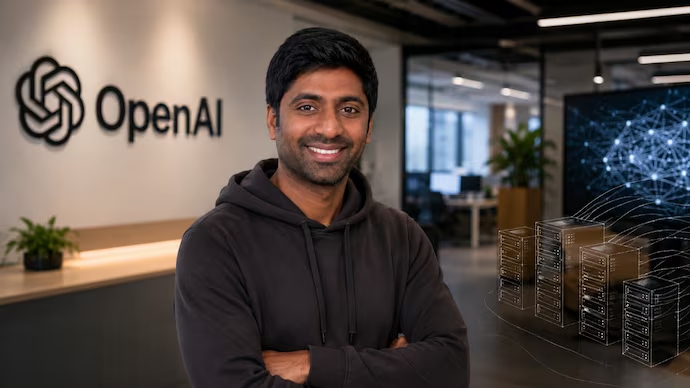


New Delhi: OpenAI has appointed Uday Ruddarraju to lead its data centre and computing infrastructure operations as the artificial intelligence company prepares for a leadership transition, with Sachin Katti set to step down from the role over the coming weeks.
Ruddarraju, an engineering graduate of Hyderabad’s Chaitanya Bharathi Institute of Technology (CBIT), will oversee the computing capacity and infrastructure required to develop and operate OpenAI’s AI models. He joined the company in 2025 and has since taken on senior responsibilities across its compute operations.
Katti will remain with OpenAI as an adviser following the transition. The leadership change comes as the company expands its data centre network and secures additional computing resources to support the growing demands of AI development.
Ruddarraju’s appointment marks another step in a career that has taken him from Hyderabad to major technology companies in the United States, including eBay, Robinhood and Elon Musk’s xAI. His experience in cloud infrastructure and large-scale computing is expected to be central to OpenAI’s efforts to expand its infrastructure.
From Hyderabad’s CBIT to Silicon Valley
Ruddarraju’s professional journey began with a computer science degree from Chaitanya Bharathi Institute of Technology in Hyderabad.
After completing his undergraduate studies, he undertook several internships, including a software engineering internship at Amazon. He later moved to the United States to pursue a master’s degree in computer science at the University of Minnesota.
His first full-time position came in 2013, when he joined eBay as a software engineer working on cloud infrastructure.
Over the next five years, he progressed to become a senior member of technical staff and a technical lead for cloud and platform systems. The experience gave him exposure to the infrastructure needed to support a large online marketplace, where reliability, computing capacity and the ability to handle changing workloads are essential.
His early career established a foundation in the engineering and operational challenges associated with running large-scale technology platforms.
Six years at Robinhood strengthened his infrastructure experience
In 2018, Ruddarraju joined Robinhood, the US financial technology company known for its trading platform.
He spent nearly six years at the company, rising through its engineering ranks to become senior director of engineering and head of infrastructure.
The role involved leading infrastructure teams as Robinhood expanded its operations and user base. Financial technology platforms depend on systems that can handle large volumes of activity while maintaining reliability, security and performance.
Managing such systems provided Ruddarraju with experience relevant to the challenges facing AI companies, where infrastructure must support demanding workloads and rapid growth.
His work at Robinhood also expanded his responsibilities beyond individual engineering projects to managing teams and overseeing infrastructure at an organisational level.
At xAI, he worked on large-scale AI computing
Ruddarraju joined xAI in 2024 as head of infrastructure engineering.
The company, founded by Elon Musk, develops AI models including Grok. Training and operating these models requires large clusters of specialised computing hardware, extensive power capacity and supporting infrastructure.
At xAI, Ruddarraju worked on the systems needed to support large-scale AI development. The experience placed him closer to the infrastructure requirements of frontier AI models, which differ from those of conventional cloud services and consumer technology platforms.
AI computing infrastructure involves more than acquiring processors. Companies must also coordinate data centre construction, power and cooling systems, networking, hardware deployment and the software required to keep computing clusters operating efficiently.
Ruddarraju’s work at xAI added this specialised experience to his earlier background in cloud platforms and financial technology infrastructure.
Joining OpenAI and rising to a senior compute role
Ruddarraju joined OpenAI in July 2025 as head of compute and infrastructure.
He was promoted to chief technology officer for compute in July 2026, according to the details provided about his career progression. His responsibilities have centred on the computing resources required to develop and operate OpenAI’s models and services.
OpenAI’s infrastructure requirements have grown alongside the adoption of its AI products. Training increasingly capable models and serving large numbers of users requires substantial computing capacity, making access to data centres and specialised hardware an important part of the company’s strategy.
Ruddarraju’s appointment to lead the broader infrastructure and compute operations places him at the centre of those efforts.
His responsibilities will include coordinating infrastructure engineering, overseeing data centre projects and maintaining relationships with commercial partners involved in expanding the company’s computing capacity.
What will Ruddarraju do at OpenAI?
Ruddarraju will report to OpenAI president Greg Brockman and oversee data centre projects, infrastructure engineering and relationships with the company’s commercial partners.
The role combines technical responsibilities with commercial coordination. OpenAI needs to expand computing capacity while working with companies that provide chips, data centre infrastructure, construction expertise and other essential services.
Ruddarraju has already worked with the company’s engineering, construction and technical teams, as well as executives at partner organisations, including Nvidia chief executive Jensen Huang.
Speaking to Bloomberg about the transition, Ruddarraju said he expected the handover to be smooth because he had already been working with the teams involved.
He also acknowledged that the new role would require greater attention to commercial relationships.
“Sachin has done an incredible job maintaining the commercial partnerships,” Ruddarraju said, adding that he would need to spend more time on the commercial side.
The comments indicate that his responsibilities will extend beyond technical planning to include the partnerships and business arrangements needed to deliver large infrastructure projects.
Sachin Katti moves into an advisory role
Katti, who joined OpenAI from Intel in November 2025, has overseen several major infrastructure initiatives during his tenure.
Among them was an eight-gigawatt project in Ohio involving SB Energy and Nvidia. He also worked on a data centre in Georgia that was described as the first to be designed and led by OpenAI.
Such projects reflect the scale of infrastructure planning required by AI companies. Large data centre developments involve long construction timelines, substantial power requirements and coordination among technology providers, developers and energy partners.
Following the leadership transition, Katti will continue to advise OpenAI rather than leaving the company entirely.
OpenAI’s GPT-Infra initiative, which uses the company’s AI models to help develop semiconductors and infrastructure, will come under chip chief Richard Ho.
The changes redistribute responsibilities across the company’s infrastructure and chip-related operations as OpenAI continues to expand its technical capabilities.
Why data centres are central to OpenAI’s AI ambitions
The leadership transition comes at a time when computing infrastructure has become one of the major constraints on the development and deployment of advanced AI.
Training AI models requires large quantities of computing power, while running those models for millions of users creates continuing demand for processing capacity.
Data centres house the specialised hardware and supporting systems needed to meet those requirements. Their development involves securing suitable sites, obtaining sufficient electricity, installing cooling and networking systems, and ensuring that hardware can operate reliably at scale.
For OpenAI, expanding this infrastructure is closely linked to its ability to develop new models and make existing services available to customers.
The company must also coordinate with commercial partners to secure hardware and deliver projects on time. These relationships can be as important as the technical design of the computing systems themselves.
Ruddarraju’s background across cloud infrastructure, financial technology and AI computing gives him experience in several of the areas involved in that work.
A Hyderabad graduate takes on a major AI infrastructure role
Ruddarraju’s appointment highlights the career path of an Indian engineering graduate who has progressed through major technology companies in the United States to take on a senior role at one of the world’s leading AI developers.
His experience spans cloud systems at eBay, infrastructure leadership at Robinhood, AI computing at xAI and compute operations at OpenAI.
The next phase of his work will involve balancing the technical demands of large-scale computing with the commercial arrangements required to expand infrastructure.
As OpenAI continues to develop and deploy increasingly capable AI systems, data centre capacity, reliable power and access to specialised hardware will remain central to its operations.
Ruddarraju will be responsible for helping coordinate those requirements, while Katti’s move to an advisory role will provide continuity during the transition.