







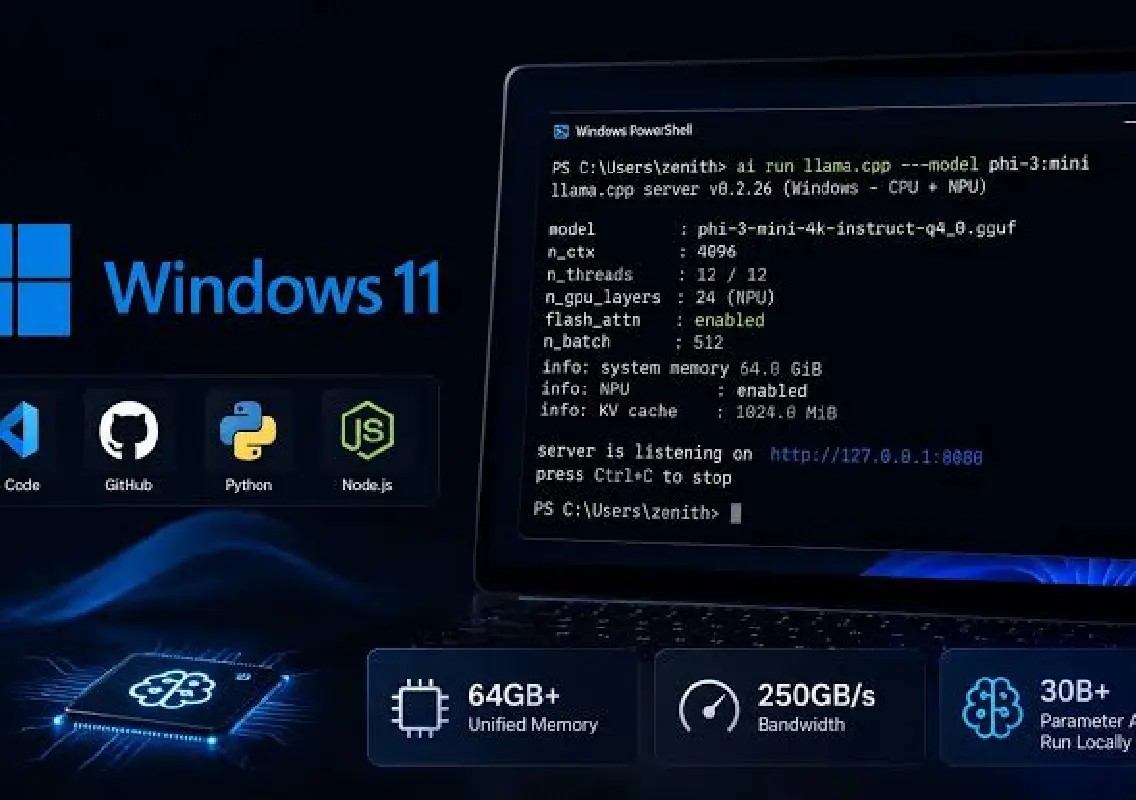


Microsoft has announced Project Zenith, a new ready-to-code Windows experience designed for developer-class devices and aimed at helping developers begin building software with less setup and fewer distractions.
A Windows setup built for developers
Project Zenith is designed for devices with 64 GB or more of unified memory and 250 GB/s or higher memory bandwidth. Microsoft says these systems can run AI models with more than 30 billion parameters locally and without metered usage, potentially reducing reliance on cloud tokens during experimentation.
The experience will initially become available with AMD Ryzen AI Halo, with additional devices from Microsoft’s OEM and silicon partners expected in the coming months.
Development tools ready from the start
Project Zenith comes with a preconfigured Windows environment and tools covering programming languages and runtimes, source control and productivity. Windows Terminal and Visual Studio Code are pinned to the Taskbar for quick access.
Windows settings are also adjusted for development. File Explorer can show file extensions, hidden files and full paths, while unnecessary tips and account notifications are reduced to create a cleaner workspace.
Local AI could change coding workflows
Microsoft is also positioning Zenith for the growing use of AI and agentic software development. The company says its developer-class hardware can support capable coding models locally, allowing some AI workloads to run at the edge while more demanding tasks can continue to use frontier models.
Project Zenith also builds on Windows Subsystem for Linux, including deeper integration with WSL containers, giving developers a built-in way to create and work with Linux containers on Windows.
A calmer starting point for developers
Microsoft says Zenith is not intended to impose a single workflow. Instead, developers can customise the environment around their preferred tools, languages and frameworks while starting from a development-focused baseline.