







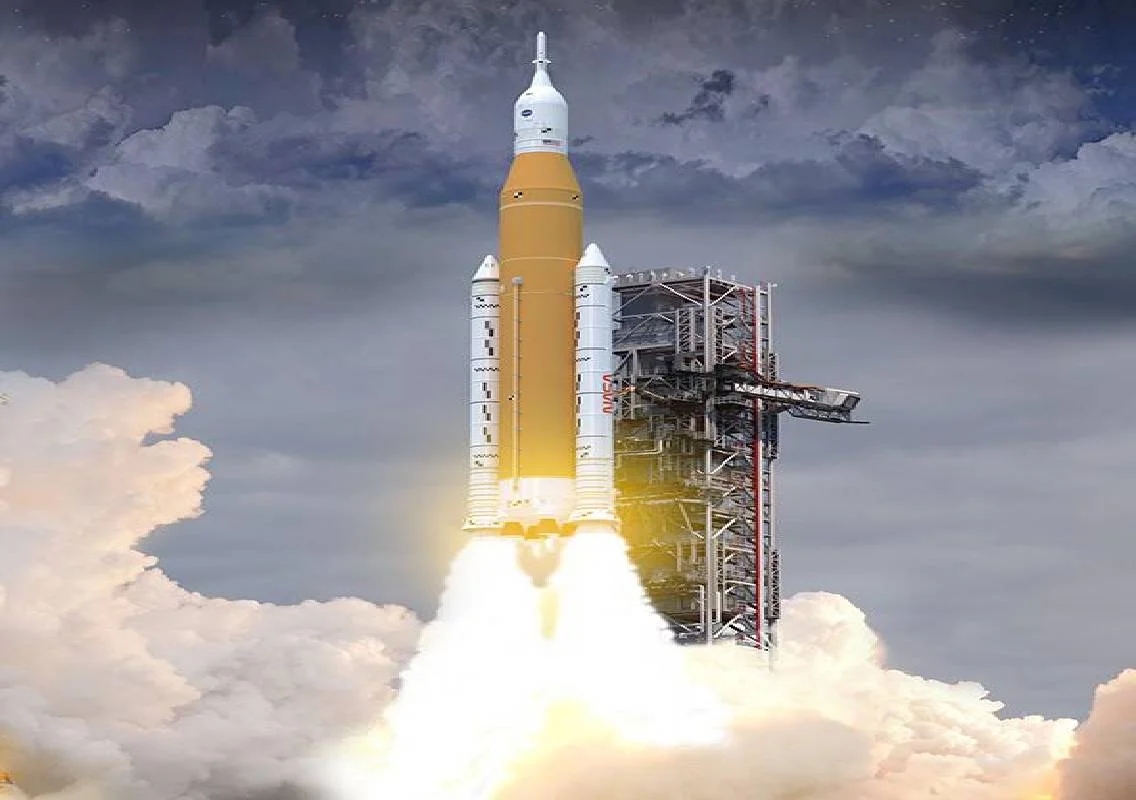


Florida: In a historic milestone for space exploration, NASA has successfully launched the Artemis II mission, sending four astronauts on the first crewed journey towards the Moon in over 50 years.
The powerful Space Launch System (SLS) lifted off from Launch Pad 39B at the Kennedy Space Center at 6:35 PM EDT (04:05 AM IST) on Wednesday, carrying the Orion spacecraft into orbit. The mission is expected to last around 10 days and represents a crucial step in NASA’s long-term plans to return humans to the Moon and eventually send astronauts to Mars.
A major step in the Artemis programme
The Artemis II mission is part of NASA’s broader Artemis programme, aimed at establishing a sustainable human presence on the Moon. Unlike its predecessor Artemis I, which was uncrewed, this mission includes astronauts and focuses on testing systems required for deep space travel.
The mission will evaluate critical components such as life support systems, navigation, and crew safety — all essential for future lunar landings under Artemis III and beyond.
What happens after launch
Following liftoff, the Orion spacecraft successfully deployed its solar arrays and began transitioning into flight operations. Engineers are currently conducting detailed assessments of onboard systems, including life support and communication systems.
The rocket’s upper stage has placed Orion into an elliptical Earth orbit. A second burn is planned to push the spacecraft into a higher orbit before it separates and begins its independent journey.
If all systems function as expected, Orion will perform a translunar injection burn — a crucial manoeuvre that will send the spacecraft on a trajectory towards the Moon.
Lunar flyby and return journey
Once near the Moon, the astronauts will conduct a flyby, travelling around its surface and observing regions not visible from Earth. This phase is expected to take place early next week and will provide valuable insights into human spaceflight conditions beyond low Earth orbit.
The mission will also help scientists study the effects of deep space travel on the human body, a key factor for future long-duration missions.
After completing the lunar flyby, Orion will begin its return journey to Earth, with a planned splashdown in the Pacific Ocean, marking the end of the mission.
Global significance of the mission
The Artemis II mission is being closely watched worldwide as it represents humanity’s renewed push into deep space exploration. It also sets the stage for future missions that aim to land astronauts on the Moon for the first time since the Apollo era.
NASA officials have emphasised that the mission is not just about revisiting the Moon but building the foundation for sustained exploration and eventual missions to Mars.
Political response
US President Donald Trump congratulated NASA and the astronauts on the successful launch, calling it a “major milestone”.
He praised the achievement during a national address, highlighting the importance of the mission for technological advancement and national pride.
Conclusion
The successful launch of Artemis II marks a defining moment in modern space exploration. As the Orion spacecraft journeys towards the Moon, it carries not just astronauts, but the hopes of a new era in human spaceflight.
With critical systems being tested and valuable data expected from the mission, Artemis II is paving the way for future lunar landings and deeper exploration of space, bringing humanity one step closer to Mars.