







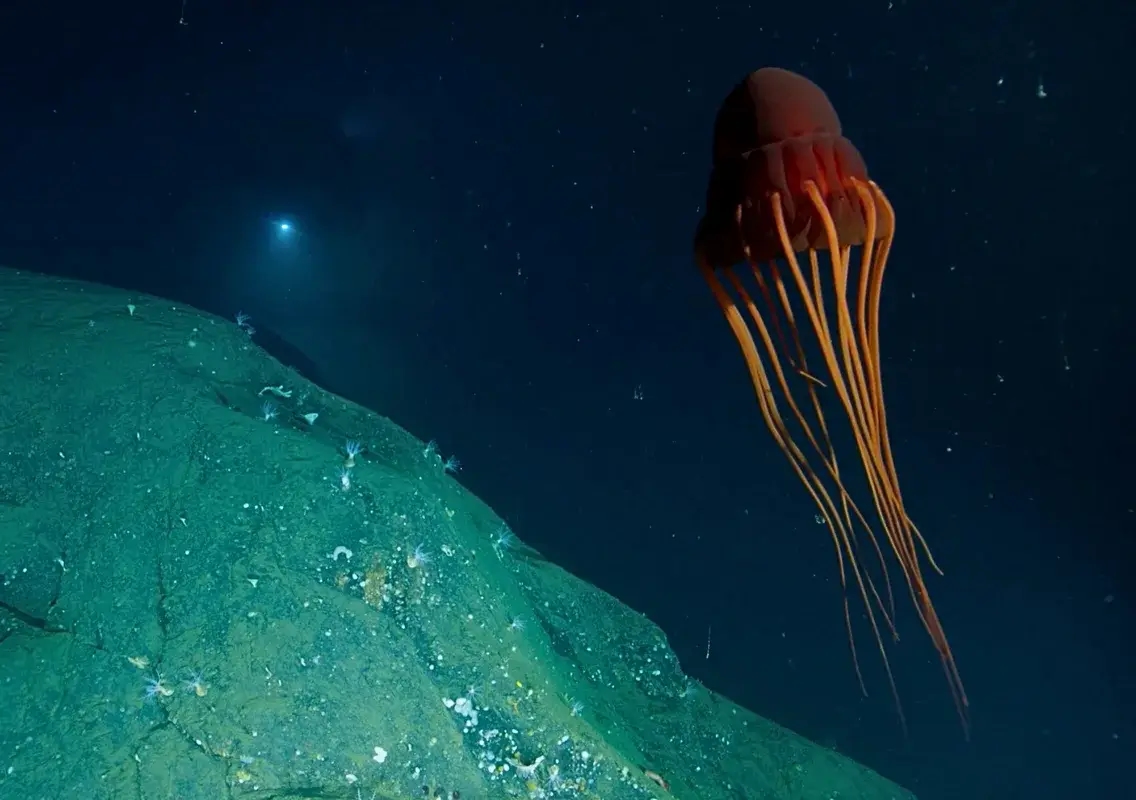


In an unusual scientific experiment during the early years of space research, scientists sent thousands of jellyfish into space to understand how living organisms sense gravity.
The experiment, conducted by NASA in 1991, aimed to study how microgravity might affect the development of biological systems responsible for orientation and balance.
Why jellyfish were chosen
The research team, led by scientist Dorothy Spangenberg, selected jellyfish because they possess a gravity-sensing mechanism that shares similarities with the human inner ear.
In humans, balance and spatial orientation are controlled by structures in the inner ear that contain calcium carbonate crystals. These crystals move when the body changes position, stimulating specialised hair cells that send signals to the brain about direction and balance.
Jellyfish use a similar system. As they develop into the familiar medusa stage, they form calcium sulphate crystals inside their bell-shaped body. These crystals move in response to gravity, allowing the animal to detect whether it is moving upward or downward in water.
Because of this similarity, scientists believed jellyfish could help reveal how organisms develop gravity-related sensory systems in space.
Jellyfish sent aboard space shuttle Columbia
To conduct the experiment, nearly 2,500 jellyfish polyps — an early stage in the jellyfish life cycle — were sent aboard the space shuttle Columbia.
The polyps were placed in bags filled with artificial seawater. During the mission, astronauts assisted researchers by accelerating their growth.
Over the course of about nine days, the polyps developed into approximately 60,000 jellyfish in space.
The goal was to determine whether the animals would still develop their gravity-sensing system while growing in microgravity conditions.
Surprising results after returning to Earth
When the jellyfish returned to Earth, scientists observed significant differences compared to those that had grown under normal gravity.
Although the space-grown jellyfish successfully developed their calcium sulphate crystals, many struggled to swim properly once back on Earth.
Researchers observed abnormal pulsing movements and signs similar to vertigo — the sensation of dizziness caused by balance disruption.
In contrast, jellyfish raised entirely on Earth showed normal swimming patterns.
Insights for future space exploration
The findings suggested that organisms developing in microgravity may have difficulty adapting to Earth’s gravity later.
Scientists believe the results could offer clues about how humans might respond if they were born or raised in space.
As space agencies continue exploring the possibility of long-term human presence beyond Earth, understanding how gravity influences biological development remains a key scientific challenge.
The jellyfish experiment remains one of the most unusual and fascinating studies conducted to understand how life might adapt to the conditions of space.