


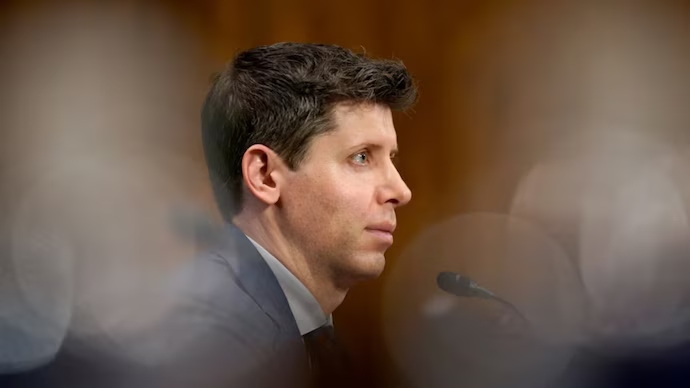


Washington: OpenAI CEO Sam Altman has said society should be prepared to accept some negative consequences from artificial intelligence if the technology delivers significantly greater benefits to people, putting him at odds with rival Anthropic’s more cautious approach to AI regulation.
In a recent interview with Politico, Altman said there was a significant difference between OpenAI’s position and that of Anthropic CEO Dario Amodei on how governments should regulate increasingly powerful AI systems.
Altman argued that attempts to eliminate every possible negative consequence could come at the cost of restricting access to AI or concentrating control of the technology in the hands of a small number of companies or governments.
“We believe that the world should accept some bad things happening for the benefits of this technology and people having the agency,” Altman said.
His comments come amid a growing debate in the technology industry over how quickly AI development should proceed and how much regulation should be imposed on companies building increasingly capable systems.
Altman backs a lighter regulatory approach
Altman has previously supported some forms of AI regulation, but his latest comments underline his opposition to regulations that could effectively give a single AI company control over the technology.
He described the idea of allowing one AI laboratory to control AI development as “a completely unacceptable trade-off”. His argument is that safety measures should not result in technology being concentrated in the hands of a limited group of companies or institutions.
OpenAI’s approach, as described by Altman, favours what he called a lighter-touch regulatory stance.
The OpenAI chief said he would not accept a situation in which development was significantly restricted simply to ensure that there were no major hacks, scams, misuse or other negative consequences.
Instead, he argued that the potential benefits could be much larger than the harms.
“I think people will do tremendously — orders of magnitude more — good stuff than bad stuff,” Altman said.
The comments highlight a central question in the AI debate: whether policymakers should attempt to prevent almost every foreseeable harm or establish rules aimed primarily at controlling the most serious risks while allowing the technology to continue developing.
Anthropic takes a more cautious position
Altman’s comments come as Anthropic has been increasingly vocal about the risks associated with advanced AI.
Amodei recently warned that AI development carries genuine dangers and argued that the industry had not been sufficiently transparent about those risks.
“For too long the industry lied to people about the fact that this technology had risks,” Amodei told CBS News. He said one of the most serious possibilities could involve risks to humanity itself.
Amodei has also argued that the rapid pace of AI development should be slowed and suggested that international cooperation may eventually be needed to put limits on the speed at which increasingly powerful systems are developed.
At the same time, he has acknowledged the difficulty of slowing AI development unilaterally when countries and companies are competing for technological and potentially military advantages.
The difference between the two executives is therefore not simply a disagreement over whether AI should be regulated. Both have supported some form of oversight, but they differ on how restrictive those safeguards should be and how society should balance potential harms against the benefits of continued development.
Altman does not argue that every risk should be ignored
Altman’s remarks do not amount to a call for completely unregulated AI development.
The distinction in his comments is between accepting some negative outcomes as an unavoidable consequence of widespread technology and accepting catastrophic risks.
Recent reporting on the interview indicates that Altman remains supportive of restrictions around the most serious AI risks while opposing measures that could unnecessarily limit access or place AI development under the control of a single entity.
That distinction is important because AI systems can create different categories of risk.
Some concerns involve scams, misinformation, cyberattacks, privacy breaches or misuse of AI tools. Others involve more difficult questions around autonomous systems, loss of control and the long-term consequences of increasingly capable models.
Altman’s argument is essentially that society should not attempt to eliminate every negative outcome if doing so would prevent people from benefiting from AI.
Why the debate has become more intense
The disagreement between OpenAI and Anthropic comes as AI systems become increasingly capable and are being integrated into areas ranging from software development and education to healthcare, finance and cybersecurity.
At the same time, researchers and former AI employees have raised concerns about the risks associated with systems that can operate with greater autonomy.
A Reuters report published in September said current and former researchers from OpenAI and Google DeepMind had expressed concerns about the rapid development of self-improving AI systems. The researchers pointed to risks including job displacement and, in more extreme scenarios, potential threats to humanity.
Such warnings have added pressure on technology companies and governments to establish clearer safety standards.
The debate is also complicated by the competition between the United States and China. AI companies and policymakers face pressure to develop increasingly advanced systems quickly, while simultaneously attempting to prevent those systems from being misused.
This creates a difficult policy balance: moving too slowly could leave countries or companies behind, while moving too quickly could increase the chances of serious failures or misuse.
Altman and Amodei have disagreed before
The differences between Altman and Amodei are not new.
The two executives became the focus of attention earlier this year during the India AI Impact Summit in New Delhi. During a group photograph with Prime Minister Narendra Modi and other technology leaders, Altman and Amodei appeared hesitant when asked to join hands.
While other leaders raised their linked hands, the two AI executives kept their hands apart and eventually raised their fists instead. The moment quickly went viral and was widely viewed as a visual representation of the rivalry between OpenAI and Anthropic.
The companies have developed different reputations within the AI industry, with Anthropic frequently emphasising AI safety and OpenAI continuing to push the development and deployment of increasingly capable systems.
Their disagreement over regulation reflects those broader differences.
The argument over who should control AI
One of Altman’s strongest concerns is the possibility that regulation could unintentionally concentrate AI power.
If governments impose rules that only the largest companies can afford to comply with, smaller developers and open-source projects could find it harder to compete.
Altman’s argument is that broad access can give individuals and businesses greater control over how AI is used rather than leaving decisions about the technology to a handful of institutions.
However, critics of this approach argue that greater access can also increase the possibility of misuse.
The challenge for policymakers is therefore to establish safeguards that prevent serious harm without creating a regulatory structure that effectively gives a small number of companies control over AI.
AI safety remains a global policy challenge
The debate is increasingly moving beyond individual companies.
Governments are considering rules around AI-generated content, cybersecurity, data protection, autonomous systems and the testing of advanced models. At the same time, technology companies are developing their own safety frameworks and evaluation systems.
In the United States, President Donald Trump’s administration has favoured a stronger emphasis on industry-led safety measures rather than broad new federal restrictions. Trump announced a voluntary agreement with major technology companies in September under which firms committed to measures including internal controls, risk assessments and external reviews.
The administration has also taken a more positive stance towards rapid AI development, reflecting concerns that excessive regulation could weaken US competitiveness.
This has added another layer to the debate over how much responsibility should rest with companies and how much should be imposed by governments.
What Sam Altman’s position could mean for AI users
For ordinary users, the debate could ultimately influence how quickly AI products become more capable and how freely they can be accessed.
A lighter regulatory approach could allow companies to launch new AI features more quickly, potentially accelerating improvements in productivity, education, coding, research and other areas.
However, faster deployment could also mean that users encounter new forms of misuse, scams or security vulnerabilities before regulators and companies have developed effective responses.
The challenge will therefore be finding a balance between innovation and protection.
Altman’s comments suggest that he believes accepting a certain level of manageable risk is preferable to restricting the technology so heavily that its potential benefits are lost or its control becomes concentrated.
A continuing divide over the future of AI
Sam Altman’s latest remarks add to an increasingly important debate about the future direction of artificial intelligence.
OpenAI and Anthropic agree that advanced AI requires some safeguards, but their approaches differ over how much risk society should tolerate and how restrictive regulation should become.
Altman believes that AI’s potential benefits are sufficiently large to justify accepting some negative consequences, provided the most serious dangers are addressed and people retain broad access to the technology.
Amodei, meanwhile, has been more vocal about the need to slow development and establish stronger safeguards, warning that the risks of increasingly powerful AI should not be understated.
The disagreement is unlikely to disappear soon. As AI systems become more capable and more deeply integrated into everyday life, governments, companies and the public will have to decide what level of risk is acceptable — and where the line should be drawn between encouraging innovation and protecting society.