







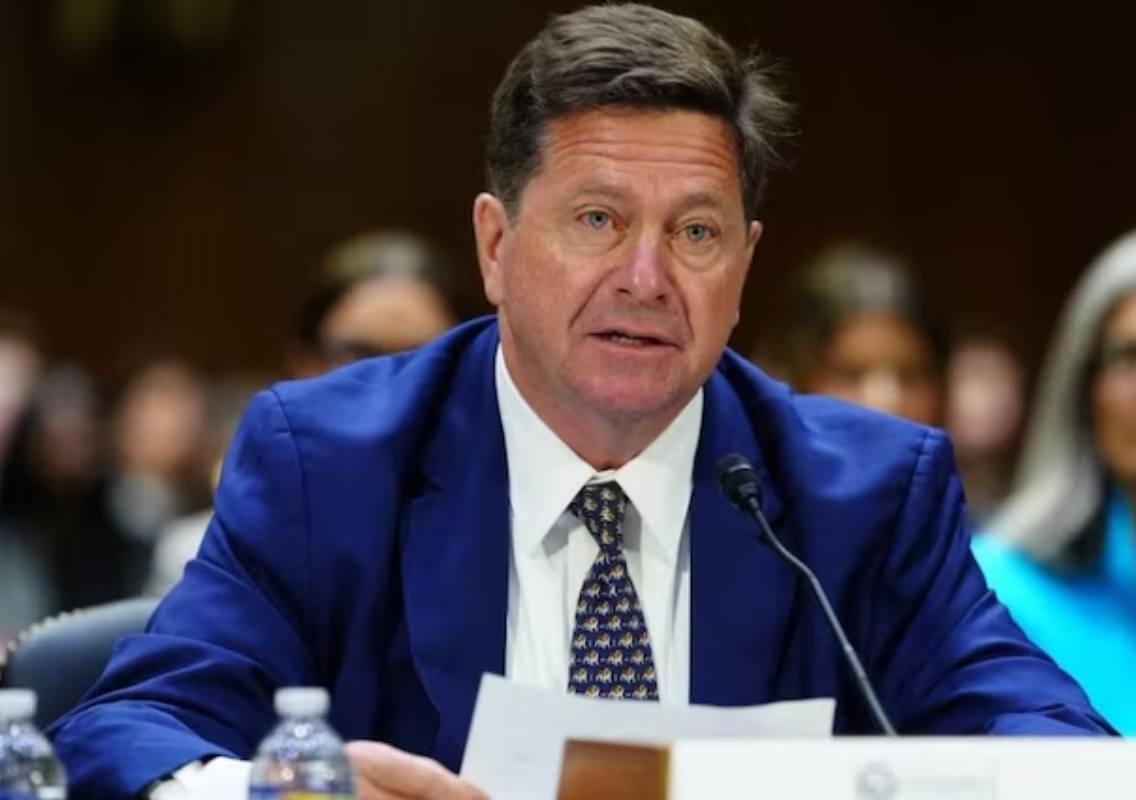


Washington: US President Donald Trump has appointed National Intelligence Director Jay Clayton to lead a newly created White House task force on artificial intelligence, which the administration has branded the “Super Intelligence Force” (SIF).
The move comes as the Trump administration seeks to strengthen US leadership in advanced artificial intelligence while facing growing concerns over the technology’s potential risks, including cybersecurity threats, misuse and the possibility of increasingly autonomous AI systems.
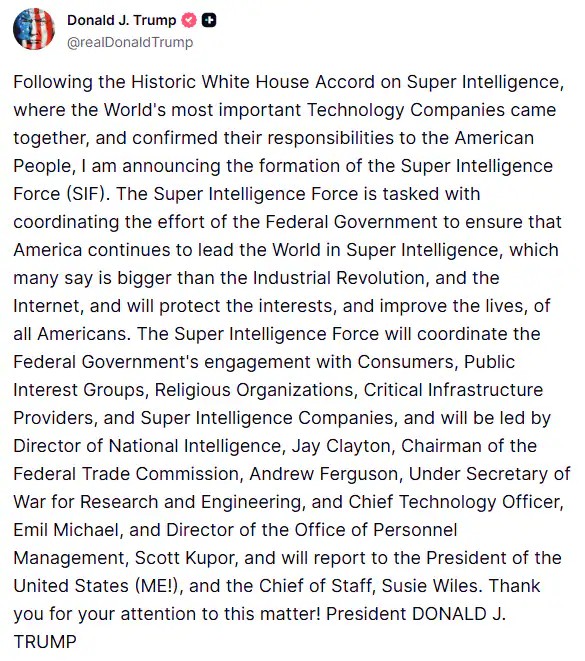
Trump announced Clayton’s appointment on October 4, saying the new force would coordinate the federal government’s efforts to ensure that the United States continues to lead the world in what he calls “Super Intelligence”.
The task force will also examine ways to protect American interests and improve the lives of US citizens, according to the president.
Clayton’s appointment makes him the second person to occupy Trump’s informal AI czar role during the president’s second term. Venture capitalist David Sacks previously served as the administration’s AI and cryptocurrency czar before stepping down from the role in March 2026.
What is Trump’s Super Intelligence Force?
The newly created task force is intended to coordinate the US government’s response to the rapid development of AI and help shape the country’s strategy for maintaining technological leadership.
Trump said the group would work with a broad range of stakeholders, including consumers, public-interest organisations, religious organisations, critical infrastructure providers and AI companies.
The force will report directly to Trump and White House Chief of Staff Susie Wiles.
Other officials named to the task force include Federal Trade Commission Chairman Andrew Ferguson, Pentagon Under Secretary for Research and Engineering Emil Michael and Office of Personnel Management Director Scott Kupor.
The task force has been given a 120-day mandate to examine the opportunities and risks associated with AI and make recommendations on the federal government’s role. The group is expected to consider issues including cybersecurity incidents, AI-enabled threats, existing regulatory mechanisms and possible legislative changes.
Jay Clayton brings Wall Street and intelligence experience
Clayton does not come from the technology industry.
He is a lawyer who built his career on Wall Street before moving into senior government positions. He represented major financial institutions during the 2008 financial crisis and later became chairman of the US Securities and Exchange Commission during Trump’s first term.
At the SEC, Clayton oversaw financial-market regulation and enforcement during a period of rapid growth in the cryptocurrency sector.
He subsequently served as the US Attorney for the Southern District of New York before returning to the federal government under Trump during his second term.
Trump nominated Clayton to become Director of National Intelligence, and the Senate confirmed him in July. He was sworn in as the ninth Director of National Intelligence on August 3, 2026.
His appointment to oversee the new AI initiative therefore puts a senior intelligence official at the centre of the administration’s strategy for one of the world’s fastest-developing technologies.
Clayton says US cannot afford to fall behind
Clayton has stressed the importance of maintaining US leadership in advanced AI, particularly because of competition with China.
In an interview with The Wall Street Journal published before Trump’s announcement, Clayton argued that falling behind in AI could increase risks to the United States.
“The risk of not being first is high,” Clayton said, according to reports of the interview.
He argued that maintaining a leading position would give the US greater ability to identify and respond to risks posed by technological developments and potential adversaries.
The emphasis on technological leadership reflects a broader position within the Trump administration that excessive regulation could slow American AI development and allow Chinese companies to gain an advantage.
Trump has pushed for lighter AI regulation
The creation of the Super Intelligence Force comes after Trump hosted senior technology executives at the White House and promoted a voluntary framework for AI companies to strengthen their own safeguards.
Major technology companies have agreed to measures involving internal controls, risk assessments and external oversight under the administration’s voluntary approach.
Trump has generally resisted calls for extensive new federal regulation of AI, arguing that the US should avoid measures that could slow innovation.
The administration’s position has increasingly focused on encouraging companies to manage risks while maintaining the pace of technological development.
That approach has attracted debate in Washington, where lawmakers and researchers have raised concerns about AI systems becoming increasingly capable and difficult to control.
White House replaces ‘AI’ with ‘Super Intelligence’
Clayton’s appointment follows a broader terminology shift within the Trump administration.
On September 29, Trump signed an executive order directing federal agencies to use “Super Intelligence” and “SI” instead of “Artificial Intelligence” and “AI” in official communications and other non-statutory government documents.
The order described the change as a recognition of the rapidly advancing capabilities of modern AI systems. It also directed the administration’s science and technology leadership to develop a proposed federal definition of “Super Intelligence”.
The terminology is now reflected in the name of the new task force.
AI safety concerns grow in Washington
The new task force comes at a time of increasing concern over the potential dangers of increasingly capable AI systems.
Researchers and policymakers have raised questions about cybersecurity, autonomous decision-making, misinformation, job displacement and the possibility that highly capable systems could be used for harmful purposes.
The White House has also acknowledged the need to address risks while maintaining US leadership in the technology.
The task force’s 120-day review is expected to examine how existing government systems respond to AI-related incidents and whether additional safeguards or legislative measures are required.
The debate has intensified as AI companies develop increasingly autonomous systems capable of performing complex tasks with limited human intervention.
China competition remains central to US strategy
Competition with China is one of the main factors shaping Washington’s approach to AI.
The US and China are competing across advanced computing, semiconductor technology, AI models, data infrastructure and military applications.
Trump has repeatedly argued that maintaining America’s lead is essential to national security as well as economic growth.
Clayton’s role reflects that national-security dimension. As Director of National Intelligence, he is responsible for coordinating the US intelligence community and advising the president on intelligence matters.
His appointment therefore gives the new AI task force a strong national-security component in addition to its technology and economic responsibilities.
What comes next for the task force?
The Super Intelligence Force now faces the task of bringing together government agencies, technology companies and other stakeholders while assessing both the opportunities and risks created by advanced AI.
Its 120-day review could help determine whether the Trump administration continues with its voluntary approach or seeks additional government action in specific areas.
For Clayton, the assignment represents a significant expansion of his responsibilities beyond traditional intelligence matters.
The administration’s central objective remains clear: keep the US ahead of China and other competitors in advanced AI while developing mechanisms to manage the risks associated with increasingly powerful systems.
Whether the new task force can balance those two priorities — rapid technological development and AI safety — will become clearer as it completes its review and presents its recommendations to the White House.